Get the best of Vancouver in your inbox, every Tuesday and Thursday. Sign up for our free newsletter.
You could say that I went in a skeptic. Not about the phenomenon, which is undeniable. Angine de Poitrine sold out both nights at The Pearl, a room that holds just under 400 people, and when a third date was added at the Commodore, something like 20,000 people reportedly lined up online for tickets. You do not argue with numbers like that. My reservation was narrower: the recent breakthrough album, Vol. II, had struck me as surprisingly one-note for a band that plays this many notes.
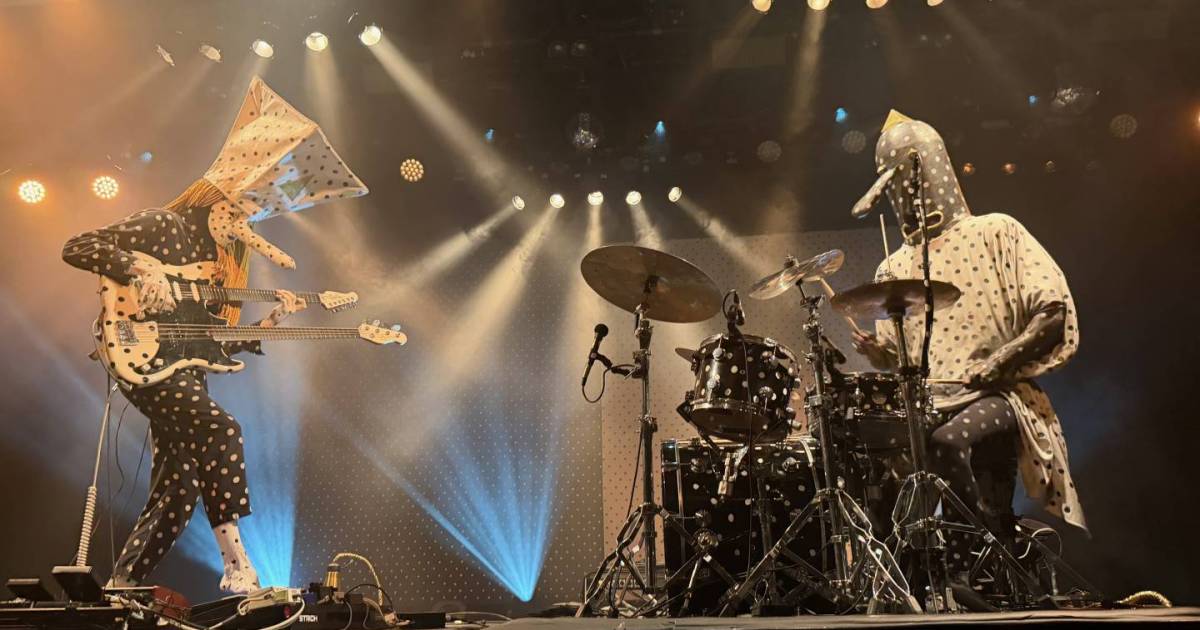
In some ways reminiscent of Primus or Battles—or at least elements of those earlier breakthrough bands—Angine De Poitrine (made up of Khn and Klek de Poitrine) is sonically unique. Khn plays a double-neck instrument that is half six-string and half bass, homemade, with extra frets sawn in by hand so it reaches the microtonal pitches that sit in the cracks between the notes your ear expects.
To an ear raised on the Western scale, the practical effect is mathematical craziness and notes arriving from between the floorboards. Klek drums with precision underneath. It is a genuinely novel sound, even if the songs can run together and be described similarly. After a steady start, a groove establishes itself, dissonant serpentine lines get layered over top with a loop pedal, and ultimately the thing accelerates into a delirious swirl. Admirable on record. I was not sure it added up to more than a very good idea repeated.
Live, however, I finally understood the appeal, and it took about 11 minutes.
The setlist was eight songs and roughly 65 minutes. “Angor” opened, “Yor Zarad” and “Tamebsz” followed, and by the time the pair reached “Mata Zyklek”, the Commodore’s famous sprung floor was doing what it was designed to do. That was the highlight of the night for me and probably the danciest thing in the band’s catalogue, a groove so physically insistent that the microtonal weirdness stopped registering as weirdness and started registering as funk.
“Ababa Hotel” and “Sarniezz” kept it going, “Fabienk” landed on the strength of being its most recognizable single, and “Sherpa” closed it out.
For my money, Angine de Poitrine’s bouncier material is their best, most memorable music. When the duo lean into rhythm, the songs differentiate themselves and stay with you.
It was also the same eight songs, in the same order, on all three Vancouver nights. I will not pretend to be an expert on math rock, but I imagine at some level it does not leave much room for spontaneity. Every hit is placed, every loop has to be captured cleanly and on time, or the next four minutes collapse, and the two of them are locked to each other with almost no margin. Khn and Klek are executing, not improvising. The aliens perform with an awe-inspiring tightness. A duo that reportedly started out laughing through grotesque improvisations in a basement now delivers something composed to the millimetre.
What I worked out somewhere in the middle of the set is that the secret appeal of this band is its looseness, and the looseness does not live in the notes. It lives in the clowning. Nobody writes enough about the clowning. The funniest thing I saw all night was Klek taking a drink. Two feet of papier-mâché nose turns a completely ordinary human act into slapstick, and several hundred people who had queued for months to see a microtonal math-rock duo lost it over a man attempting to hydrate. Before the show I learned that these 333-year-old time travellers have stayed on Earth out of interest in three of our exports: our rock music, our pyramids, and our hot dogs. They commit to that for every second they are on stage.
Get close, and the costumes reward the attention in a way the photos online do not convey. The masks are papier-mâché, oversized, with long pendulous noses and hard angular planes, and the surfaces are deliberately imperfect, visibly handmade. The band have kept the original build quality even as the venues have grown, and up close you can see the seams. The polka dots run over absolutely everything. Hands and feet are painted white and speckled black, with no skin breaking the illusion. Khn plays barefoot, working a pedalboard he can only half see through a mask with no useful sightlines, which is a degree of difficulty most bands would not accept for a visual gag.
And what an incredibly successful gag! The story is that they got double-booked at the same Saguenay venue twice in one week back in 2019, assumed nobody would come twice to see the same band, and played the second night in disguise. The disguises never came off.
The comedy that grew out of that origin story is the real show here. They are more talkative than most bands with mouths. They never break character, but they communicate constantly, in alien squeaks, grunts, and interrogative honks, all of it aimed straight at the crowd. They throw triangles with their hands, and hundreds of grown adults—some covered in dots themselves—throw triangles back. They cock those enormous heads at the audience in mock bewilderment and get a laugh out of a gesture that involves no face at all. It is physical comedy performed by two men who have deliberately removed every tool a comedian normally uses, and they are very, very good at it. So even though the music is fixed and drilled in, a playfulness happens everywhere else: in gestures and honks and generous, hilarious stares.
What is the next evolution of this band? Can they sustain this for much longer? I have no idea. What I can report is that a couple of records I admired more than I loved turned into a vividly memorable show. Clearly this band is meant to be received live. While all these tickets were sold on the strength of viral clips and mystery, what keeps people in the room is two guys in polka dots doing bits with no face and no words, set against slappa-da-bass music with no margin for error anywhere.