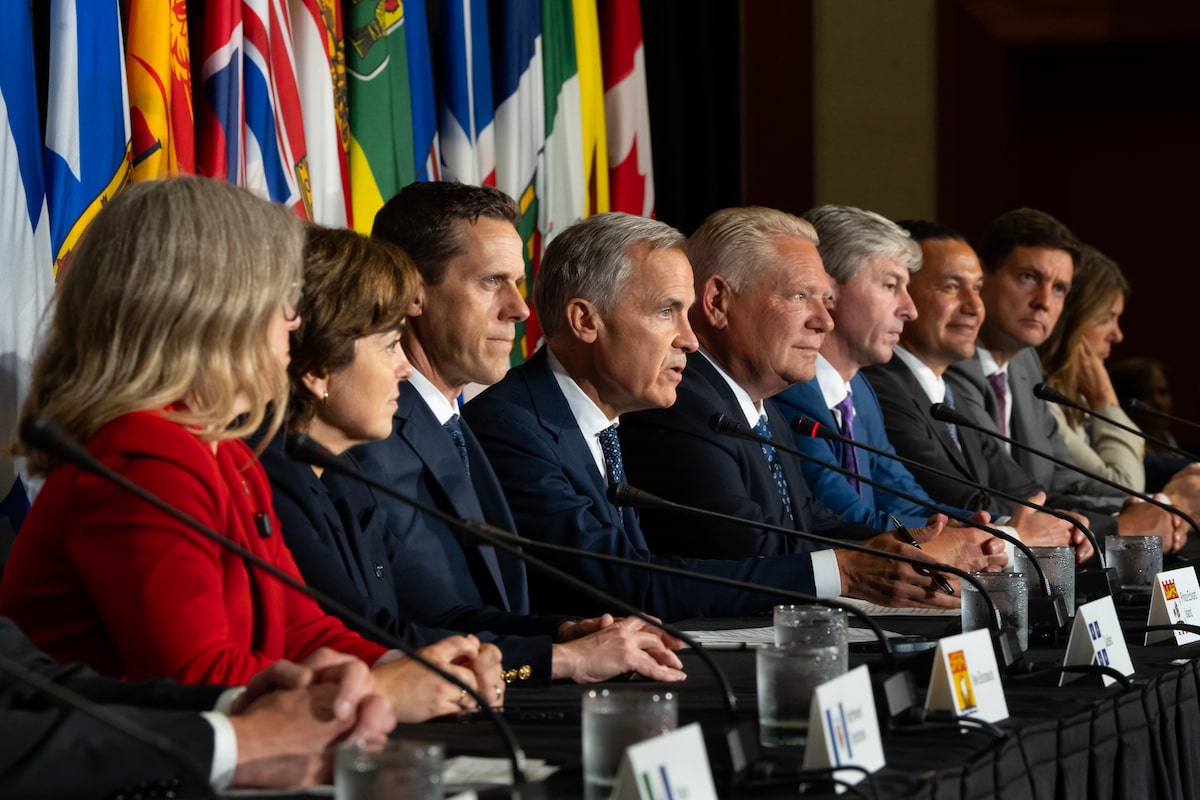
Prime Minister Mark Carney, centre, and Canada’s premiers hold a closing press conference at the First Ministers Meetings in Charlottetown on July 23.Darren Calabrese/The Canadian Press
If Davos was the theory, last week’s walkout was the practice: the moment Canada formally abandoned the strategy of trying to appease Donald Trump, as a means of fending off his lunatic designs on this country, and opted for defiance instead. The reaction, at home and around the world, was enthusiastic. Now comes the hard part: What do we do now?
Already it is clear that the Trump administration has more trouble in store for us, of which the mad king’s announcement of another round of 50-per-cent tariffs, to take effect Jan. 1, is only the foretaste. It is possible things could get very ugly indeed. Mr. Trump’s willingness to take the Gordie Howe Bridge hostage to back his demands for a cut of the revenues from a deal Canada and Michigan had already signed tells you how unconventional this trade war is likely to be. We are going to wish tariffs were all we had to worry about.
So we had better be thinking through how we are going to manage this crisis – what combination of diplomacy and firepower, defence and offence, we are prepared to deploy. So far several broad strategies have emerged, though of course there is no reason we could not pursue more than one, sequentially or concurrently. They are:
Negotiation
The one still favoured by much of the business community, and by the Premier of Alberta, Danielle Smith. You see this in the calls for both sides to “return to the bargaining table,” as if Canada’s withdrawal from the talks were all just a big misunderstanding, or a clash of egos, or a stagey negotiating tactic.
There’s just one question this raises: Negotiate what? Even before the last-minute flurry of demands that prompted the Prime Minister to finally walk away it was clear any “deal” would be on intolerable terms: not only signalling our agreement to double-digit tariffs in several key industries, but with no assurance that this would buy us tariff-free access generally, or even certainty for the industries in question: The Trump administration reportedly reserved the right to raise any tariff at any time. To say nothing of their insistence that Canada apply U.S.-level tariffs to third countries, even those we already had free-trade agreements with.
Andrew Coyne: The whole world is watching as Canada stands up to Trump
And this was only for starters. Had we agreed to the deal – were we to agree to a deal now – all it would do is qualify us for the grander round of negotiations over USMCA itself, whose terms we thought had already bought peace. But even a USMCA deal would last only as long as Mr. Trump, or whoever replaced him, felt like honouring it. And why would he, when the threat of tariffs had proven so useful? Why, especially, when his great dream of hemispheric dominance was within reach?
We have to stop pretending that the world is like it was, or as we might wish it to be: as if this were a mere dispute over tariffs; as if agreements with a criminal regime had any binding significance; or as if a psychopath’s demands could ever be sated.
Retaliation
The strategy the federal government has fallen back on. The list of several hundred items to be tariffed as of Sept. 8 matches the U.S. tariffs in dollar terms, though not in proportion either to exports or GDP.
Or, for that matter, in the impact on consumers. The announcement that Canada would retaliate triggered a lively debate among some economists as to whether the benefits, in terms of whatever reduction in U.S. tariffs they procured, were worth the costs in higher prices for Canadians.
Normally, the costs of either side’s tariffs are greater for the country that imposes them than they are for their intended targets. So normally, many economists would say: Don’t retaliate. Just because the other guys insist on impoverishing their own consumers, doesn’t mean we should do the same. We can’t know how much our tariffs will induce them to reduce theirs. But we know what they are doing to us.
Opinion: Canada’s furious, I get it. But by retaliating, we punish only ourselves
Again, if this were a normal trade dispute with a normal administration, I might agree. But this isn’t, and they aren’t. Normally, the other side’s objectives are limited to seeking advantage (or preventing disadvantage) in this or that industry. But Mr. Trump’s ambitions extend far beyond that. They are geopolitical, if only in the most primitive, self-aggrandizing sense.
In the prisoner’s dilemma, famous from game theory, the risk-reward calculus facing the players changes when the game is played, not once, but repeatedly: an iterated prisoner’s dilemma. That’s more or less the situation facing us. The payoff to retaliating might be different when the issue is not what impact it might have on the immediate dispute, but on the Trump administration’s attitude toward us generally.
A lot of discussion has focused on the importance of targeting retaliatory tariffs strategically, toward particular industries or swing states. I doubt these things can be so finely calibrated, but in any case that isn’t really the point.
The purpose of retaliation isn’t so much to cause them pain, economic and political, though that is surely part of it. It is to signal our own, presumably greater, readiness to endure pain – since the issue is existential for us, and tangential, at best, for them. It’s to show (not only to the United States but to any state: this is multiple simultaneous iterative prisoner’s dilemmas) that any attempt to coerce us will ultimately fail, and at ruinous cost to the aggressor.
Still, it’s a risky strategy, especially with such an unhinged administration. This could go places far beyond mere tit-for-tat tariffs. In which case we should be thinking about …
Escalation
We have some weapons in our arsenal that to date we have been unwilling to consider, either for fear of how the Americans would respond or how it might divide Canadians.
I am talking about taxes or even quantitative restrictions, not on imports of American goods, but on exports of Canadian commodities, the kind the American economy depends on and could not easily replace, notably oil and gas, potash, electricity and critical minerals.
Certainly we should be in no rush to impose these. The economic impact would be severe, both on us and them, and they could readily lead to further escalations on the American side. But as part of an “escalate to de-escalate” strategy, they should not be ruled out: We have to at least maintain the credible threat that they might be used.
To make them credible to the Americans means making them plausible at home. Efforts are being made at the moment to declare them off-limits, notably by the Premiers of Alberta and Saskatchewan (rebutted, remarkably, by the former premier of Alberta, Jason Kenney). But export levies are federal turf; the premiers have no actual power to prevent them.
If we really get into it with the Americans, I don’t think we’ll have much choice. The domestic political fallout can be limited, provided we do not single out any one commodity or region, but rather impose whatever measures are selected across the board: electricity, gas and minerals in British Columbia; oil and gas in Alberta; potash and uranium in Saskatchewan; electricity and various minerals in Manitoba, Ontario, Quebec, and the Atlantic provinces.
The policy should at all times be shared sacrifice, aiming to impose the same proportionate reduction in provincial GDP. Recycling the proceeds from any tax to the provinces affected could also help equalize the burden.
The other element necessary for credibility: Don’t over-threaten. Literally cutting off exports of oil or electricity is doomsday stuff. It’s not a credible threat. But a policy calculated to raise the prices Americans pay for energy and materials might be.
Diversification
This has been the thrust of federal policy until now: to reduce our dependence on the United States to the point that the administration could not use it against us. Hence the rush over the last year and a half to negotiate and sign trade and investment treaties with partners around the world.
The collapse of talks last week shows the limits of that strategy. Even as we attempt to expand our exports to other countries, we remain primarily reliant on exports to the U.S.; and since the President views that as important leverage over us, he is unlikely to look kindly on any efforts to reduce it. Hence the urgent efforts to prevent us from pursuing an independent trade policy: leverage in the service of leverage.
After one year under Carney, results on trade diversification are mixed
The question is whether we can shift enough of our trade, quickly enough, to escape this trap before the U.S. slams it shut. That suggests something dramatic is in order, a hint of which was also contained in the Prime Minister’s statement last week: “This fall, we will begin discussions with the European Union – the world’s second-largest economy – to build a much stronger and deeper security and economic partnership.”
I don’t think that means joining the EU, and I don’t see what purpose that would serve. But it surely means something.
Fortification
Another way to reduce American leverage over us is to make our economy stronger, less easily blown off course every time the President huffs and puffs. Or in other words, raising national productivity – long a problem, given how poorly we have performed relative to other countries, and becoming something of a crisis, given the crippling costs of population aging, it must now be rated, in light of the threat posed by Mr. Trump, as a full-blown emergency.
But where the other approaches to dealing with Mr. Trump – negotiation, retaliation, escalation and diversification, all of them outward-looking, internationally focused – all seem to have the Carney government’s full attention, very little has been achieved on the domestic front: the things that are most within our capacity to control.
Canada has potential for investment ‘super cycle’ with certain policy changes: TD report
There’s no mystery to the productivity agenda. Its broad outlines are well known, and command broad consensus in policy circles. They include sweeping tax reform, slashing business subsidies, eliminating interprovincial trade barriers, and opening the cozy oligopolies that dominate too many of our industries to more foreign competition.
It’s a massive to-do list, full of potential political booby-traps and requiring tackling deeply entrenched interests, which is why no government of either party has been willing to take it on. But if ever there were a time for governments to discover their courage, it is now.
If we can’t summon the nerve to confront our economic problems now, with the very life of the country at stake, we never will. And if we aren’t willing to do what it takes to safeguard our independence, we don’t deserve it.