“The Canadian team unified. You cannot say that about the United States administration.”
#### 2. Sovereignty and the Right to Veto Canada’s Trade Deals
The second irritant cut deeper than any tariff. US negotiators demanded influence over trade deals Canada strikes with other countries. Specifically, they wanted Canada to implement sectoral tariffs on steel and aluminum matching US levels — and to grant Washington the right to update those Canadian tariffs if US policy changed, even if Canada had already signed a trade agreement with the third country.
The American logic was preventing cheap foreign products from sneaking into the US through Canada. For Canada, it was a non-starter. It would lock the country into permanent economic dependence on Washington precisely at the moment Carney is trying to diversify Canada’s trading relationships.
#### 3. French Language Laws and Canadian Content
The US raised objections to Canada’s French language requirements, though the specifics are murky. Canada’s side claims Washington objected to bilingual labeling regulations — a claim the US denies. More concretely, American negotiators allegedly asked Canada to exempt US streaming services, specifically Netflix and Amazon Prime, from Canadian content requirements.
Canada’s “Cancon” rules require broadcasters to ensure 35 to 60 percent of content is Canadian, and 2023 updates extended discoverability requirements to streaming platforms. Quebec has stricter French-language content rules on top of that. Richard’s framing of the stakes was blunt: “Quebec today is only really still a part of the country because of these French language laws.” Even if Carney wanted to concede, he couldn’t without triggering a political crisis at home.
Notably, Greer has since softened the US position, calling the discoverability issue “not a deal breaker.” But the fact that it surfaced at all — in the final hours of negotiations — told Canada something about how the US was treating the relationship.
#### 4. The Pencil-Signed Deal
The fourth irritant was trust itself. Canadian negotiators pushed for assurances that the US wouldn’t scrap any agreement overnight. US negotiators refused, maintaining that tariffs would be subject to change at any time. Carney’s characterization captured the core problem:
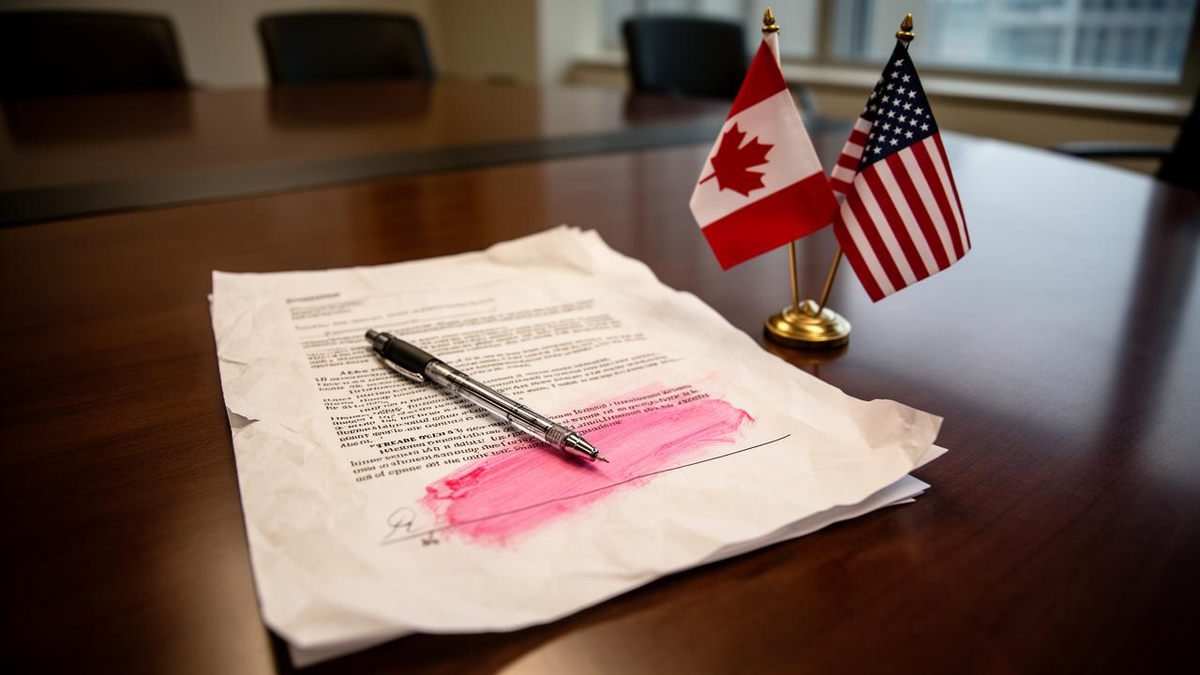
> “Sometimes its signature was written in pencil.”
That phrase distills the entire episode. Canada wasn’t just negotiating tariffs; it was trying to determine whether a deal with this American administration meant anything beyond the next news cycle.

### The Escalation Timeline
### The Retaliation Strategy: Aiming at the Midterms
Canada’s response is not random. The duties range from 15% to 50% on over 700 American products — dairy, construction products, home appliances, motorcycle and railway parts, and agricultural goods. Steel and aluminum duties double to 50%, exactly matching the US rate.
Richard’s analysis is that Canadian officials are deliberately targeting specific US states to influence the 2026 midterm elections. While 6% of US exports to Canada may seem small nationally, certain states have disproportionate exposure. The political pressure, the theory goes, could constrain Trump’s trade policy by forcing Republican members of Congress to answer to angry constituents back home.
Canada has also announced a CAD $7.5 billion support package for businesses affected by the tariffs.
The dispute has descended into personal attacks. Trump called Ontario Premier Doug Ford a “flunky” and signed an executive order renaming Lake Ontario to “Lake America” — a move Richard noted is doubly absurd because the lake predates both countries, and “Ontario” derives from an Iroquoian word meaning “sparkling water.” Ford responded by calling Trump a “loser.”
### The Numbers Behind the Damage
| Metric | Value | Period |
|—|—|—|
| US tariffs on Canadian exports | 50% on ~CAD $20B (USD $20B) | 2026 |
| Canadian retaliatory tariffs on US goods | CAD $27.6B (~USD $20B) | 2026 |
| Share of US exports to Canada hit by retaliation | ~6% | 2026 |
| Share of Canadian exports to US hit by US tariffs | ~5% | 2026 |
| Canadian business support package | CAD $7.5B | 2026 |
| Proposed US steel/aluminum tariff reduction | 50% → 25% | Negotiated, now stalled |
### The Broader Economic Trap
The escalation lands at a brutal moment. The Iran war continues to push inflation to 3% or higher in both countries. US tariff projections were already rising after the strike-down of Trump’s earlier AIPA tariffs, and bond market pressure threatens affordability and growth. Canada’s GDP growth is sluggish, caught between the trade war and structural population headwinds.
One mitigating fact Richard emphasized: even with these new tariffs, roughly 90% of Canadian goods still enter the US tariff-free under the existing USMCA framework. The new 50% tariffs affect only about 5% of Canadian exports. The relationship is damaged but not severed.
### What Comes Next
Richard offered two concrete predictions. First, Trump is likely to increase auto tariffs on Canadian imports to 50% at the start of 2027 — a direct consequence of the truck exclusion that poisoned the talks. Second, and more fundamentally, tariffs are not going away anytime soon. Even if a deal is eventually struck, the relationship has entered a new, more adversarial equilibrium. Canada will continue pursuing trade deals outside the United States regardless of the outcome.
The most likely near-term scenarios: a partial deal that leaves steel, aluminum, and auto tariffs in place at elevated levels, or continued escalation with Ontario Premier Ford’s threats to cut electricity exports to US states as the next lever. Either way, the deeper structural shift is already underway — Canada is diversifying its trade relationships, and the era of frictionless North American trade is over.
The question for Canadian negotiators is no longer whether Washington will honor its commitments, but whether any deal signed in this environment is worth the paper it’s written on. As Carney put it, the problem isn’t finding an agreement — it’s finding one that won’t be erased the next time the president changes his mind.