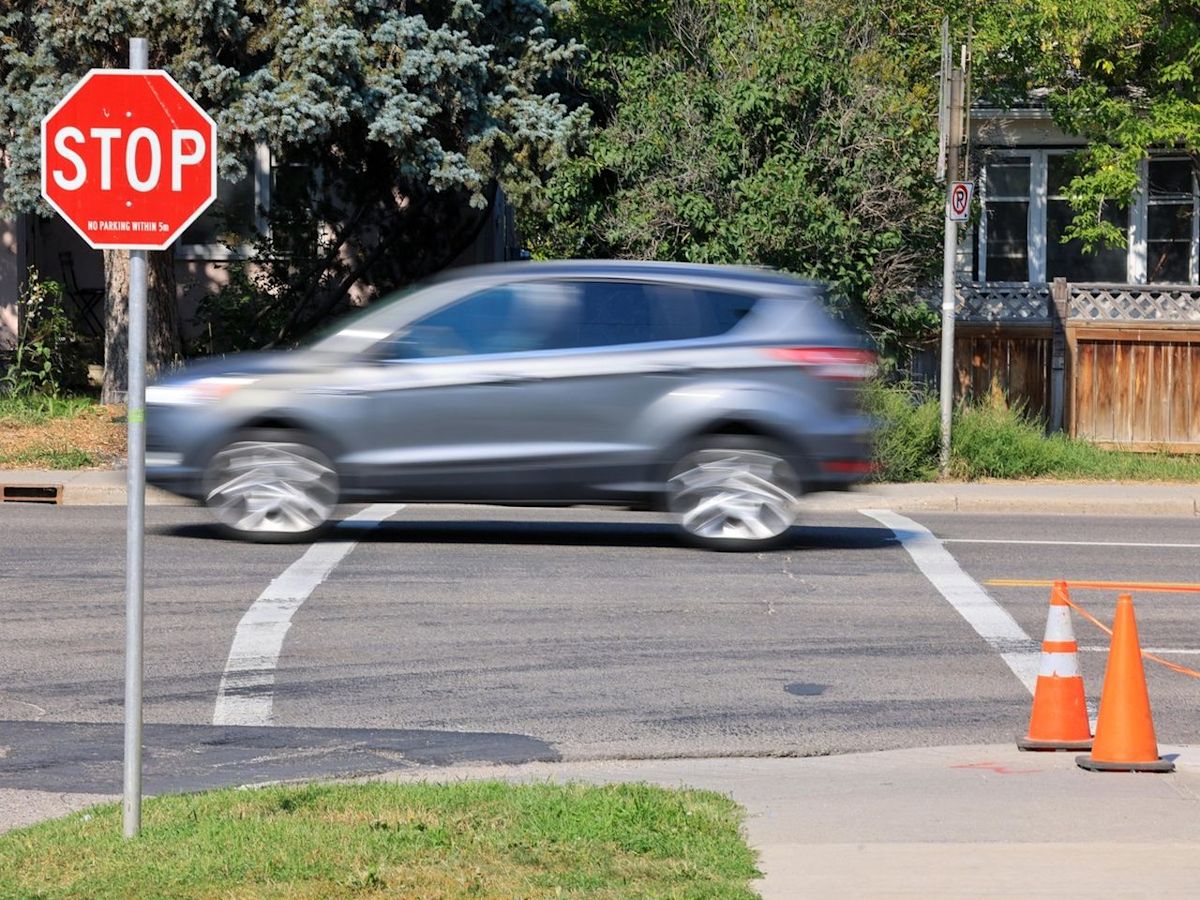
Artificial intelligence has pinpointed Calgary’s 50 most dangerous intersections that lack traffic control lights.
And city lawmakers are being asked to spend $6 million to upgrade about half of the crossroads based on those findings.
The city’s AI platform assessed 17,000 interchanges, handing out scores of up to 100 points based on their risk rating, many of them falling short of the criteria of requiring safety controls such as curb extensions or rectangular rapid flashing beacons (RRFBs). That criterion includes traffic and pedestrian volumes, speed limits and road configuration.
It ultimately highlighted 50 intersections lacking traffic controls that scored risk ratings ranging from 93.55 to 99.02.
Topping the list with that maximum score was Martindale Boulevard and Martindale Gate N.E., followed by Falshire Drive and Falton Drive N.E., with a rating of 98.54.
Coming in third at 98.13 was Madigan Drive between Madeira Way and Manora Place N.E.
Those locations fall just short of the threshold for requiring RRFBs, which requires 9,000 vehicles per day, but city administrators say adding traffic signals would proactively address safety issues.
“Administration could proactively advance improvements at these locations rather than waiting for future traffic counts, warrant studies or collision history to justify intervention under traditional processes,” states a report that will be debated by the community development committee on Sept. 1.
The list was ultimately narrowed to 26 sites that could be upgraded between 2027 and 2030, with the $6 million cost in addition to the existing budget for safety improvements.
That recommendations come at a time when the city struggles with a record number of pedestrian collisions. Last year, 15 pedestrians were killed on the city’s roads, a 225 per cent increase from the previous year.
In February, a two-year-old child was killed after being struck by a Jeep while being pushed in a stroller by their parents in a marked crosswalk.

Police tape hangs on a crosswalk sign on Horton Road in Calgary on Monday, Feb. 16, 2026, where a fatal collision claimed the life of a toddler in a stroller the night prior.
The report says “there may be public scrutiny regarding the use of AI-supported prioritization in decision making.”
But Ward 4 Coun. DJ Kelly said AI is being used in concert with public feedback and professional assessment.
“AI is giving us another tool, and it’s great to have that validation,” said Kelly, who sits on the community development committee.
That’s a contention echoed by an engineer with the city’s mobility Traffic Safety team.
“Locations are selected based on obviously the engineering side, which we do regularly, as is based on the traffic volumes, collisions, etc.,” said Surendra Mishra.
Kelly said a number of locations cited by AI were already on the city’s radar, often due to complaints from the public, adding measures are already being taken at two sites identified by AI in his ward.
The stubborn scourge of distraction among drivers and pedestrians — usually involving cellphone use — makes upgrading those sites all the more urgent, said Kelly.
“Those are things 20 years ago you didn’t need,” said Kelly, referring to flashing lights that bring drivers back from their phones.
Boosting the safety of intersections is probably the most common request he hears from the public, said Kelly.
Injecting $6 million into that effort “is not a wildly out-of-line figure,” that will likely be debated during budget deliberations in November.
The first-term lawmaker said earlier councils have underfunded such infrastructure and it’s time to catch up on it.
Committee chair and Ward 5 Coun. Raj Dhaliwal disagreed with that last point, saying the previous council funded requests made in the city’s Safer Mobility Plan.
But he otherwise agreed with Kelly on the need for enhancing safety for both pedestrians and drivers in a city with a rapidly increasing amount of vehicle traffic.
“We’ve had a 21 per cent population growth since 2016 and some of these roads were built before 2016,” said Dhaliwal.
“This (funding recommendation) isn’t based on perception, it’s based on data.”
Even though this year’s tally of pedestrian casualties is down from 2025, there’s still too much carnage on city streets, he said.
“It’s a little better than last year, but I want to achieve zero (fatalities),” he said.
He said more needs to be done to educate motorists and pedestrians on safety in both schools and in the wider community.
Catch up with the day’s headlines, curated by our editors and delivered to your email inbox at lunchtime on every business day. Sign up now for the Calgary Herald Noon News Roundup.