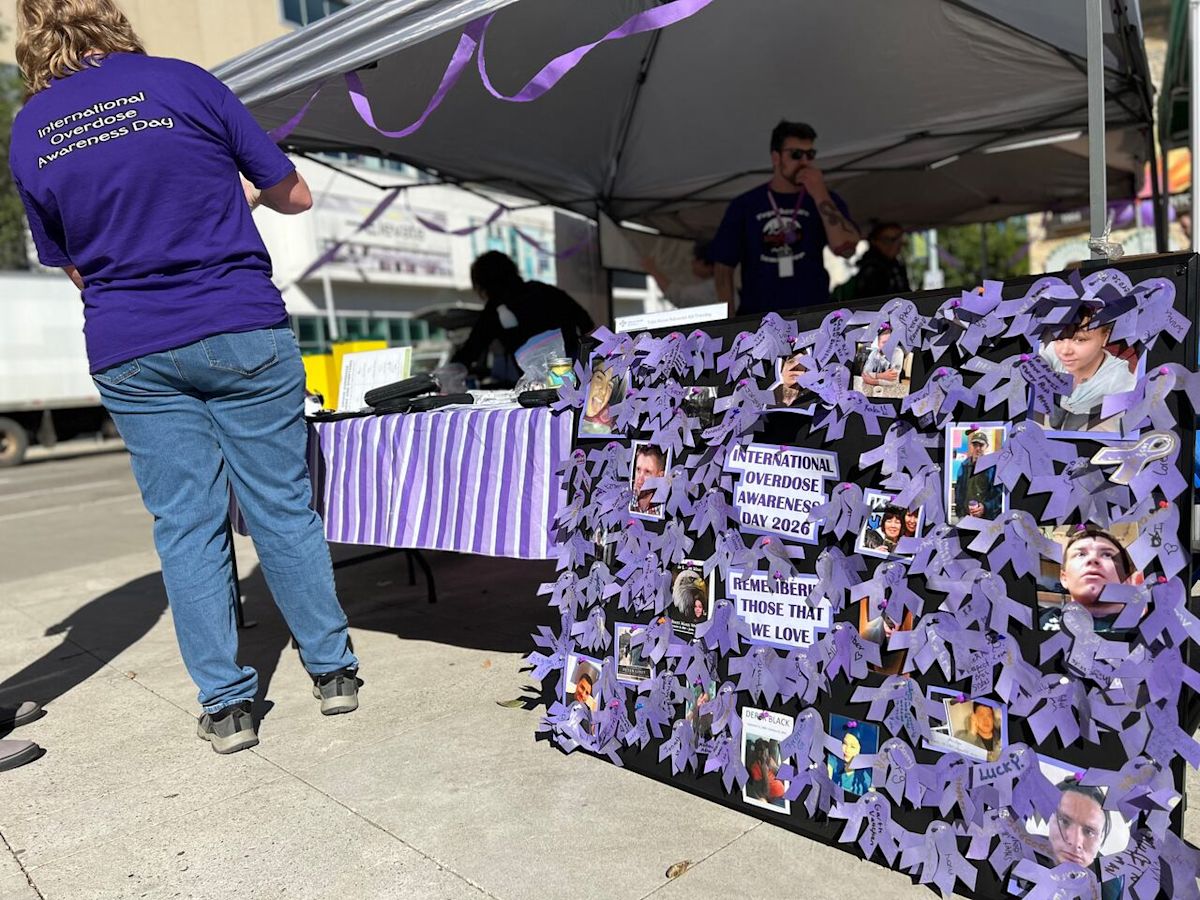
Organizations that work with substance users in Edmonton marked International Overdose Awareness Day at Sir Winston Churchill Square on Monday, and some advocates spoke about the number of fatalities occurring behind closed doors in homes.
Patrick Black, a nurse and the manager of Boyle Street Community Services’ overdose prevention team, told CBC News that stigma around substance use remains an issue.
“[Substance users] wake up [from a poisoning] and then they continue on because of the stigma around substance use,” he said. “Often people are afraid to call 911.
“They’re worried a cop car or fire truck is going to show up in front of their apartment building or their house, and alert all their neighbours something’s going on.”
This stigma can feed into feelings of shame or guilt a substance user may have and can ultimately have fatal results for substance users, Black said.
“If they’re using substances, they’re hiding it from their partners, their family, their neighbours, their friends. Often, they go into a bathroom, they lock the door, [or] they go into their bedrooms, they lock the door,” he said.
“Then they experience drug poisoning, and no one’s aware and around to actually provide naloxone and reverse the poisoning and save their life.”

Patrick Black, a nurse and the manager of Boyle Street Community Services’ overdose prevention team, told CBC News that drug poisonings are often underreported. (Mrinali Anchan/CBC News)
Boyle Street Community Services is a non-profit organization that works with people experiencing homelessness and poverty.
Along with people involved with HIV Edmonton and the Queer and Trans Health Collective, staff at Boyle Street Community Services took to Sir Winston Churchill Square on Monday to provide information and naloxone administration demonstrations.
An Edmontonian who struggles with substance use told CBC News he wants the public to understand that drug-poisoning deaths can happen anywhere as the drug-poisoning crisis continues to take lives in the city.
Kristopher Daniel Pinnell said he has struggled with addictions for almost 11 years and survived a cocaine overdose in 2024.
“Mine happened in my home, in my private residence,” Pinnell, who is also a musician, told CBC News. “I was lucky to have somebody there that knew CPR, otherwise we would not be talking.”
He said he has struggled with addictions and mental health at various points in his life, but added that he once had what he called an upper-middle-class life with a partner, a child and a home in Vancouver.
As the years progressed, his battle with addictions ripped that away from him, he said.

(Mrinali Anchan/CBC News)
Pinnell said at one point he had been transferred to care at Edmonton’s Henwood Treatment Centre but lost that treatment option when the program was suspended because the facility sustained flood damage this summer.
With operations suspended at Henwood, Recovery Alberta previously told CBC News that existing patients have been reconnected with other supports where possible.
Pinnell said he is now on a waitlist for another program and he believes his life now hangs in the balance because of the uncertainty about where and how he can receive immediate treatment.
“I’m here now because I don’t know how much time I have left for my voice to be heard, not just for myself but for others as well,” he said.
‘Public understanding of the crisis is distorted,’ Boyle Street says
Last year, 770 people died of drug poisoning in Edmonton, according to the Alberta substance use surveillance system.
“The public understanding of the crisis is distorted: most coverage focuses on open-air substance use by those most visible and marginalized,” Boyle Street Community Services said in a news release last week.
“But in 2025, over half of unintentional opioid-poisoning deaths in Edmonton occurred in private residences.”
Black said he believes “the numbers are just a drop in the bucket.”
He noted that while other health zones in the province have seen their number of drug-poisoning deaths decrease, that hasn’t been the case for Edmonton which has seen an increase in such deaths.
On top of that, Black said he suspects that “upwards of half the drug poisonings that are happening out there are not being tracked or recorded.”
“The city of Edmonton sees about one [drug-poisoning] death every 11 hours,” he said.
Black said the issue is hitting the demographic of men between the age of 20 and 50 particularly hard.
“If it doesn’t affect someone in your friends and family group now, it possibly will in the future.”
Pinnell said he wants the humanity of drug users to be better understood.
“We need more education,” he said. “We need to change the stigma of addiction.
“Right now, people say, ‘Well, why don’t you stop?’ I had thought of that. It doesn’t work that way, unfortunately. It takes over. It controls you.
“You wake up in the middle of the night and you can’t stop, and you don’t know why. You’re sitting next to yourself, watching yourself do stuff you would never do if you were not using [drugs]. It’s a very debilitating disease.”