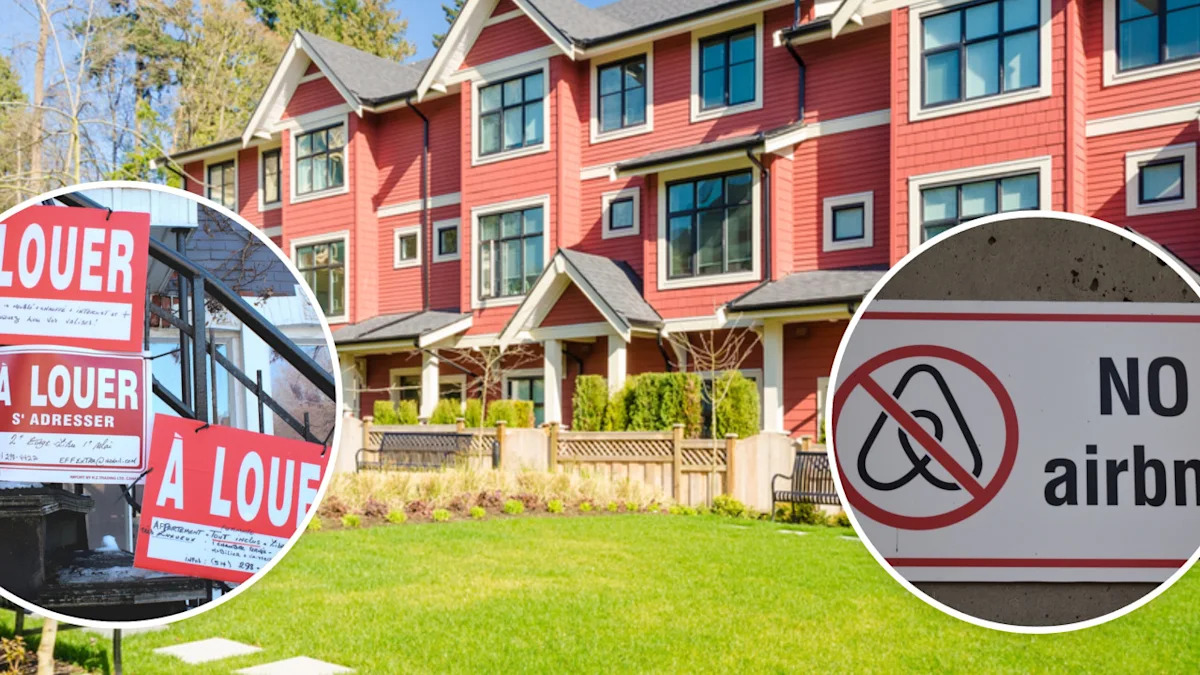
 For rent signs in Montreal + apartments in Vancouver + No Airbnb sign
Strict rules limiting platforms like Airbnb have slowed the rate of rent increases across Canadian cities, saving local tenants tens of dollars each month, according to research examining six years of national housing data.
The findings, published in a joint study by McGill University Professor David Wachsmuth and University of Waterloo postdoctoral researcher Cloé St-Hilaire, provide concrete empirical proof linking short-term rental restrictions to reduced rental inflation.
“We found absolute, iron-clad evidence that short-term rental regulations put downward pressure on rent,” Wachsmuth, the study’s lead researcher, said in a statement. “Lots of things cause housing to be expensive, but this is low-hanging fruit to manage those costs.”
The City of Vancouver acted as a pioneer in 2018 when it limited short-term listings strictly to primary residences, preventing hosts from running secondary units like basement suites or laneway houses as full-time vacation rentals. British Columbia expanded similar restrictions provincewide in 2024.
Don’t Miss A measurable drop in monthly rent prices
While housing experts and residents long assumed short-term platforms drove up prices by removing long-term housing supply, the researchers set out to verify whether restrictions actually cooled local markets.
By comparing cities with primary residence restrictions against municipalities that allowed unrestricted vacation listings, the study revealed a clear divergence in rental price trajectories.
Before the rules came in, rents in cities with lots of vacation rentals were rising about as fast as they were elsewhere in Canada. But once cities started limiting short-term rentals to people’s primary homes, rent increases began to slow compared with places that didn’t have those restrictions.
Key findings from the McGill University study include:
First-year impact: Rents were 1.7% lower — or roughly $24 lower per month — one year after a municipality implemented strict short-term rental rules compared to what they would have been without regulation.
Compound savings: The price-dampening effect accumulates over time as rules remain active for 3 to 4 years.
Direct tenant savings: By 2023, strict short-term rental regulations saved Canadian tenants an average of $55 a month in regulated areas.
National impact: Across all regulated markets, these restrictions saved Canadian renters a total of $192.4 million each month in 2023.
Story Continues
In short: Without Vancouver’s early adoption of short-term rental limits, local tenants would be paying significantly more in monthly rent today.
Read more: 3 essential money moves to make once you’ve saved $50,000
Regional spillover effects
The study highlights that housing markets operate regionally rather than in isolation. Consequently, the financial relief extended beyond the borders of strict municipalities and into adjacent, unregulated areas.
While tenants in regulated markets saved an average of $55 a month by 2023, renters in neighbouring municipalities that did not adopt restrictions still experienced savings of around $40 a month. The researchers pointed to Greater Montreal as a prime example of this spillover effect: Strict rules implemented within Montreal proper helped cool rent growth in nearby municipalities, like Laval and Longueuil, that did not implement short-term rental rules. For the researchers, this demonstrates how municipal regulations can stabilize housing costs across an entire metropolitan area even if regulations only apply in target areas.
The low-hanging fruit of urban housing policy
While the policy yields tangible savings, researchers emphasize that curbing vacation listings alone will not resolve Canada’s broader housing affordability crisis.
Wachsmuth emphasized that short-term rentals are not the only factor driving overall rental costs. Significantly expanding the supply of dedicated rental housing would have a far greater impact on bringing prices down, but adding new housing stock at scale remains difficult and time-consuming for cities.
Restricting vacation platforms, by comparison, represents the low-hanging fruit of municipal policy. It offers local governments a straightforward regulatory tool to deliver immediate, measurable relief to renters while broader supply initiatives slowly take shape.
What To Read Next
The most expensive financial mistakes are often the ones you don’t see coming. Join 19,000+ Canadians who get the money moves, risks and opportunities shaping their finances — delivered free each week. Subscribe now.
This article originally appeared on Money.ca under the title: Did Vancouver’s Airbnb crackdown actually make rent cheaper?
This article provides information only and should not be construed as advice. It is provided without warranty of any kind.