
Navigating the salary cap is one of the most important tasks for a front office. Teams that can avoid total cap chaos by walking the tightrope of inking players to deals that match their value (or compensate for future value without breaking the bank) remain successful. Those who don’t often see struggles and front office changes.
As we do each year, PHR will look at every NHL team and give a thorough look at their cap situation for the 2026-27 season, though in a slightly different format than before. This will focus more on players who are regulars on the roster versus those who may find themselves shuttling between the AHL and NHL. All cap figures are courtesy of PuckPedia. We’re currently covering the Atlantic Division, last up are the Maple Leafs.
2026-27
Upper Limit: $104MM
Current Cap Charge: $106,752,382
Cap Space: -$2,752,382
Potential Bonuses: $3.5MM (around $1MM could be reached)
Dead Cap: None
While it looks like Toronto is in a spot where they need to shed salary, Max Domi is expected to land on LTIR to start the season. Until he’s able to return, they’re able to get into cap compliance with too much difficulty.
Expiring Contracts (RFA): None
Expiring Contracts (UFA): None
2027-28
Projected Upper Limit: $113.5MM
Current Cap Charge: $106,752,382 (23 players signed)
Cap Space: $6,747,618
Potential Bonuses: $3.5MM (around $1MM could be reached)
Dead Cap: None
Yes, you read the above correctly; the Maple Leafs don’t have any pending free agents next summer among players currently projected to play on their roster. The projected increase in the salary cap will give them some wiggle room next summer but basically, GM John Chayka basically has most of next year’s roster in place already.
Expiring Contracts (RFA): D Emil Andrae ($1.55MM), F Easton Cowan ($900K)
Cowan had a solid rookie season, one that saw him being eased into things. While he wasn’t a top-six forward for most of the year, the hope is that he’ll get there. If he does over the next couple of years, he could jump into the $7MM or $8MM range fairly quickly. Otherwise, a bridge deal likely lands somewhere around the halfway mark of those numbers.
Andrae was the key part of the return for Joseph Woll, with Toronto believing he’s capable of playing a bigger role than he did with Philadelphia. If he proves he can be more of a fourth or fifth option, he could push past the $3.5MM mark on his next deal with arbitration rights.
Expiring Contracts (UFA): F Teddy Blueger ($2.5MM), F Max Domi ($3.75MM), D Oliver Ekman-Larsson ($3.5MM), F Dakota Joshua ($3.25MM), F Steven Lorentz ($1.35MM), F Auston Matthews ($13.25MM), F Jack Roslovic ($4MM), Colton Sissons ($4.25MM), D Troy Stecher ($1.35MM)
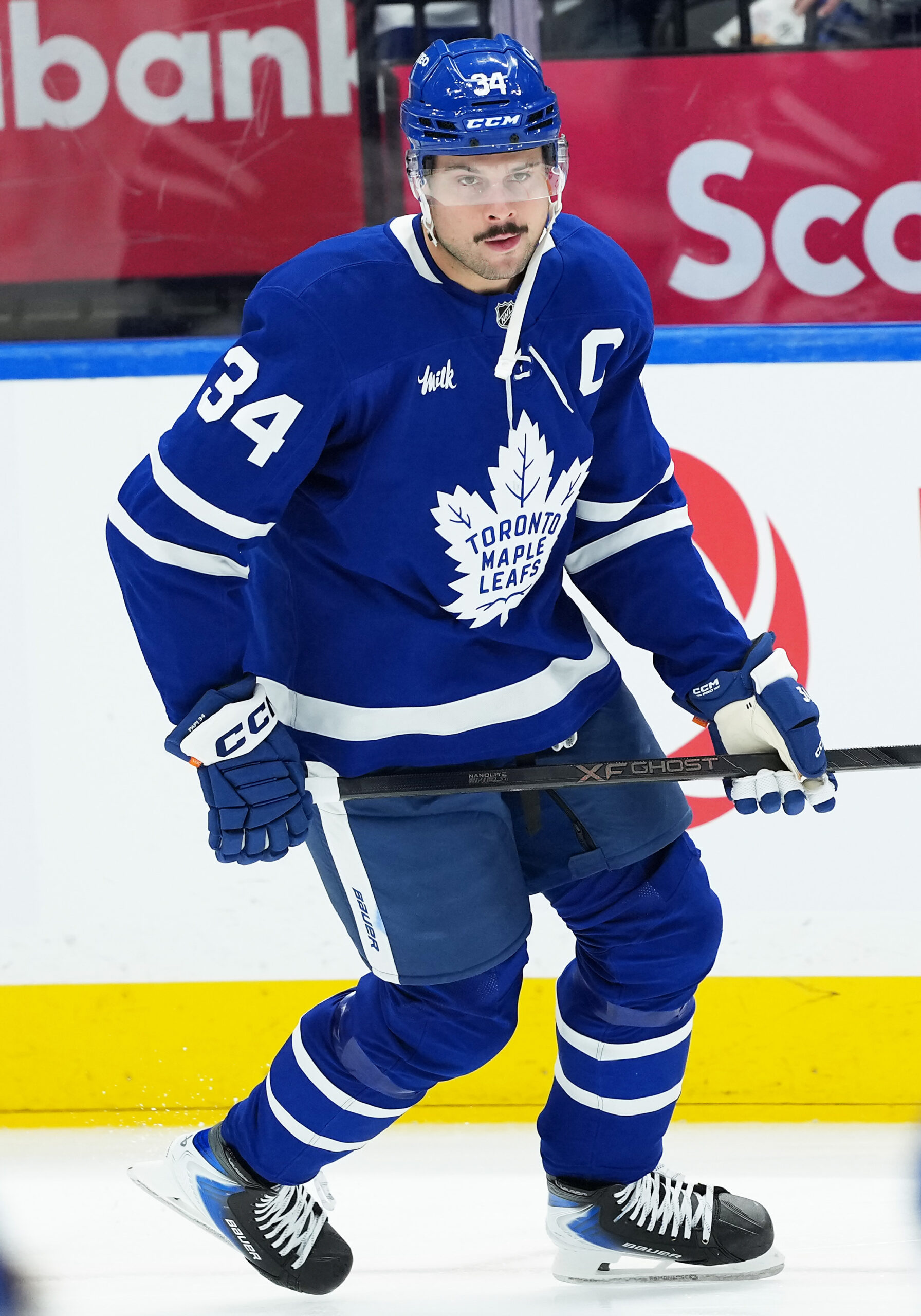 While it seems so long ago now (when it really hasn’t been), this Matthews contract was once the priciest in NHL history in terms of his AAV. It didn’t hold the record for too long overall. He was also one of the few who eschewed long-term deals in favor of medium-term ones, a trend that may become much more popular moving forward. This deal allows Matthews to hit the open market as a 30-year-old where, in theory, he could get a big jump in pay and a longer-term pact if he wanted it. However, his production has dipped the last couple of years while he has dealt with some injuries. He’s still a top-liner but not among the elite shooters like he was. If this continues, he could still land a small raise given his role but it won’t put him among the top-paid players again.
Sissons had a quiet year in Vegas but his overall track record as a strong checking forward helped earn him a notable raise from Toronto, one that caught some off guard for an 11-point player. If he gets back to being a third liner with the Maple Leafs, a small raise should be doable. But if his performance is similar to his time with the Golden Knights, he probably won’t have as strong of a market two years from now. Roslovic learned his lesson after his last couple of trips through free agency didn’t go well. This time, he jumped on a day-one offer, earning himself a nice raise off his second straight 20-goal season. If he’s in that territory for both of these years, that should be enough of a track record to pick up a small increase again.
Domi had a decent first season in Toronto to land this deal but hasn’t come close to reaching that production since then and, as noted earlier, appears to be LTIR-bound. He’s a serviceable middle-six forward who can play down the middle if needed so there’s still some appeal. If he gets back to full health, it’s plausible that he could still land something around this price tag. Joshua hasn’t come close to matching his breakout from two years ago while battling his way back from testicular cancer. He has been more of a fourth liner since then and unless his effectiveness ticks up, he’s probably looking at a cut in pay on his next contract.
Blueger had a nice half-season with Vancouver last season, producing at a career-high rate after a pair of years with at least 26 points. That gives Toronto a bit of upside value-wise with this deal, especially if he holds down a third-line role. In that case, he could push more toward the $4MM mark on his next contract. Lorentz has found a way to be productive from the fourth line while providing physicality and some solid defensive play. These are the types of players who have seen their value jump up a bit as of late so a multi-year pact with an AAV starting with a two should be doable for him.
Ekman-Larsson has fit in quite well over the first half of his contract with Toronto, showing he can still handle a top-four role. While he’ll be 37 when this deal expires, if he’s playing at a similar clip, a short-term pact closer to $5MM per year should be within reach. He’s also an option to go year-to-year which would make him eligible for incentives in his deal. Stecher was a good waiver pickup, going from a fringe piece in Edmonton to a third-pairing regular in Toronto, helping earn this deal earlier this summer. Being an undersized blueliner coupled with his role, however, will probably keep him around this price point moving forward.
2028-29
Forecasted Upper Limit: $123MM
Current Cap Charge: $66,227,382 (12 players signed)
Cap Space: $56,772,618
Potential Bonuses: $3.5MM (around $1MM could be reached)
Dead Cap: None
It’s fair to say that this number will go down significantly after signing the 2028 free agent class. Matthews and Cowan are the headliners while presumably, some of the veteran UFAs will be retained as well. Still, with enough expiring deals, this is where Chayka should have some runway to reshape the roster.
Expiring Contracts (RFA): F Gavin McKenna ($1.075MM plus $1MM in ‘A’ bonuses and $2.5MM in ‘B’ bonuses)
McKenna was the top pick back in June and is expected to play a prominent role in Toronto’s lineup right away. If he indeed becomes a true top-line player fairly quickly, he could be eyeing deals around the range some of the prominent top picks signed for this summer ($15MM to $18.8MM). Meanwhile, his A bonuses (up to four at $250K apiece) have a realistic shot at being maxed out while his B ones would be much less likely.
Expiring Contracts (UFA): G Sergei Bobrovsky ($7MM), F Brandon Duhaime ($2.6MM), F Nick Paul ($3.15MM), F John Tavares ($4,389,280)
Tavares took a big discount (and then helped more on the cap side with deferred money) to stay with his hometown team. While he’s no longer a top-line threat, he’s still a quality second-line center making less than what some fourth-line pivots received this summer. Yes, he’ll be 38 when this contract ends and probably not in the same role he has now but they’ll get plenty of value out of it. He’s a viable candidate to go year-to-year after that with bonuses, giving Toronto (assuming he stays) some extra wiggle room if needed cap-wise.
Paul was acquired on the opening day of free agency with the Maple Leafs hoping he can rebound. After flashing top-six upside at times in Tampa Bay, he struggled last season and slipped a bit on the depth chart. But given his overall versatility, they should get a decent return on this contract while a small raise could be doable. Duhaime had a tough year in Washington but benefitted from his track record and the added interest in physicality. If he can get back to being a 20-point player, Toronto should get a good return while his market value would jump past $3MM per year. Otherwise, he’s likely to remain around this price point.
Bobrovsky had his ups and downs in Florida and couldn’t get the long-term deal he was seeking, sending him to Toronto instead. Last season was a struggle and if he repeats that with the Maple Leafs, this will be a problem for them. But even if he gets to around league average, they’ll do okay. Can he do that on a deal that carries him through his age-40 year? That remains to be seen.
2029-30
Forecasted Upper Limit: $133.5MM (8.5% increase)
Current Cap Charge: $48,013,102 (7 players signed)
Cap Space: $85,486,898
Potential Bonuses: None
Dead Cap: None
The Maple Leafs may need a new starting netminder at this point (unless Artur Akhtyamov is pushing for the role by then) and Tavares will need to be replaced. Between the expiring deals and the forecasted cap increase, they should be able to afford both of those pieces.
Expiring Contracts (RFA): None
Expiring Contracts (UFA): D Jake McCabe ($4,513,102), D Morgan Rielly ($7.5MM), G Anthony Stolarz ($3.75MM), D Chris Tanev ($4.5MM)
Despite a summer of trade speculation, Rielly remains in the fold. A strong producer offensively just a couple of years ago, he has taken a step back on that end while also scuffling defensively. Still, this price tag isn’t terrible now for a second or third option which is where he’s likely to be this season. He’ll be 36 when this deal is up and while he could get a multi-year pact at that time, his role at the time may make it that he’s unable to beat this price point.
McCabe also is on a deal with some deferred money, something that’s now illegal league-wide. He was the de facto number one last season in terms of usage, a role he’s not suited for. He’s ideally a third option and this price tag is great for someone in that slot. He’ll be heading to his age-37 season on his next contract so while a small raise may be achievable, it shouldn’t be a huge one at that time. When healthy, Tanev remains a high-end shutdown defender. Staying healthy has been a big challenge for him, however, and he’s signed through his age-40 campaign. It’s probably his final contract and Toronto’s value on this one will largely come through whether or not he’ll be able to play.
Stolarz had a great first season with Toronto, leading to an early extension that seemed reasonable if he could even come close to that level. That wasn’t the case last season while dealing with some injuries as well. Still, as long as he can get back to even being a good backup goalie, this deal should work out okay. He’ll be 36 when the contract expires and unless he can become a true starter by then (unlikely, given Bobrovsky’s presence), he may be around this price point again on his next pact.
Signed For 2030-31 And Beyond
For that season, there will be a new CBA in place so trying to forecast the cap and cap space basically becomes a guessing game. Accordingly, we’ll go back to the old Deep Dive format for players signed beyond the 2030-31 campaign.
Reshaping the back end may be the theme of the 2030 offseason with three of their top-four (in terms of money) blueliners up at the same time. Having that many expiring deals will give Chayka ample room to operate on that front.
F Matthew Knies ($7.75MM through 2030-31)
F William Nylander ($11.5MM through 2031-32)
D Darren Raddysh ($8.5MM through 2033-34)
Nylander’s not known for his game-to-game consistency but he has been over a point per game in four straight years now and is a legitimate top-line winger. This is a little bit on the high side today but over the next couple of seasons, as more move into this price range, the Maple Leafs will get good value here. He’ll be 36 when this deal is up so the focus on his next contract may be more on term instead of maximizing AAV. Knies bypassed a bridge deal last summer to sign this agreement, one that is already team-friendly. He’ll only be in his late-20s when this deal expires, giving him a chance at a max-term agreement if he wants one, one that feels quite certain to reach double digits in terms of AAV.
Raddysh had a breakout year with Tampa Bay last season, leading to an eventual sign-and-trade deal in late June. If he remains a top-pairing, high-producing defender, this could prove to be quite a bargain given where the market has gone since then. However, if he goes back to being more of a second-pairing option with secondary offense as he was the two years before then, this could be a problematic pact. There’s certainly some risk/reward with the contract but the reward could be significant. He’ll be 38 when this deal is up and it seems unlikely he’ll be producing enough by then to command this price tag on a new contract.
Outlook
While there isn’t much short-term room to work with over the next couple of years, Toronto will have a ton of flexibility starting in 2028 to really reshape its core if needed. With few long-term commitments on their books, Chayka will have some runway to operate with from a cap perspective but a bit of patience will be needed first.
Photo courtesy of Nick Turchiaro-Imagn Images.