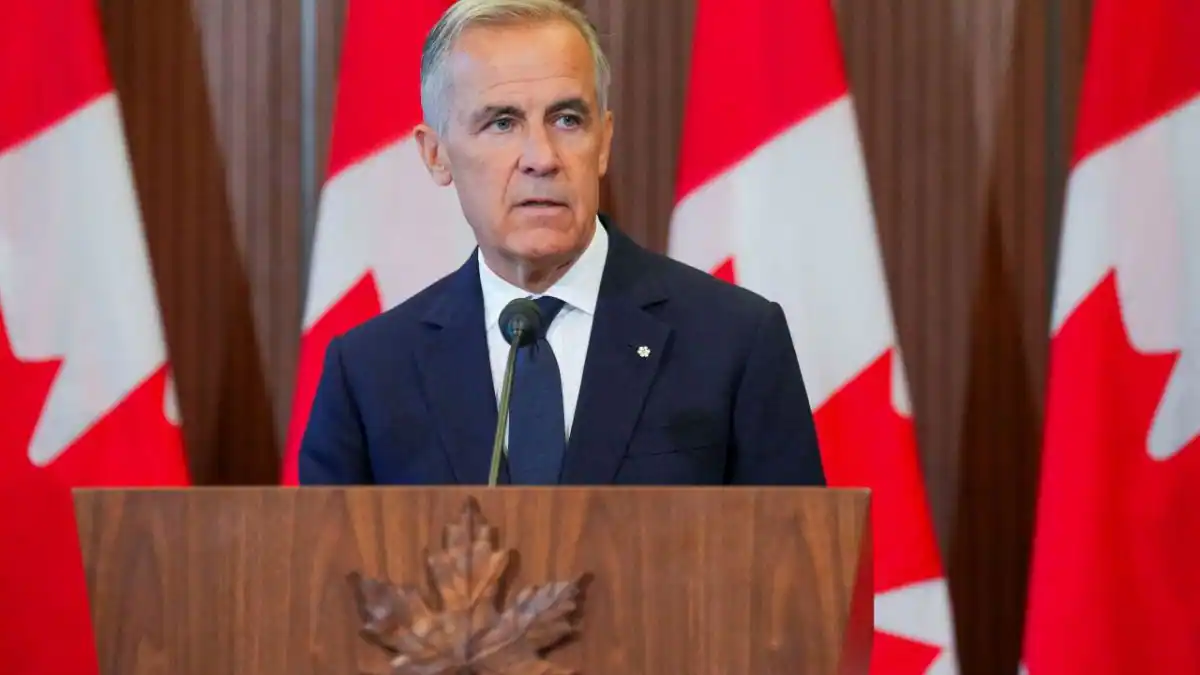
Carney’s remarks came a day after a report suggested that Canada was exploring the possibility of becoming an associate member of the European Union
Canada is seeking a closer and potentially “unique alliance” with the European Union but has no plans to become a member of the bloc, Prime Minister Mark Carney said Sunday, after a report said Ottawa was exploring the possibility of becoming an “associate member”.
The Wall Street Journal reported that Canada was considering whether it could secure a new form of associate membership with the EU as it looks to deepen ties with the bloc amid an escalating trade dispute with the United States.
The report, citing unnamed officials from both the EU and Canada, said the European Union was open to creating an associate membership status for Canada. The bloc has historically maintained strict rules around membership.
But Carney rejected the idea that Canada was seeking full membership.
“We’re not looking to become a member of the European Union,” Reuters quoted Carney as saying.
“What we are looking — and will begin discussions for — is a unique alliance between Canada and the European Union,” he told reporters at the Toronto International Film Festival. “We share the same values, we have the same priorities and we have very complementary strengths.”
Carney’s comments came as Canada prepares to intensify its engagement with European partners. His office confirmed Saturday that the prime minister will travel to France and Britain next week.
 More from World
During the trip, Carney is scheduled to address the European Parliament in Strasbourg and attend EU President Ursula von der Leyen’s State of the European Union address.
A separate report by The Globe and Mail said it was the EU, rather than Carney, that had floated the idea of associate membership. The newspaper cited an anonymous source as saying that any discussion about a formal title for the relationship remained premature.
The European Parliament, however, announced Monday that it was opening an antenna office in Ottawa. It said the move “underlines the European Parliament’s commitment to deepening political dialogue and cooperation with Canada.”
Canada looks beyond US trade ties
Ottawa’s push for closer relations with Europe comes as its trade relationship with the United States faces growing strain.
Canada’s escalating trade war with the US has increased the urgency of its efforts to strengthen ties with other trading partners and expand cooperation beyond its biggest economic partner.
Relations between Ottawa and Washington have deteriorated sharply since Donald Trump returned to the White House last year, with trade and other disagreements driving the two countries further apart.
The dispute has resulted in tariffs covering tens of billions of dollars in cross-border trade.
Trump renewed his criticism of Canada on Sunday, describing it as “the worst country to deal with”, while also saying he believed Ottawa was “dying to make a deal.”
“They’ve ripped off our country for years,” he told reporters aboard Air Force One.
The US president also reiterated his intention to impose new tariffs on Canadian cars, trucks and auto parts beginning January 1.
Canada, EU explore deeper economic ties
Against that backdrop, Canada and the EU are discussing ways to deepen economic and strategic cooperation.
The Wall Street Journal reported that the two sides are exploring arrangements that would allow Canadian goods, services and workers involved in strategic supply chains to move more freely across the Atlantic.
The areas under discussion include energy, artificial intelligence, defence and critical minerals. Such arrangements could effectively shift the EU’s economic border to facilitate greater movement between Canada and the bloc.
The discussions also extend to major infrastructure and technology projects.
Canada and the EU are considering cooperation on underwater cables, data centres, cloud storage and new satellite networks. They are also discussing infrastructure that could facilitate the shipment of Canadian energy to European markets, the newspaper reported.
Carney has also held regular discussions with several European leaders, particularly French President Emmanuel Macron, about the possibility of allowing Canadians to live and work in the EU without visas, according to the Wall Street Journal, which cited two officials familiar with the matter.
Macron’s press office did not respond to a request for comment.
Separately, Macron’s office confirmed that the French president will meet Carney on September 20 in Saint Pierre and Miquelon, the French territory made up of islands off Canada’s Atlantic coast.
Closer EU ties face challenges
Despite the push for a deeper Canada-EU relationship, efforts to expand ties are likely to face challenges.
Past attempts at closer economic integration have shown the difficulties involved in securing agreement across the European bloc.
The Canada-EU trade deal itself faced significant resistance in Europe. More than a decade after the agreement was reached, and nine years after it provisionally entered into force, several EU countries have still not ratified it.
With inputs from agencies