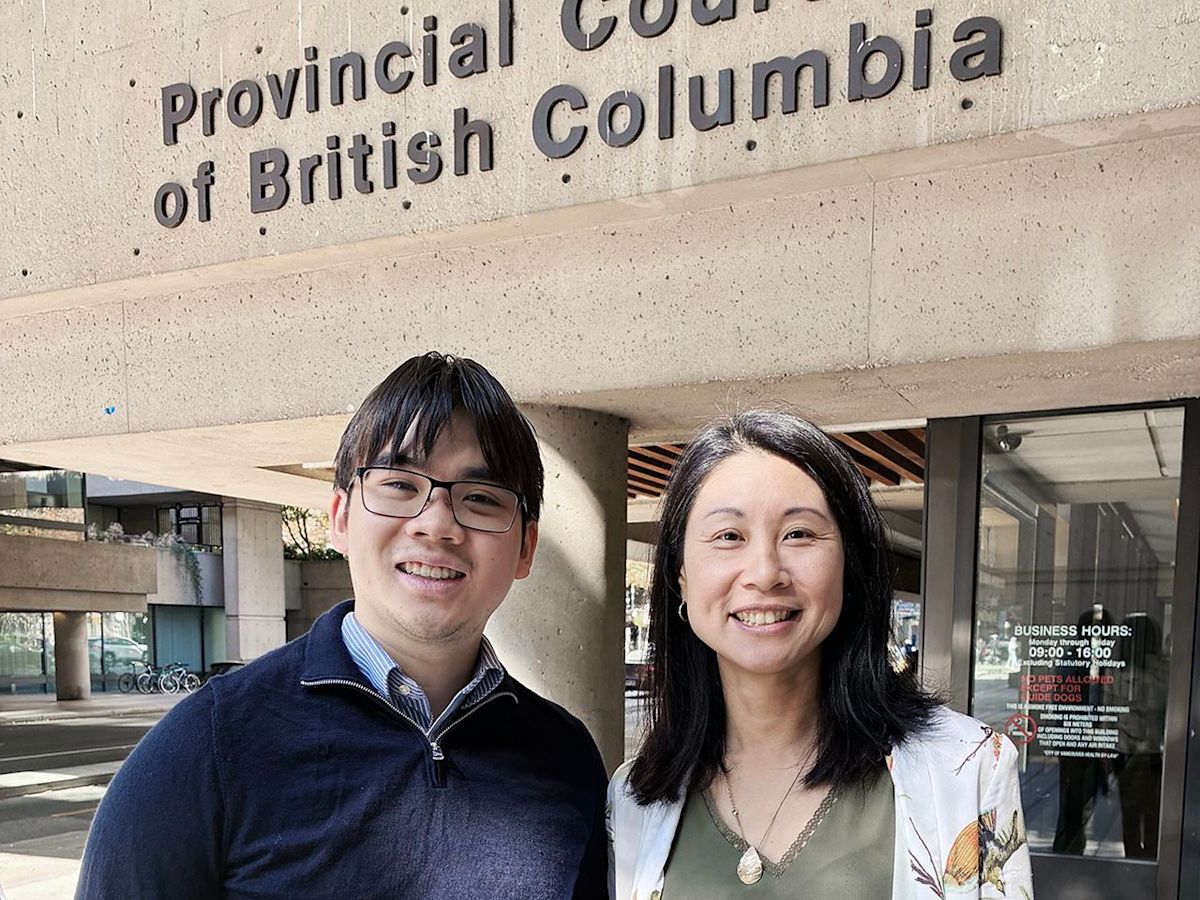
Candidates in Vancouver’s municipal elections are required to use their “usual” name on the ballot, the city’s lawyer told a provincial court hearing on Wednesday.
The city’s chief election officer, Jason Twa, filed two identical applications against seven candidates in total asking the B.C. provincial court to forbid the use of their names in Chinese characters alongside their English names, arguing they were not part of their usual names.
The candidates, including current ABC councillor Lenny Zhou and a OneCity candidate for council, Iona Bonamis, opposed the order, saying the Chinese character names they use alongside their English names are indeed their usual names.
“It’s been part of my identity my entire life, it’s a name that my parents gave me at birth,” Bonamis said outside court before the hearing started. “It’s what my relatives call me, it’s what many in the Chinese community call me.
“It’s a key part of who I am,” she said.
City lawyer Grant Murray told Judge Roger Cutler that all the candidates, with the exception of Bonamis, appeared to exclusively use their English names and not their Chinese names on social media.
The case was heard by Cutler by video from Duncan to eliminate any perception of bias from a Vancouver-based judge.
Murray told the court in Zhou’s case, “All of the correspondence (with the electoral office) is signed Lenny Zhou or Lenny, not the name in Chinese characters.”
It “doesn’t appear that he typically uses” that Chinese name and in the 2022 election he said it was not his usual name, he said.
He said most of the candidates had originally filed their nomination papers using only their English name using the Latin alphabet and returned to the electoral office on Friday, the final deadline for nomination papers to be filed, and asked to add their Chinese character names.
One of the candidates twice changed changed her Chinese name, he said.
Murray said he found it “odd” that the candidates hadn’t included their “usual” Chinese names on their original filings.
Bonamis, whose Chinese name is 陶思穎 (To Sie Wing), said she was told at the time of filing that the city’s chief election officer would likely legally challenge whether the usual name she provided was acceptable under the Vancouver Charter.
The Charter is the unique provincial legislation that governs the City of Vancouver. According to the Charter, nomination papers must include the full name of the person nominated and “the usual name of the person nominated, if the full name of the person is different from the name the person usually uses.”
“My English name is Lenny Zhou. My Chinese name is Zhou Nan (周楠). That was the name my parents gave to me at birth,” Zhou said. “This is not a name I invented for the campaign. This is the name I’ve already been using for 40 years, and it’s the name people already know me by.”
Murray said the court could provide guidance to the city for this and future elections on what defines a “usual” name.
Of the 123 candidates for council, park board and school board published on the City of Vancouver’s website, seven included their Chinese name.
One of the filings by Twa named Bonamis, Zhou and Christopher Lee, a OneCity school board candidate, and a second named Yuk (Alfred) Chien, Yunzia (Chris) Qiu, Lorraine Lowe and Shirley SiO.
Lowe (刘黛明) is also running for city council, while Qiu (仇云霞) is running for the park board. Chien (錢育廷) and SiO (邵己凌) are running to become school trustees.
The hearing is scheduled to resume Friday morning.
Bonamis said if the court allows her to use her name, it will send a message that Vancouver respects different cultures and that it’s a multicultural city.
Lee, 18, whose Chinese name is pronounced Lee Kei Peng, said it’s important for him to have the name on the ballot because “it’s a core part of my identity.”
“I’m a very proud Canadian. I’m also a very proud Chinese Canadian,” he said. “Canada is a multicultural place and we should respect that, the electoral office should respect that.”
“I don’t think it’s about having the Chinese name on the ballot to win votes, it’s about … our identity. It’s what the people in the Chinese community know us as.”
It’s a sign that we can “represent every single voice that Vancouver has,” he said.
Related