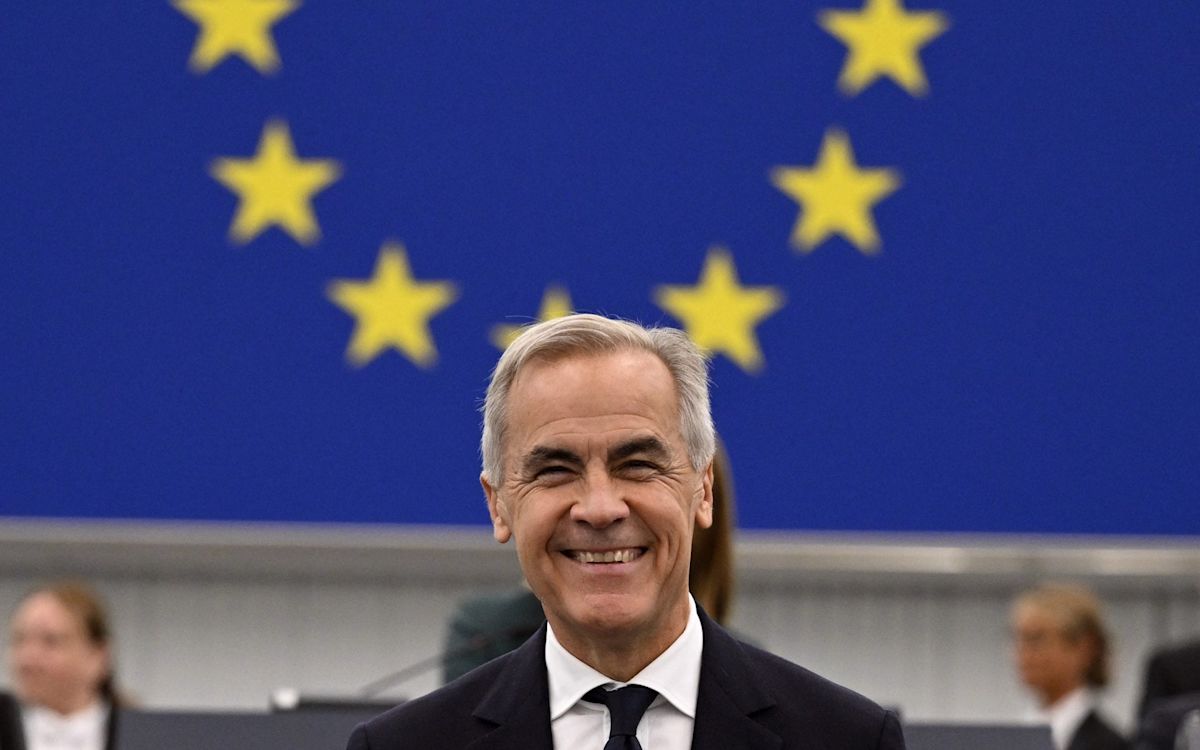
Mark Carney is back in the news as the ubiquitous champion of the old, rules-based international order.
Building on a speech he made in Davos earlier this year to the effect that “middle” powers should huddle together for warmth in an era dominated by superpower rivalry, he sought this week to further cosy up to the EU as an alternative to increasingly hostile relations with Trump’s America.
It’s fair to say that the Canadian prime minister’s speech to the European parliament was more important for its political signalling than its real-world economic significance. Ever since Trump made Canada the butt end of his war on international trade, Carney has ridden a wave of offended Canadian patriotism.
His determination to stand up to Trump’s demolition of multilateralism has won plaudits around the world, but no more so than in Europe, where he was greeted by European MPs as a kind of second coming.
Tears almost literally rolled down their cheeks as they listened in rapture to a speech – half delivered in French, half in English, peppered with references to Johann Wolfgang von Goethe, the great German polymath – extolling the virtues of nations with like-minded values and institutions standing together, like a forest, against the “ferocious storm” of today’s geopolitics.

Here at last was someone who thought of the EU as a “good thing” amid the growing backlash from the populist right. Compliments are rare these days, and the EU is grateful for any that come its way.
Time for a reality check. Carney seeks closer ties with Europe, but it is far from clear that he wants anything quite as grandiose as the “associate membership” proposed by Ursula von der Leyen, the president of the European Commission.
Indeed, he specifically ruled it out. “I am not proposing a third bloc in order to become a great power rival – only with better manners [than Trump’s America].”
He has no intention of pursuing membership of the EU, or even the European Economic Area, a kind of halfway house applied to Norway, Iceland and Liechtenstein that includes participation in Europe’s single market, budgetary contributions and free movement of labour.
What he aspires to looks surprisingly like what Britain wants to achieve, but has thus far been unable to secure a grown-up relationship between sovereign jurisdictions that prioritises mutually beneficial trade, resilient international supply chains and common defence objectives above the protectionist and acquisitive characteristics of today’s superpower leviathans.
I’m not sure that’s what von der Leyen means when she talks of associate membership. Sadly, the EU cannot seem to move beyond its federalist goals. The ambition is always to draw nations into its own orbit, subverting sovereign independence as it goes.

Mark Carney, pictured with Ursula von der Leyen, the president of the European Commission, seeks closer ties with the EU – Yves Herman/Reuters
Needs must, nonetheless, and almost anyone who holds out the hand of friendship these days will probably get it bitten off; such is the EU’s needy search for renewed legitimacy.
Anyone, that is, apart from Britain, where attempts to “reset” relations after the acrimony of Brexit have largely failed.
That’s not for want of trying on the UK’s part, but it is repeatedly rejected. Consistently, Europe demands some form of sovereignty subversion in return for closer economic ties.
Admittedly, there is some logic to the asymmetry between its broad welcome for Canada’s Carney and its continued hostility to the UK.
Despite its vast landmass and rich array of natural resources, Canada is a relatively small economy compared to the UK, at not much more than half its nominal GDP.
Moreover, its trade with Europe is tiny compared with the UK’s. What’s more, Europe cannot become a substitute for the trading relationship Canada enjoys with the US in the near future.
Canada and the US have one of the largest trading partnerships anywhere in the world at nearly $1tn (£747bn) in goods and services a year, and the US accounts for more than 70pc of all Canadian exports.
The EU, by contrast, is still less than 10pc of Canada’s global trade.
The bottom line is that Canada is far more economically integrated with the US than Britain ever was with the EU. For Europe, closer ties with Canada are all upside, and it will demand little in return.
As for Britain, Europe still hasn’t finished with the punishment beating it wants to inflict on the UK for daring to leave the EU’s embrace. Pour encourager les autres, it demands that the UK suffer.
Repeatedly, it refuses to give ground or listen to reason. All trade is good, even when it results in a deficit and is unfairly pursued, but the EU seems to regard its rigidly pursued federalist ambitions as the far more important goal.
In any case, what may be on offer to Canada is still withheld from the UK. To his credit, John Healey, the new Chancellor, seems unwilling to put up with this ongoing discrimination – unlike his predecessor, Rachel Reeves, who made closer alignment with Europe part of her growth strategy.
Healey’s self-evident coolness towards the EU is largely explained by his time as defence secretary, when Europe treated the UK disgracefully regarding access to the EU’s €150bn (£112bn) rearmament fund.
The price demanded was extortionate, causing Healey to call off talks. By contrast, the saintly Carney will no doubt receive the red carpet treatment when it comes to matters of defence.
I imagine Healey can expect no better in trying to ensure that Britain is included in the bloc’s “made in Europe” industrial policy, which seeks to limit procurement budgets to European products.
Of course, Carney would not be asking for greater ties with Europe but for a certain gentleman in the White House; the crass way Trump pursues territorial ambitions belongs more to the 19th century than the 21st.
These include Canada, which Trump seeks to absorb via economic coercion rather than the European method of economic integration and voluntary submission.
Attempts to normalise relations collapsed after the US demanded that Canada cede trade sovereignty in return, which would have made it a trade vassal in all but name.
Before returning to Canada, Carney was a remarkably competent governor of the Bank of England, a tenure marred only by his entirely inappropriate interventions on behalf of Remain during the Brexit referendum.
No surprise, then, that he should seek refuge in the EU as a buttress against the madness of emperor Trump.
But I suspect he’s fighting a losing battle. Economic power is quickly gravitating toward frontier AI models, where Europe is beholden to global corporations that both Trump and his Chinese counterpart, Xi Jinping, seek to bend to nationalistic ends and geopolitical power.
Europe is nowhere in this arms race. The addition of Carney’s Canada is scarcely likely to turn the tables.