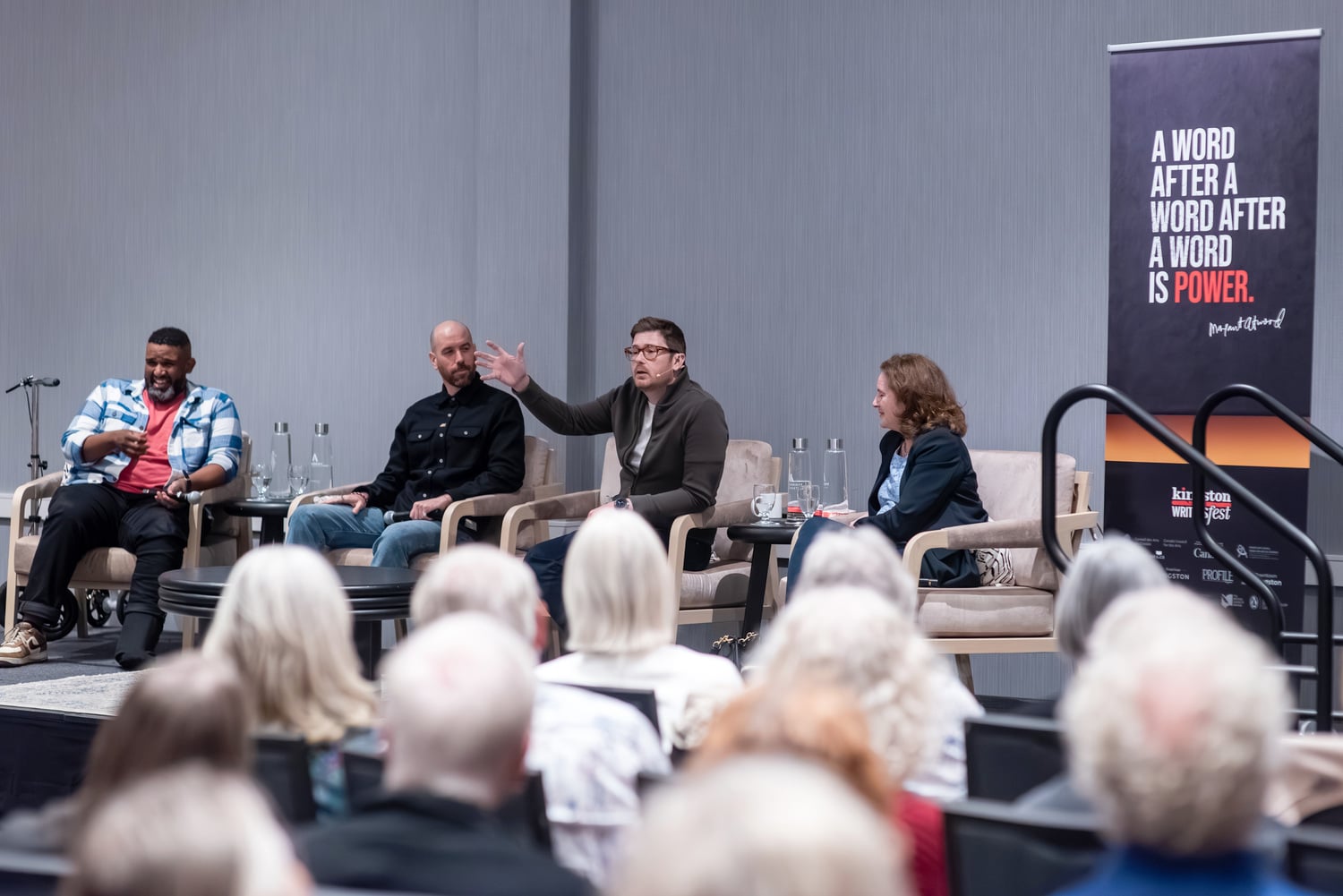

Photo courtesy Kingston WritersFest
Writers and readers alike are gathering north of the border this week.
For more than a decade, the Kingston WritersFest has brought dozens of Canada’s authors together for conversations about their work. The festival kicks off this Thursday, Oct. 1, and runs through Sunday.
This year’s line-up includes five authors who are on the shortlist for Canada’s top literary award, the Giller Prize, along with three nominees for the Hilary Weston Writers Trust Prize for Non-Fiction.
It also features opportunities for attendees to work on their own writing in masterclasses.
Catherine Wheeler caught up with the festival’s director Bruce Geddes about why the festival creates opportunities for burgeoning writers to develop their talent and make connections.
Their conversation has been edited from length and clarity.
Catherine WheelerKingston WritersFest hosts conversations and masterclasses with Canada’s top writers
BRUCE GEDDES: There’s a practical element to it. A number of the people who put out books this year are also instructors in different programs across the country. So if they’re coming here and we can take advantage of both their skills as a writing instructor and their talents as a novelist or non-fiction writer, then we should. I think that as a former workshop attendee myself, I love having the opportunity to talk to writers whose work I’ve admired and whose work I can really dig into, and so I can ask them what they were thinking when they made this or that decision or how they handled this or that problem in their books. So I think that’s also a big draw for writers to come and talk to those people.
It’s also an opportunity to meet other people who are in your position, and hopefully, meet some people who with whom you can end up exchanging manuscripts with down the road, which is really a lot of the value of these things, is meeting people who are as serious about writing as you are and are willing to lend a hand and help each other in a mutual sort of way.
CATHERINE WHEELER: It can really mean a lot to meet people who are going through the same thing you are in what can often be a personal experience.
GEDDES: Yeah, and it’s so hard to find people to seriously look at your manuscript and give you honest feedback. Your first reaction is to give it to people you know, friends of yours, but your friends will lie to you. They’ll tell you everything is great and yeah, it’s fantastic and that doesn’t really help. So you need people who are going to give you an opportunity perspective of opinion and are going to give you honest feedback and really help move your manuscript to the next stage.
WHEELER: I’m a big reader, and the conversations you get into with other readers is so fun. It’s just fun to go off and talk about books in a fun and free way.
GEDDES: Yeah, I totally agree. I don’t think there’s anything better than So, next to reading a great book, the next thing that’s just as good or even better is being able to talk about it with your friends and or with people who’ve read the book. It’s the ultimate watercooler conversation, but longer and better and more interesting. So, yeah, this is an opportunity to do that to find people who are who are at the events that you’re at because they like those authors and so you can chat with them about what they’ve read and what they liked and what they’re looking forward to.

Kingston WritersFest is based in Kingston, Ontario. Photo courtesy Kingston WritersFest
WHEELER: Are there any panels you’re excited for?
GEDDES: Well, we’re doing a couple of experiments this year. One is I’ve got a panel called “A Fan’s Life,” and it’s for a book called On Sports by David McFarlane. It’s sort of his reflection on being a fan for 70-something years and how sports weaves in and out of his life. That’s not a traditional, it’s not normally a sort of audience that we would have. So we’ll see how that goes.
Another one is, we’re doing three healthcare-related programs. Kingston has a big healthcare sector. So we’re bringing in a guy, Damian Tarnopolsky, who’s a who teaches in the narrative-based medicine lab at University of Toronto, which is sort of this idea that your patients tell stories and that if you understand the stories and understand the sort of subtext of stories as you would if you were a writer or a very careful reader, you can be you can produce better outcomes for your patients. So he’s doing a talk about narrative-based medicine and then doing a workshop and that’s open it’s directed mostly at healthcare professionals. It’s open to anybody, but it’s mostly directed at healthcare professionals. Then we’re all also doing one from an oncologist, Dr. Charles Hayter who’s doing a workshop on how to write illness. That’s for anybody, but but with a special bent towards healthcare professionals. So there’s a couple of experiments there.
We’re also doing one all in Arabic because we happen to have Jamal Saeed, who’s a phenomenal Syrian-Canadian writer. He’s in town; he lives here. So I thought we’ve got a small but growing Arabic-speaking population in Kingston, and I thought, wow, we should take advantage of the fact that Jamal’s here, and what a rare thing to have a workshop in your own language by someone who’s as accomplished in a language as anybody. So we’ll see how that goes, too.
WHEELER: All of that sounds super fun, and it’s bringing more people into the conversation, too.
GEDDES: Yeah, exactly, exactly. But I mean, I’m also excited for the big sellers, too. Helen Humphreys has a much beloved memoir called Summerland, and she’s appearing with Judith Thompson, who’s a multi-time award-winning playwright who’s written her first novel. And then some of the other some of the other bigger names are going to be really interesting to see as well.