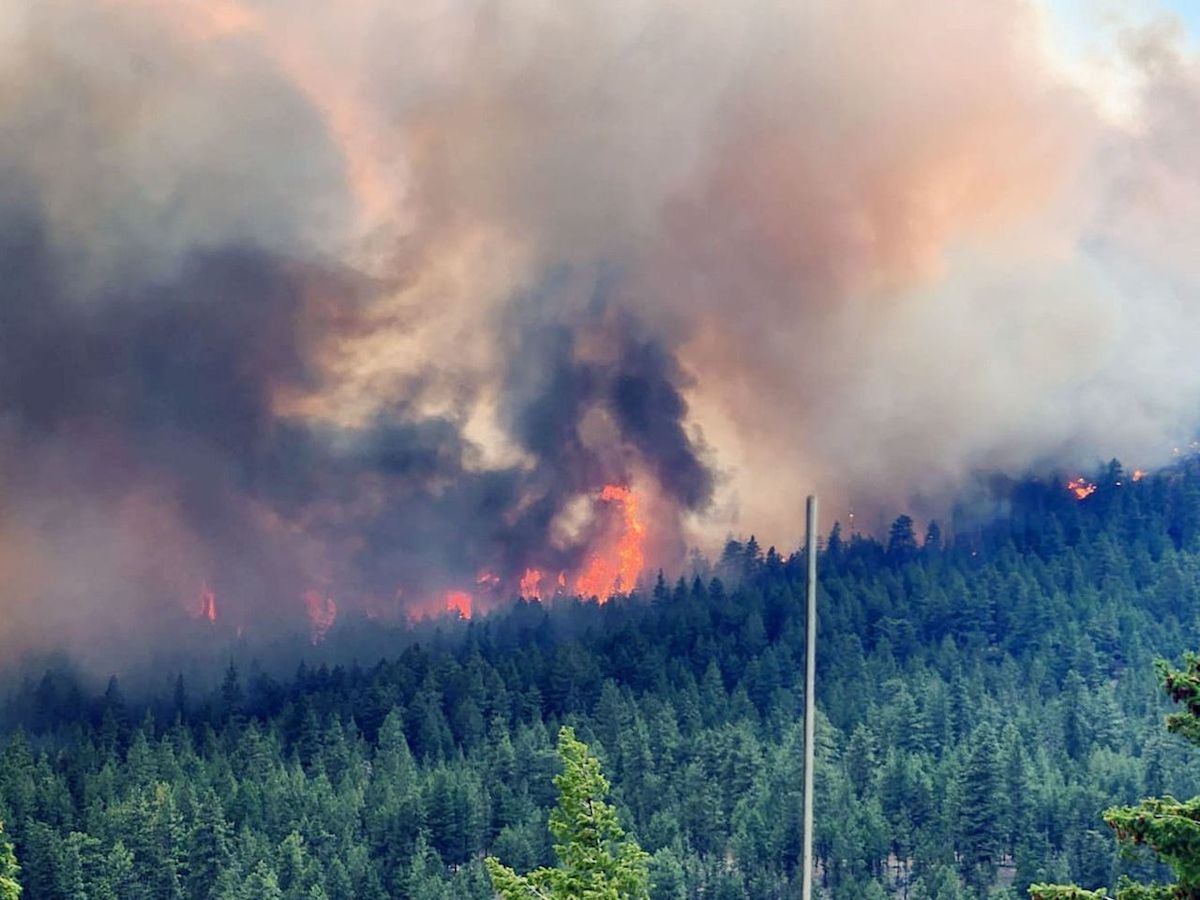
There is no safe level of wildfire smoke, warns a leading B.C. expert in the long-term health risks of particulate matter from smoke.
Stephanie Cleland, an assistant professor at Simon Fraser University’s faculty of health sciences, was responding to a global report on Wednesday that says nearly half the world’s population was exposed to “extremely high” levels of ozone pollution from wildfire smoke and heat this year.
She said the findings don’t surprise her given how far wildfire smoke can travel and how significant the health risks are even on days that don’t appear to be smoky.
“The air quality health index might classify as a low risk, but we know that health effects can still occur at those levels. Even if they can’t see or they can’t smell it, it can still pose a health risk,” she said.
Researchers are beginning to link long-term exposure to smoke to cognitive decline, dementia, respiratory and cardiovascular related mortality, she said.
The report from Copernicus Atmosphere Monitoring Service analyzed satellite data to show how extreme heat and air pollution drove up ozone pollution across the world this year, resulting in 40 per cent of the population being exposed to harmful levels of ozone.
Copernicus climate scientists gave ratings based on the daily ozone concentrations. Regions were rated good (under 60 micrograms per cubic metre), fair (60 to 80 µg/m3), moderate (80 to 90 µg/m3), poor (90 to 100 µg/m3), very poor (100 to 110 µg/m3), or extremely poor (over 110 µg/m3).
Asia, followed by Europe and North America, experienced the highest exposures.
Metro Vancouver was rated poor, while parts of the Pacific Northwest were very poor.

Source: Copernicus Atmosphere Monitoring Service
Ground-level ozone is a pollutant that results from thousands of chemical reactions triggered by sunlight and high temperatures. These reactions occur primarily between nitrogen oxides, mainly produced by the combustion of fossil fuels, and volatile organic compounds.
Mark Parrington, a senior climate scientist who worked on the Copernicus analysis, said ozone was already an issue during heat waves but now there are added emissions from climate-fuelled mega wildfires.
He says tmajor industrial cities like Vancouver and Toronto increasingly have poorer air quality, especially during the summer, when fine particulate matter and ozone from wildfire smoke is added to already high levels of ozone from industry, solvents and road traffic.
“When you have fires, they get a lot of organic compounds, nitrogen oxides, particulate matter, a wide range of things … and this is one of the main causes of degraded air quality when we have smoke creeping into urban areas,” he said. “Ozone is a secondary pollutant. It’s produced chemically with sunlight, nitrogen oxide and volatile organic compounds.”
Only five per cent of the global population was exposed to good levels of ozone and only 15 per cent to fair levels, according to the analysis.
According to Copernicus, about 60 per cent of Asia’s population was exposed to extremely poor ozone levels in 2026, rising to 90 per cent when populations exposed to poor and very poor levels were included.
“It’s scary,” said Cleland, who says there needs to be a better understanding of long-term risks of breathing in these toxic particles and chemicals.
“Many people are being exposed to that long-range transport smoke … and once it gets into urban centres, millions of people are exposed.”
She thinks people should check air quality reports, just as they check the weather, before planning outdoor activities.
“A lot of the research has looked at short-term exposure to wildfire smoke,” she said. “But we’re also starting to learn that wildfire smoke can affect our brains. So there’s research showing that it affects cognitive performance, it affects people’s mental health.”
Ozone exceeded air quality alert standards several times and in several U.S. states this summer, said Parrington, and that ozone drifted into Vancouver.
“If it gets up into the troposphere, it can then be transported long distances, and then if it heats up, then it releases nitrogen oxides again, which can have an impact on organic photochemistry thousands of kilometres away from where the fires are burning.”
Some parts of Europe, which had catastrophic wildfires this summer to the west of Madrid and in the southwest of France, had “extremely poor” ratings.
“The fires in Europe were more extreme but the fires in Canada, they burn at a much larger scale for a longer period of time,” said Parrington.
During June, fire activity started to increase rapidly in Canada and the Western U.S. In July, during the World Cup, the massive wildfires burning in the Northwest Territories and Ontario caused a blanket of smoke to spread across Canada and the Northern U.S. to the Atlantic, prompting air quality advisories in many cities.
Conditions improved with several storms helping to clean the air but it raises the question of whether athletes should be playing outdoors, given, as Cleland says, there really is no safe level of wildfire smoke.
Parrington said the data highlights the need for global action on air quality and human-caused climate change because of the cross-border nature of pollution.
Related