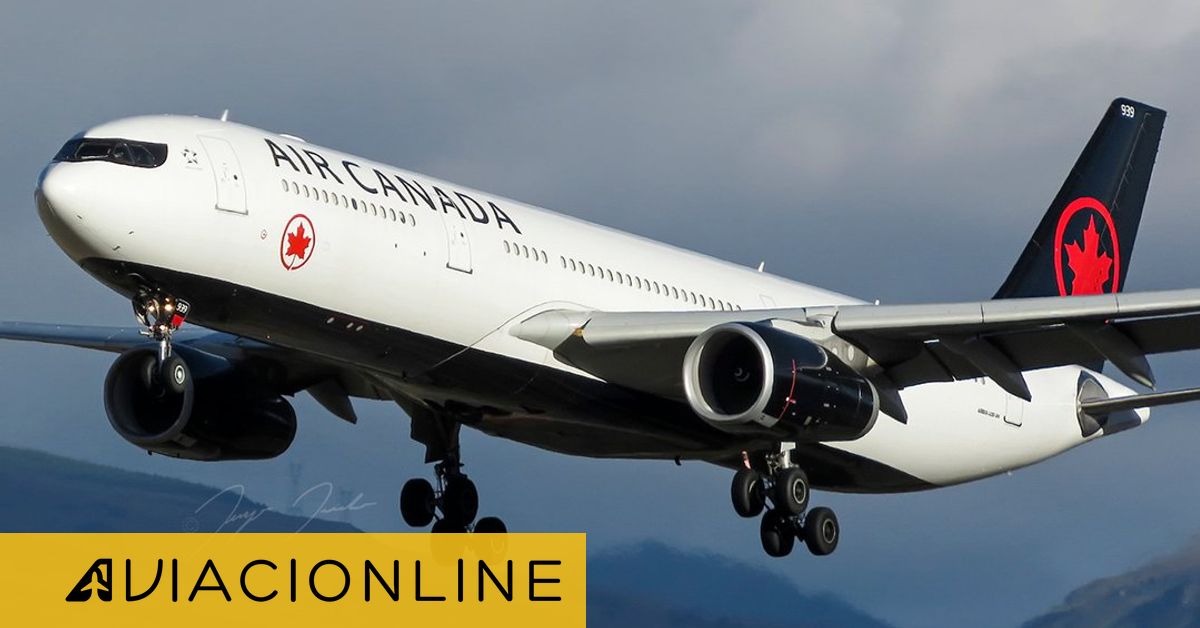
Air Canada held an event in Quito to formalize the return of its passenger services to the Ecuadorian market, interrupted since 2019-2020. The Canadian carrier will reconnect Mariscal Sucre International Airport (UIO) with Montreal (YUL) starting December 4, 2026 and with Toronto (YYZ) from December 5, reinforcing Ecuador’s direct connectivity with North America.
No other airline currently offers nonstop flights between Canada and Ecuador. Bilateral traffic stood at around 62,000 passengers in both directions in the 12 months through June 2025, with Toronto–Quito as the most relevant city pair.
Credit: Diogo da Conceição
Schedule and capacity
The operation will be seasonal and will essentially run until the end of March 2027 (some local reports mention residual flights to Montreal in early April). In total there will be four weekly frequencies: three from Montreal and one from Toronto, with more than 2,100 weekly seats to the Ecuadorian capital.
When will Air Canada resume flights to Quito?
Air Canada will connect Quito from Montreal starting December 4 and from Toronto starting December 5, 2026.
What type of aircraft will Air Canada operate to Quito?
It will operate Boeing 787 Dreamliners equipped with Signature Class, Premium Economy and Economy cabins.
How many weekly frequencies will Air Canada have to Quito?
It will have four weekly flights: three from Montreal and one from Toronto, with more than 2,100 weekly seats.
How long will Air Canada’s seasonal flights to Quito run?
Both connections run until late March.
What was Air Canada’s last operation in Ecuador?
It was in 2019, with Boeing 767 aircraft from its Rouge subsidiary.
What other South American destinations is Air Canada consolidating?
Air Canada confirms the return of seasonal flights to Santiago de Chile, will operate Montreal–Lima year-round, will resume Toronto–Rio de Janeiro, will add frequencies between Toronto and Bogotá, and complements its offering with flights to Buenos Aires, Cartagena and São Paulo-Guarulhos.
Published schedules:FlightRouteDepartureArrivalDaysSeasonAC962Montreal–Quito17:4000:10+1Wed, Fri, SunDec 4, 2026 – Mar 26, 2027AC963Quito–Montreal09:0015:15Mon, Thu, SatDec 5, 2026 – Mar 27, 2027AC960Toronto–Quito17:5500:10+1SatDec 5, 2026 – Mar 20, 2027AC961Quito–Toronto09:0015:10SunDec 6, 2026 – Mar 21, 2027
The flights are on sale through aircanada.com, GDS, agencies and the airline’s sales office in Quito. Promotional round-trip Economy fares have been published from around USD 470 plus taxes on the basic fare, with a carry-on bag included.
Onboard product: 787 with three cabins
Unlike the previous chapter, when Air Canada Rouge operated Boeing 767s to Quito between December 2019 and the pandemic suspension in March 2020, this time the operation joins the mainline network. The services will be flown with Boeing 787 Dreamliners configured with Signature Class, Premium Economy and Economy. Local sources specify 787-8s on Montreal–Quito and 787-9s on Toronto–Quito; the most widely cited reference capacity is 255 seats.
Quiport stressed that the return is the result of years of negotiations with the airline and that the new Montreal–Quito route, together with the reinstatement of Toronto–Quito, expands Mariscal Sucre’s nonstop network. Air Canada Cargo, meanwhile, already links Quito with Miami and Toronto.
Mark Galardo, EVP, CCO and President of Cargo at Air Canada, framed Quito as “a strategic addition” for tourism, trade and connectivity, with connections at the Toronto and Montreal hubs to Canada, the United States, Europe and Asia-Pacific. Alfredo Babun, regional commercial manager for Chile, Peru and Ecuador, said the airline is targeting load factors above 90%, combining Canadian winter tourism, VFR and connecting traffic.
Part of a South American push
The return to Ecuador is part of the New Frontiers strategy and of a more aggressive 2026-27 winter in South America:
resumption of seasonal flights to Santiago from Toronto and Montreal;year-round service between Montreal and Lima, with an earlier season start and more frequencies;seasonal return of Toronto–Rio de Janeiro, also moved forward;additional frequencies on Toronto/Montreal–Bogotá;complementary network to Buenos Aires, Cartagena and São Paulo-Guarulhos.
Air Canada Vacations, in addition, has put together a guided tour program to Ecuador (Andes, Amazon, coast and Galápagos) aligned with the new nonstop frequencies.
For Quito, the operational message is clear: it regains a three-cabin widebody bridge to two of Canada’s main hubs in the highest-demand window of the northern winter, and once again has a nonstop option to North America after seven years.