
For the past year, The Globe and Mail’s environmental policy columnist Adam Radwanski has also been warning that Carney is squandering his green creds. The 2025 federal budget, Radwanski declared, “makes good on expectations” that the prime minister “is deprioritizing climate targets.” Among activist organizations the language is much sharper. The DeSmog website, for example, decries Carney’s “Climate Betrayal” and lists infidelities including that he has “fast-tracked oil and gas expansion while rolling back key environmental laws.” The most vivid demonstration of this general disgruntlement has been the resignation of Steven Guilbeault – a man openly contemptuous of Alberta and its key industry, who as Minister of Environment and Climate Change had been Trudeau’s most forceful climate warrior – first from the Liberal caucus in May and then as an MP on September 1.
At the same time, Carney has won public gratitude and/or respect from a long list of conservative voices. The Macdonald-Laurier Institute’s Heather Exner-Pirot recently described Carney as a champion of the resource sector. The debating duo of Rudyard Griffiths, co-founder of the Dominion Institute, and Sean Speer, once a policy advisor in former Conservative Prime Minister Stephen Harper’s office, promoted a recent podcast by wondering if Carney has changed his political stripes entirely to become “genuinely conservative”.
Even Alberta Premier Danielle Smith and Harper himself have given Carney kudos. For some optimists, the case is actually closed. “I think we’ve seen enough that we need to stop collectively questioning [the] government’s bona fides at this point. There’s full commitment there,” gushed Kendall Dilling, president of the Pathways Alliance, just last Friday. Pathways is the massive carbon capture and storage project that Alberta has promised Carney to indirectly “decarbonize” the heavy oil that would be shipped through any new West Coast export pipeline.
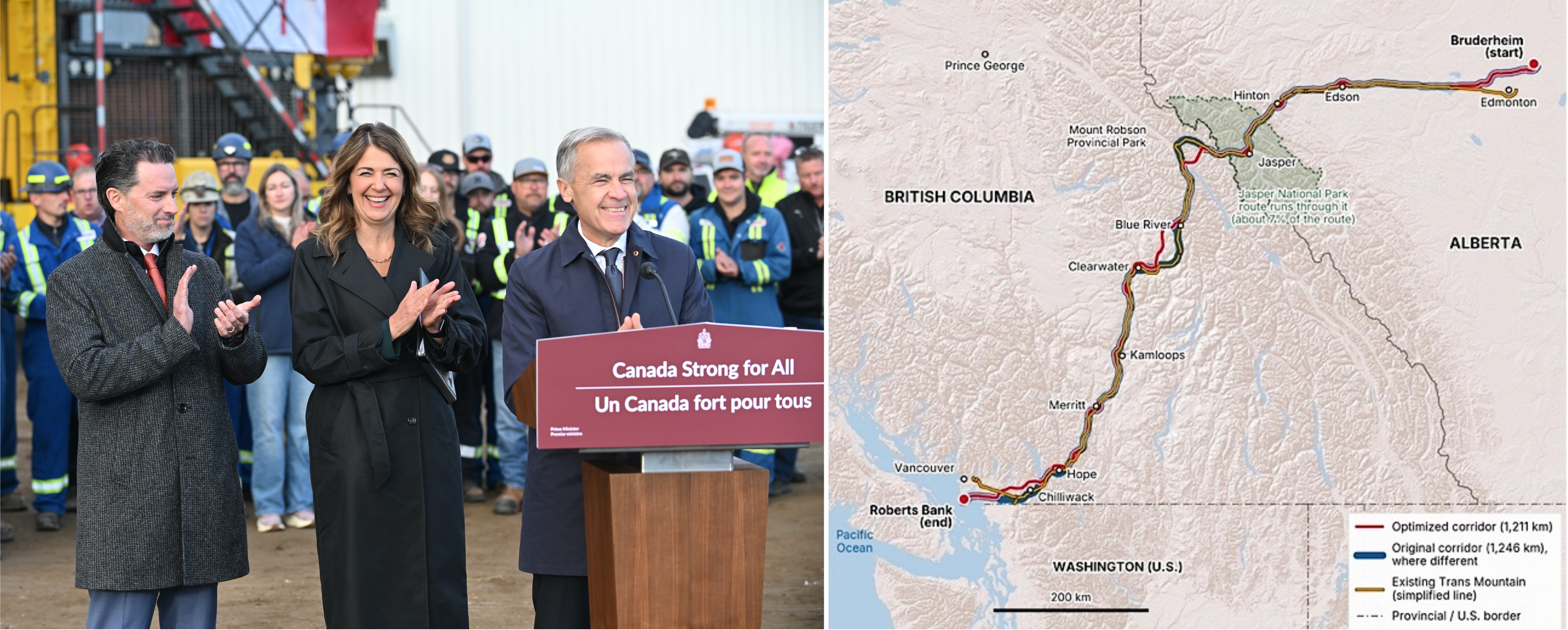 xNumerous conservative figures, including Alberta Premier Danielle Smith, have praised the “New Carney” for his endorsement of major energy projects. Shown at left, Smith (centre) and Carney (right) announcing the Pacific Link oil pipeline in Fort McMurray, Alberta, October 2026; at right, map of the proposed project. (Sources: (photo) The Canadian Press/Greg Halinda; (map) Government of Alberta)
In place of Trudeau’s fixation on fighting climate change via suffocating government taxes, mandates and rules, “New Carney” has supposedly prioritized maximizing Canada’s economic potential by slashing regulations and red tape, refocusing Ottawa’s priorities and unleashing the power of capital markets. He even talks about making Canada an “energy superpower”, a term popularized by Harper that refers almost entirely to oil and natural gas.
If this is truly the case, then Carney has pulled off an improbable 180-degree pivot by abandoning his own personal commitments – expressed repeatedly and earnestly since 2015 – about the necessity of a net-zero future and the need to constrain business, destroy entire industries and reorient society to achieve it.
So which version is the real Carney?
Canada’s European Vacation
For all the hype, Carney’s recent moves need to be considered from a broader perspective. Consider, for example, that the Building Canada Strong Act does not abandon dirigiste economic management in favour of an unfettered market. Rather, it installs Ottawa and its bureaucrats in the central decision-making position, layering further laws and bureaucracy on top of the existing mountain. Only projects deemed to be in the “national interest” can be considered for fast-track approval. Market forces do not determine what gets built and what doesn’t; political considerations still reign supreme.
This is starkly illustrated in the recent announcement that Alberta will at last get its long-sought additional crude oil pipeline to the West Coast. Everything about the “Pacific Link” project is political: the previous 18 months of regulatory horse-trading between Smith and Carney and their respective ministers and bureaucrats, the announcement’s timing just before Alberta’s October 19 referendum, the conditions under which the pipeline will be built, the multi-billion-dollar “equity interest” being handed to Indigenous groups, and even the source of the required $35 billion in capital itself, at least 90 percent of which will come from federal and provincial taxpayers.
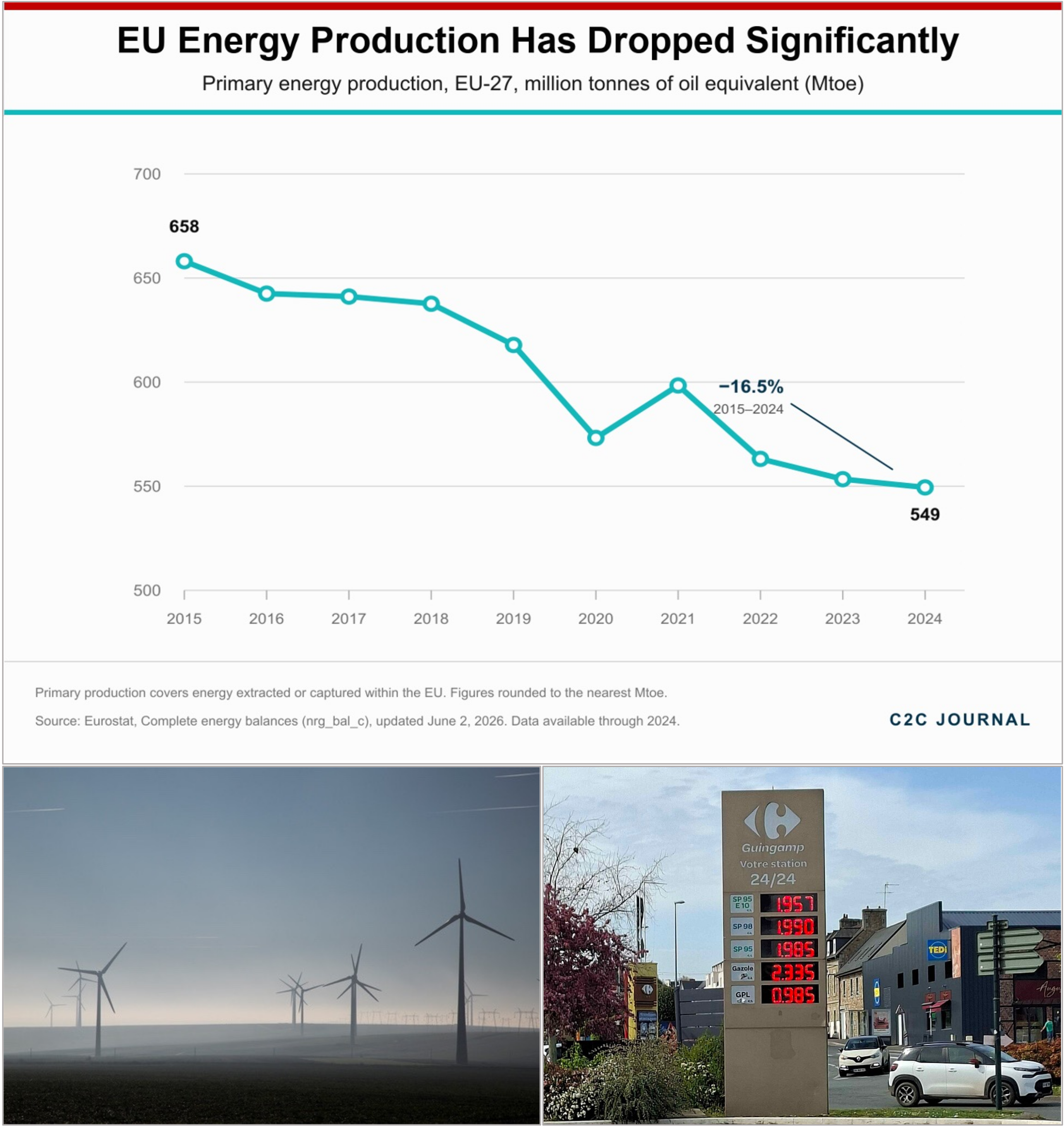 xMighty no more: The European Union’s economic decline is closely tied to its aggressive policies on climate change and falling energy production. At bottom right, gas station in Grâces, Brittany, France, displaying fuel prices starting at Can$3.11 per litre, April 2026. (Source of bottom left photo: World Bank Photo Collection, licensed under CC BY-NC-ND 2.0)
Consider also Carney’s recent French kiss with Europe. At his rapturously received speech in January at the World Economic Forum in Davos, Switzerland, he sketched out a new world order populated by resurgent middle powers, mostly the once-mighty nations of Europe. But the reason countries such as France, Germany and the UK no long count as major economic powers is mostly self-inflicted. Alongside castles and cathedrals, today Europe is best known for its high energy costs driven by aggressive net-zero policies, the intermittency of wind and solar power, heavy regulations and carbon “pricing”. Together this policy package has delivered accelerating deindustrialization.