
On Tuesday, World Athletics released the qualification system for the Los Angeles 2028 Olympic Games, which will take place July 15-30, 2028. There are two main ways athletes qualify for the Olympics: achieving an entry standard (a specified time or mark in their event) or through world rankings (based on points athletes earn by competing and performing well at eligible competitions).
Historically, the balance between these two pathways has been 50/50. For LA28, however, World Athletics is putting more emphasis on rankings, with an expected 60 per cent of athletes qualifying through that route and 40 per cent through entry standards.
 Evan Dunfee wins gold in the 35 km race walk at the 2025 World Athletics Championships in Tokyo. Photo: Nick Iwanyshyn
What do the changes mean for athletes?
Athletes who consistently perform well against strong international competition could, in theory, qualify without ever achieving the official Olympic standard. Rather than relying on one fast performance, athletes will have another route to earning a place on the Olympic start line.
According to Canadian Olympian Rory Linkletter, the changes don’t offer any clear advantage or disadvantage, but they could make athletes more vulnerable to setbacks during the qualification period.
“The only thing that’s frustrating, from an athlete’s perspective, is that this makes getting injured or not getting into the right races or not having the right opportunity a little bit more volatile,” he told Canadian Running. “What I mean by that is we have less margin for error when the standards are this out of reach.”
Canadian Olympic race walker Evan Dunfee also sees both sides of the change. However, he believes the increased emphasis on rankings could create more opportunities for Canadian athletes to qualify without having to travel overseas to chase points.
 Canada’s Brendon Rodney after Team Canada takes gold in the men’s 4×100 relay final Paris 2024 Olympics. Photo: Nick Iwanyshyn
More opportunities to qualify at home
Canadian athletes have often travelled to Europe and the U.S. to find races where they can run fast times or earn valuable ranking points. But Dunfee says the new system could make domestic competitions more important, particularly for athletes who don’t have the financial resources or connections to access international meets. He points to the 2027 NACAC Championships and Pan American Games as two major opportunities. Both will offer valuable ranking points, and athletes selected to represent Canada will have access to fully funded national teams.
“That doesn’t matter who your agent is, if you make Team Canada you can go and compete there,” Dunfee told Canadian Running. “So in a way, I think that helps the athlete who doesn’t necessarily have the resources to chase fast races or big meets abroad, provided they can make the team.”
 Canada’s Jazz Shukla in the qualifying round of the 800m at the Paris 2024 Olympic Games. Photo: Kevin Morris
How accessible is the new system?
The shift toward world rankings could create more opportunities for athletes who struggle to achieve increasingly demanding Olympic entry standards. But earning ranking points isn’t necessarily easy or inexpensive.
Athletes earn points based on their performances and finishing positions at eligible competitions, with higher-level meets generally offering greater opportunities to accumulate points. This means athletes with the financial backing to travel internationally and access competitive fields may have an advantage over those with fewer opportunities.
Dunfee acknowledges that European athletes have more opportunities to compete in high-level meets, but he believes Canadian athletes are in a better position than is sometimes suggested. Canada has a relatively strong domestic competition circuit, including several Silver and Bronze Label events.
Dunfee points to Canadian middle-distance runner Zoe Sherar, who qualified for the 2025 World Athletics Championships through competitions in Canada.
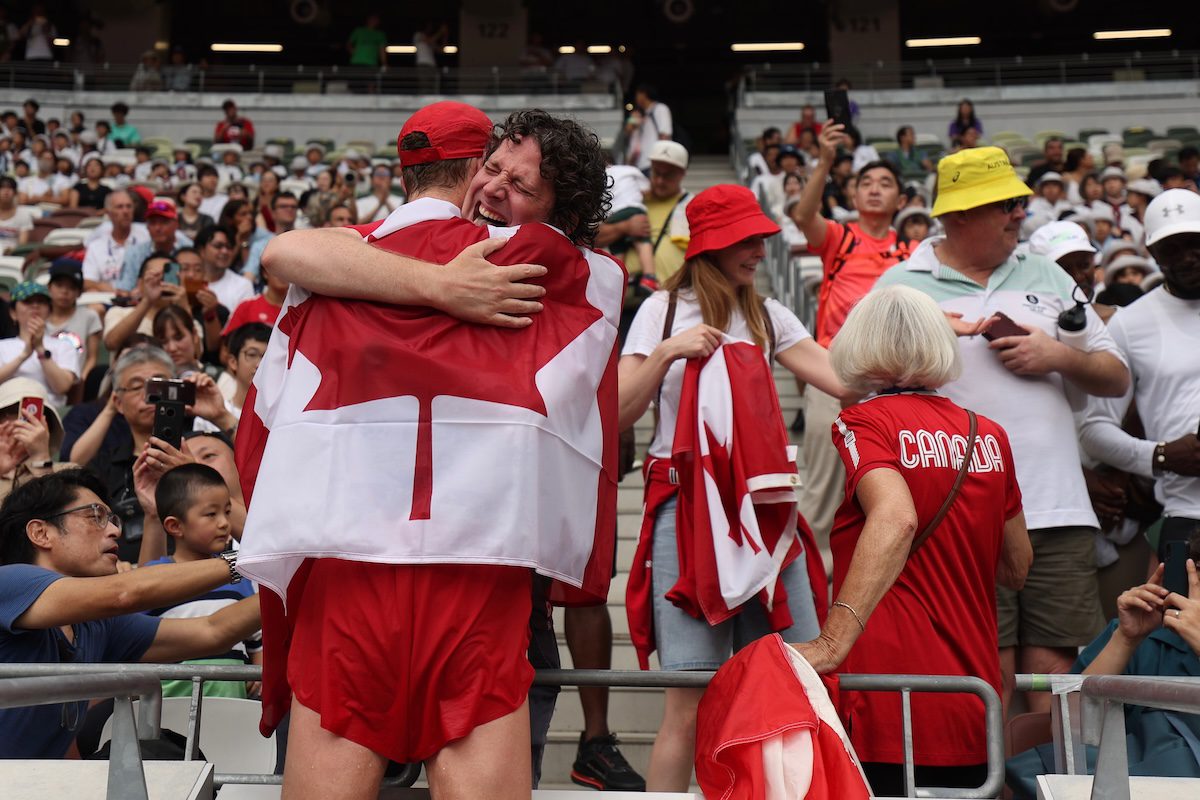 Evan Dunfee wins gold in the 35 km race walk at the 2025 World Athletics Championships in Tokyo. Photo: Nick Iwanyshyn
How to improve the system
While Dunfee sees potential benefits for Canadian athletes, he believes the qualification system still has a fundamental fairness problem: access to competitions is often determined by agents and meet directors rather than an athlete’s ability.
An athlete with sponsorship and a well-connected agent may have a much easier time getting into high-level competitions, where they can earn valuable ranking points. Meanwhile, an athlete with comparable performances, but fewer connections may struggle to get the same opportunities.
Dunfee suggests a model similar to professional tennis, where an athlete’s ranking determines which level of competition they can enter. “I think generally moving in the direction where you actively try to move up through the ranks to get into bigger meets would be a good move away from the agents/meet directors holding an incongruent amount of power over who gets to compete and therefore pick up points,” he said.
 Photo: Nick Iwanyshyn
What happens if too many athletes achieve the standard?
If more athletes achieve the LA28 standard than there are available places in an event, only those who meet the applicable qualification criteria and are highest in the rankings will secure spots.
For the marathon, the men’s entry standard is 2:05:00, while the women’s is 2:22:20. Both are much faster than the standards for the Paris 2024 Olympics: the men’s standard was 2:08:10 and the women’s was 2:26:50.
For LA28, the marathon field size has also been reduced from 80 to 70 athletes, a change that follows a consistent pattern of slowly reducing the number of participants in the event over time.
Linkletter said it doesn’t make sense to continue cutting down the field when it makes little practical difference in the execution of the race. “The Olympic marathon is one of the iconic events—it’s how they close the Olympics every cycle and is one of the oldest, most historic, true Olympic spirit events,” he said. “Obviously I’m biased in that regard, but I do feel like we get punished because we have a versatile sport that has a lot of athletes.”
When does Olympic qualifying begin?
Marathon runners will be the first to begin their qualifying campaigns, with the window having opened Nov. 1, 2026, and closing April 30, 2028. For the 10,000m, race walks, combined events and relays, the qualification period runs from Dec. 19, 2026, to June 18, 2028. All other track and field events will have a window from June 19, 2027, to June 18, 2028.
The marathon also has a special qualification provision: the first five finishers at any Platinum Label marathon during the qualification period will be considered to have achieved the Olympic entry standard. Los Angeles will feature 23 events for men and 23 for women.