Why are centrist dads so obsessed with getting closer to the European Union? Not only is Andy Burnham at it, but even Canada, which lies thousands of miles from the Continent, is having a go.
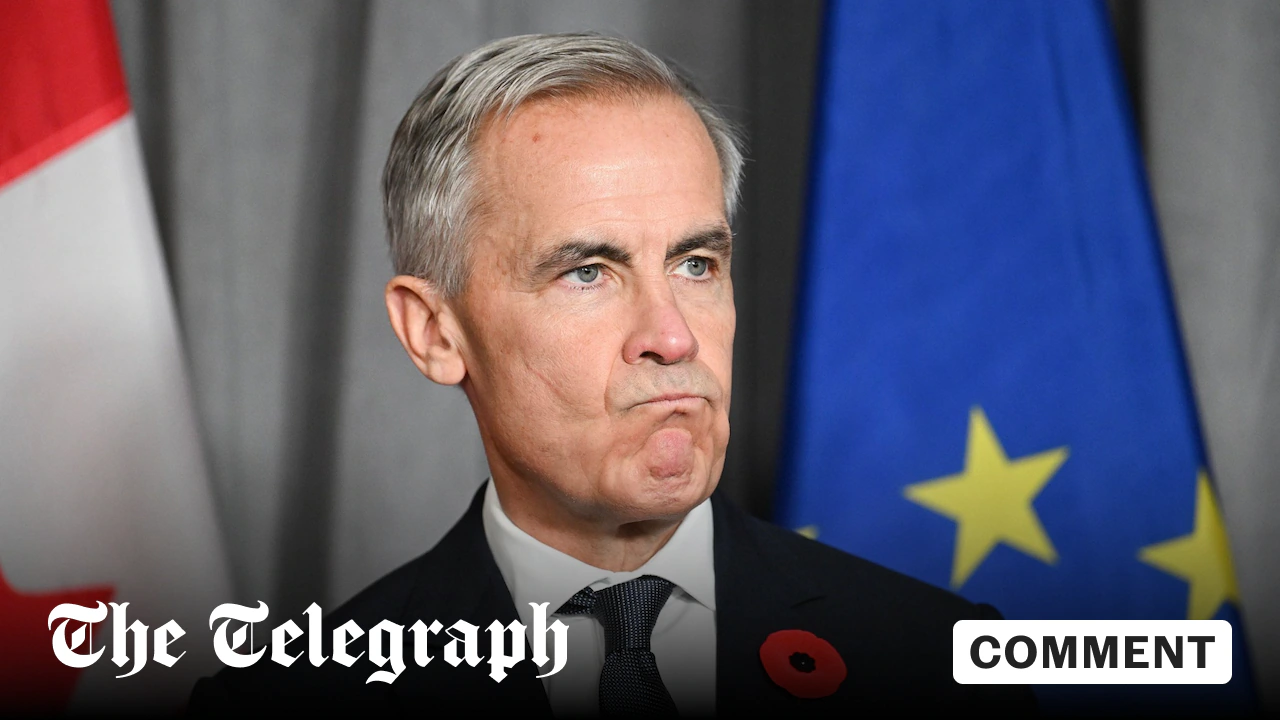
Last week, its prime minister, Mark Carney – denizen of Davos, erstwhile central bank governor and champion of centrist daddyness everywhere – confirmed Ottawa’s interest in becoming an “associate member”. It was like the death rattle of a doomed elite.
Firstly, nobody seemed to know what it meant. There is no basis for the move in EU treaties, no precedent, and no established means of ratification. Beyond the rhetoric – Carney described it as “the deepest possible partnership short of accession”, while the official declaration, quite hilariously, called it “ever-closer association” – the details remained shrouded in mystery.
Secondly, nobody seemed to know what benefits it would offer. This year, Canada and the Eurozone are forecast to grow by around 1 per cent, and Britain by about the same.
So it is hard to see any economic advantage to this grand projet. By contrast, India is forecast to grow by 7 per cent, China by 4.5 per cent and Israel – which we now sanction – at more than three times the pace of Britain. It’s like seeing drowning centrist dads cling together as they drop under the waves of reality.
But this is less about economics than geopolitics. At Davos in January, Carney described the world disorder of Donald Trump as “a rupture, not a transition” arguing that “middle powers must act together, because if we’re not at the table, we’re on the menu”. In Strasbourg last month, he protested – a little too much – that he was “not proposing a third bloc”, but there was no disguising his ambition to be king of the world (or at least chief executive of it).
These people have rarely been more delusional. After decades of luxury democracy, soaring tax-and-spend, welfarism, net zero, virtue signalling, the neglect of defence, multiculturalism, globalism, social engineering, mass immigration, Palestinianism, the mutilation of industry and the policing of manners, the old elites are a busted flush. The milk has been past its sell-by date for a long time; Trump has just broken the bottle.
It’s not that Carney and the crew is wrong in their analysis. This period will be become notorious for the spectacular vandalism wreaked upon the world by the orange berserker in the White House.
But how is centrist daddyism the answer? After all, that’s what got us into this mess in the first place. On paper, a Plan B alliance is imperative, but the middle powers remain heavily dependent on the United States for their security, from intelligence cooperation and air defences to the nuclear umbrella that has been the bedrock of pax Americana for eight decades.
Four years of war in Ukraine have exposed our limits. Like France, Germany and others, Canada only recently got its act together to meet Nato’s former requirement of spending 2 per cent of GDP on defence, after years of shameless freeloading (the bar has since been raised further). That isn’t easily fixed.
To put this in perspective, the last time the world was this dangerous, between 1969 and 1988, we were spending between 4 and 5 per cent, and we didn’t have any building-back to do.
Clearly, a challenge of this magnitude will not be solved by more summit communiqués from the luxury classes. What the West needs is structural, cultural and spiritual restoration, and these ain’t the men for the job.
Deliciously, Europe is sliding hard in the wrong direction. When Carney’s Canada finally unveils his “associate EU membership” next June, he will likely find that once again, history has outstripped him.
The French go to the polls in the spring, and the frontrunner is Marine Le Pen, the populist nationalist with a track record of fondness for Russia. As Germany rapidly rearms, meanwhile, the openly Putinophile Alternative für Deutschland recently achieved its best election result in Saxony-Anhalt, and is now well ahead of Friedrich Merz’s Christian Democrats nationally.