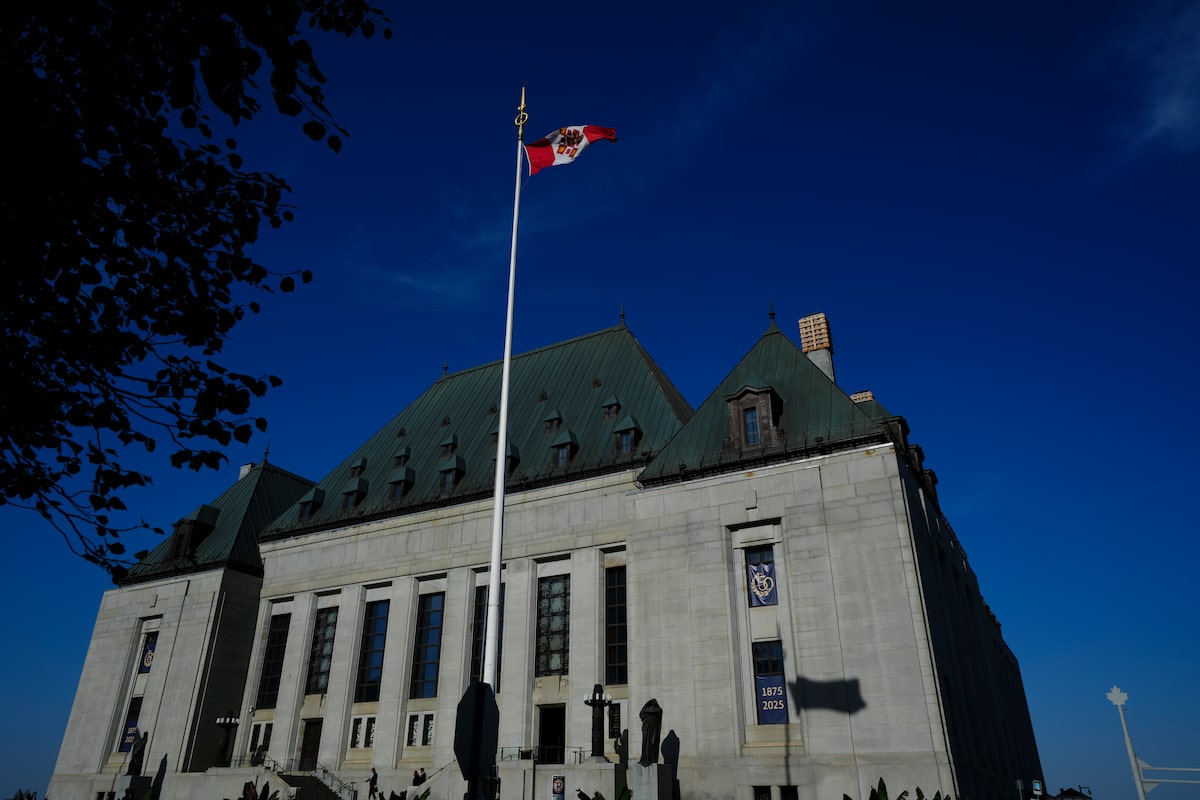
The Supreme Court of Canada flag flies outside the courthouse in Ottawa. In 1990, the judicial body proclaimed that the U.S. Constitution is the “great constitutional exemplar.”Sean Kilpatrick/The Canadian Press
Joel Bakan is a professor of law at the University of British Columbia and the author of Just Rights: The Canadian Charter in Troubled Times.
In 1998, our Supreme Court ruled that “commitment to social justice and equality” is an unwritten principle of Canada’s Constitution. That principle, typically understood to call for repair, or at least mitigation, of society’s historical and structural injustices and inequalities, demands that governments take measures to protect vulnerable groups, establish social safety nets and provide essential services such as health care, education and public safety.
Yet Canada’s courts have rejected arguments that the Charter demands governments take protective action, having ruled against Charter claims to social assistance, housing support, health care, climate mitigation and bicycle lanes, among other things. Such claims defy the “archetypical feature” of constitutional rights, courts say – namely, that those rights are designed to stop governments from acting oppressively (a “negative” conception of rights), not to demand governments act protectively (a “positive” conception).
That judicial stance can be traced, at least in part, to the influence of U.S. constitutional law on Canadian courts, most clearly manifest in the Supreme Court’s 1990 proclamation that the U.S. Constitution is the “great constitutional exemplar,” teaching us, here in Canada, that “government requires to be constitutionally shackled to preserve the rights of the individual.”
Opinion: The question on bike lanes shouldn’t be about constitutional rights but if they save lives
If “shackling” government is the essence of Charter rights, then the idea that rights might demand governments to take action (that is, they can be positive rather than negative) is logically eliminated.
But that logic only begs a larger question: Why should we, in Canada, be guided by how rights are understood in the United States?
“Canadians have a somewhat different attitude towards government and its role from our U.S. neighbours,” then-Supreme Court justice Bertha Wilson wrote in dissenting with the “great constitutional exemplar” notion. Here, she said, government “has an important role to play in the creation and preservation of a just Canadian society….[and is not] regarded as a monolith of oppression but rather as having a beneficent and protective role to play.”
By rejecting positive rights, Canadian courts have imprinted a U.S. conception of rights upon the Charter, and in so doing, foreclosed an important pathway for pursuing social justice and equality – a constitutional principle that distinguishes Canada from America. Our courts would do well to find other “constitutional exemplars” more closely aligned with Canada’s values and its traditions of protective government.
European countries are obvious candidates, where courts routinely recognize and enforce positive constitutional rights, as they similarly do in numerous Latin American and Asian countries. As well, our own Supreme Court has affirmed that Charter equality rights can “impose affirmative duties on the government to take positive action,” albeit in limited circumstances. The Charter itself also includes positive rights – for instance, democratic rights and legal and trial protections – meaning that, as former Supreme Court justice and current Governor-General Louise Arbour has observed, “any claim that only negative rights are constitutionally recognized is … patently defective.”
In short, recognizing positive rights would not be a huge leap for Canadian courts. It is possible, and indeed constitutionally called for.
As well, such recognition would align with Canada’s international obligations, which include positive rights to health care, housing, an adequate standard of living and education, among others, as per the International Covenant on Economic, Social and Cultural Rights. The Supreme Court has ruled that courts must consider Canada’s international obligations when adjudicating relevant Charter rights – yet the impact of the Covenant’s positive rights awaits consideration by courts.
The Editorial Board: Memo to the PQ: The Constitution is not a menu
Admittedly, the fact that positive Charter rights are possible and constitutionally called for does not mean their adjudication would be simple. Because such rights demand that governments spend and reallocate public monies, their enforcement risks encroaching on legislative, policy and budgetary decisions, and therefore on governments’ democratic mandates. That is not, however, a good reason to bar positive rights entirely. Experience from other countries – and indeed our own Supreme Court, when adjudicating the Charter’s positive right to minority language education – demonstrates judicial capacity to manage potential risks of positive rights with proper regard for governments’ and legislatures’ democratic jurisdictions.
In 2002, the Supreme Court rejected that the Charter’s Section 7 right to security of the person required the Quebec government to provide social assistance benefits. Positive rights had no place in Section 7 law, then-chief justice Beverley McLachlin reasoned. But “one day,” she said, Charter rights might “be interpreted to include positive obligations.”
Now would be a good time for that to happen, especially as democratic backsliding and rising illiberalism around the world – including in our “great constitutional exemplar” – place the commitment to social justice and equality at risk of government neglect and attack.