
Spotting a rare or little-known species sounds like something reserved for scientists. I am not a scientist. But after spotting kahukura red admiral in my front garden in the middle of Auckland, I became curious about our insect life.
There are around 2000 moth and butterfly species in New Zealand and 90% of them are endemic. Our butterflies, I quickly learned, are already well-researched and understood in comparison to our moths. Who, it turns out, are not just drab and dusty but incredibly varied in colour and form. We have lichen mimics that look like mint chocolate chip ice cream. A lime-green species said to bring messages from the spirit realm. A cherry red moth that flies during the day.
Moths offer unlimited mystery. Many of them have never been studied. “You could feasibly start looking at some species here and make a completely novel observation about them pretty quickly,” Leilani Walker, curator of entomology at Auckland Museum, told me while I was doing research for my new book Butterflies and Moths of Aotearoa.
Some of our moths, like a bog-specialist named after Harry Houdini, are extremely elusive. One Titanomis species had not been seen for 65 years. In 2024, however, a Swedish tourist snapped a pic of a pretty moth outside the sole pub on Rakiura Stewart Island and uploaded it to iNaturalist. Local lepidopterists were soon aflurry and in time determined it was Titanomis, risen from the ashes of presumed-extinction. To celebrate, they gave it a new name, Frosted Phoenix.
With these sentiments and stories in mind, I bought a head torch, a UV light from TradeMe and dug an old bedsheet out from the back of the cupboard. This super scientific set-up is known as “THE BUG SHEET.” And for the nature curious, it provides some of the cheapest and best fun around. You simply throw the sheet over the washing line at dusk, shine the UV light on it, and return throughout the evening to see what nocturnal beauties fly in. The best nights for it are moonless, warm and still.
Last year I won a writers residency at the Surrey Hotel. In October, I took the BUG SHEET set-up with me to the Surrey in Grey Lynn. It was Halloween. As little ghosts and their mums took to the streets, I set up THE BUG SHEET. It was a balmy evening with a light wind. Only a single specimen came by but what a specimen. Her all-white wings and body were completely pearlescent. Shades of pink, yellow, green, and purple rippled off her wings as the angle of my headtorch changed, like the colours that appear on the surface of a bubble. The leading edge of each wing was covered in gold leaf. She was stunning, almost bridal.
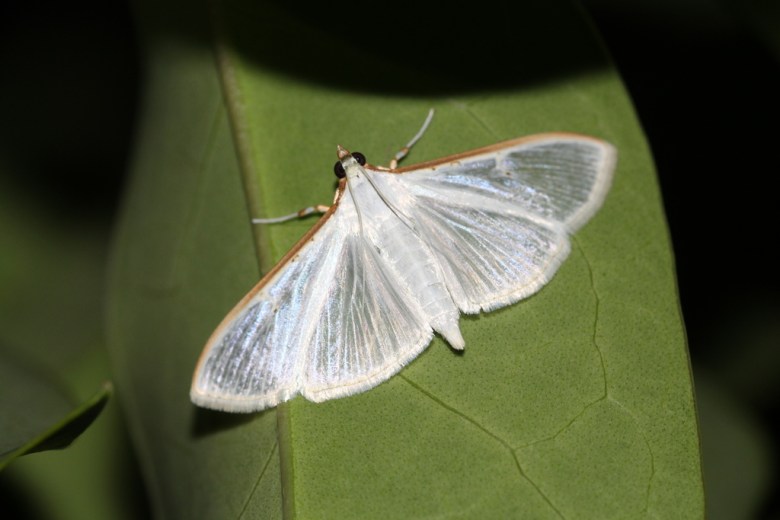 The jasmine moth, beautiful guest at the Surrey. Photo: Yannick Juvé
I raced back into my Surrey suite, grabbed some ID books and tried to figure out her name, but failed. Delicately, I trapped her under a wine glass and brought her inside. In the morning, with some online iNaturalist sleuthing, her identity became clear – Jasmine Moth or Palpita vitrealis. There were only about 20 observations on iNaturalist NZ at that stage.
The Jasmine moth only recently arrived in New Zealand. The first recorded observation was on a farm in Leigh in 2022. These moths likely arrived via wind currents from Eastern Australian or New Caledonia. Astounding for such a small creature, but a reminder that we aren’t the only animals criss-crossing the globe. New Zealand monarchs arrived in much the same way, having migrated from North America to Hawaiʻi and then island-hopped their way across the Pacific before settling out here in the 1870s.
Nature sometimes feels far away, like something you need a long weekend to access. But THE BUG SHEET has beckoned over 20 species in a single night to my garden, and 25% of all known butterfly and moth species have actually been observed in our biggest city. Animalness is all around us. We just need a moment to notice it.
Butterflies and Moths of Aotearoa by Liv Sisson (Penguin, $50) is available in bookstores nationwide.
