
Some public art is launched with great fanfare at prime locations. Others you have to discover because they are in such obscure locales.
Such is the case with Greg Snider’s Project For A Public Works Yard, which is located at the northwest corner of National and Chess streets on the False Creek flats, next door to a city works yard, a city gas station, and a fire training facility.
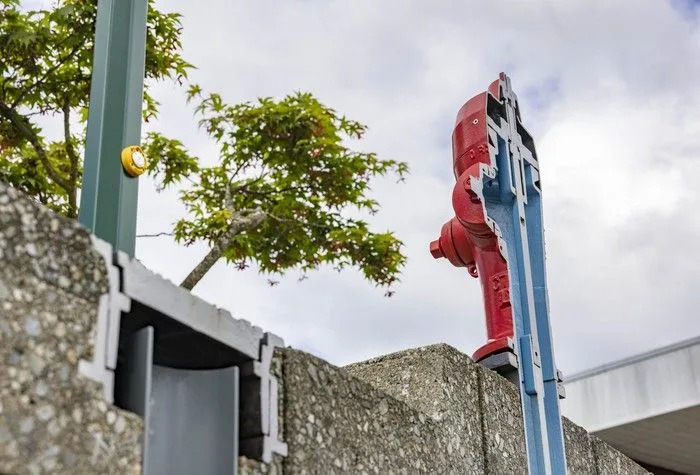
The sculpture is basically a “cutaway” of typical street infrastructure. It slices the infrastructure in half so you can see what goes on underneath — what Snider calls “the infrastructure underground.”
Above a raised sidewalk sits what you’d normally see, such as a fire hydrant, a storm drain, a parking meter, a street light, and a traffic light.
Beneath the sidewalk are the guts of the infrastructure — pipes and valves of many shapes and sizes, most made of cast iron.
The artwork was commissioned for Vancouver’s National Works Yard when it opened in 2024, and was recently refurbished.
“I proposed that I would make a piece that represented everything the works yard did,” said Snider, 81, who taught visual art at Simon Fraser University before he retired.
“That included all of the engineering, all of the electrical, the parking, and the gas line, (which is) not really the city’s purview. The two types of sewers, the storm drain and the sanitary sewer and the water mains — everything was going to be represented.
“The idea was it’s as if you took this piece and just pulled it up out of the ground and exposed everything that was underneath. The guys who do all this incredible work … it gets buried. Nobody sees it for 100 years.”

Artist Greg Snider with his sculpture project
Snider was approached by the city’s then-art consultants, Barb Cole and Mike Banwell, to submit a proposal because his art deals with labour and work. The commission was $90,000, but it took a year-end-a-half to build, so he figures he only made about $11,000 after expenses.
“I had an engineer back in the day look at it and say, ‘Oh, that must have cost $250,000,’” he recalls. “They were pretty impressed I could do it for $90,000.”
City staff were very helpful putting it together. The site was once the eastern end of False Creek, and he had to sink four piles five storeys into the ground to reach bedrock or solid ground before he could install the piece.
“They didn’t tell me (that) when I took the commission,” he said.
“They said, ‘Oh, by the way, you’re going to have to pile this.’ Fortunately, the pile driver was still on site, so I went and talked to him. They drove four 50-foot piles down underneath.”

Artist Greg Snider’s sculpture
The city also helped cut many of the pieces so people could see the inner workings of the infrastructure.
“You’ve got the fire training facility right here,” he said with a smile. “They actually don’t have a cutaway hydrant to show their young trainees, so they come over here to look at mine.”
Everything is colour-coded, so you can figure out what does what.
“Blue is for water,” he explains, pointing to a large pipe under a fire hydrant. “So here’s a water main, an eight-inch water main running down the street.”
The design not only shows what is beneath the street or sidewalk, it also shows where the utilities would branch off to a house.
“This brighter yellow is the gas line coming into the house,” he relates. “This is the sanitary sewer coming back out of the house. That sanitary sewer drops down into a pipe, which is orange.”
Many of the fittings are from the Terminal City Iron Works on Victoria Drive, a giant industrial complex that closed in 2015. The company is still around, it just moved to Langley.
“These valves are made to last,” he said, pointing to a large orange valve with a TC logo. “This big eight-inch, non-rising stem valve was actually pulled out of a boneyard in Burnaby as a ball of rust. I took it home, cleaned it all up, took it apart, and it works beautifully. There’s nothing wrong with it. Even though they had abandoned it in the boneyard, it could still be put back into service any time.”
Artist Greg Snider’s sculpture
During the recent restoration, they removed the rusty bits, sandblasted them, and put them back up. The street light had rusted so badly the city asked if he wanted a new one, but Snider said no — the original had been lowered to about three metres, and a new one would have been too tall.
One upgrade in the restoration is that the traffic lights now work. At one point, the city thought National street might become a connector to Clark Drive, and nixed a working traffic light in the artwork because it might confuse people. But the connector didn’t happen, and the traffic light is now hooked up.
With the new St. Paul’s Hospital rising nearby, Snider’s sculpture will soon be exposed to more people. But it’s always been appreciated by city workers.
“Many of the work yard staff bring their families all the time to admire the artwork,” said Krystal Paraboo, Vancouver’s Head of Public Art. “It’s kind of a way of describing the important and challenging work that they perform. It’s honouring and celebrating them.”
Related