
Just when I thought this city council’s contribution to public infrastructure would be limited to decisions on how many ancient buses to replace or which decrepit arena to tear down, it turns out the group, ahem, now has a much bigger bridge to cross.
Two of them, in fact.
City administration’s announcement that a pair of Edmonton’s iconic river crossings need to come down is nothing short of a bombshell that will reverberate for years through city finances, politics, transportation dynamics and more.
“Generational infrastructure” is how the city’s deputy manager of infrastructure, Sara Nichols, termed the call to fully replace the structures rather than again rehabilitate them.
When it comes to the 126-year old Low Level Bridge — Edmonton’s first river crossing — and the 113-year-old High Level Bridge, it is hard to imagine the city without them.
They are historic, beautiful landmarks that offer a connection to Edmonton’s past. In the case of the High Level Bridge, it was instrumental to Edmonton’s long ago amalgamation with Strathcona and is a rare example of a crossing that accommodated trains, automobiles, streetcars and pedestrians.
But more fundamentally, they are vital arteries for moving people in and out of Edmonton’s core. It says something about our city, good and bad, that so much of our traffic flow still depends on these geriatric crossings.

Night scene of Edmonton’s Low Level bridge over the North Saskatchewan River in February 2023.
‘Eventual decommissioning’
Last we heard about the bridges, the city was moving ahead with plans for another round of refurbishment that would again extend the life of the structures. Money had been set aside, traffic workarounds conceived, and lengthy closures were scheduled, including a three-year shutdown for the High Level.
But in preparing for the work, bridge experts took a more detailed scan of all the piers, trusses and substructures, and apparently found that this was not the usual repair game. The analysis led to the conclusion that a shift in mindset on the bridges is needed to “prepare for their eventual decommissioning,” says a report from city managers.
I quibble a little with that language, because a deeper dive into the city’s position shows that refurbishment of the bridges is still possible. It’s just that it would be really expensive, probably to the point of irrationality.
In the case of the High Level, council previously set aside $200 million for rehabilitation, but the expanded scale of the work means the estimated price tag has nearly doubled.
“At 113 years old, the bridge is beyond the end of its lifecycle, making rehabilitation a high-risk, high-cost endeavour with an extended construction schedule,” the city report says.
“Every 20 to 25 years, another renewal will be required, each time more expensive and riskier than the previous, if even possible. Maintaining the High Level Bridge in operation for the next 75 years could require a total investment of upwards of $1 billion.”
I think council and the public will have a lot of questions on those figures, stark as they are, to make sure saving the bridges is truly infeasible.
But assuming administrators have given a fair assessment, they have a general timeline in mind for how the coming years should play out.
The plan calls for basic refurbishments to take place on the Low Level in 2027 and High Level in 2028. That work will give several more years of safe operation to the bridges, allowing traffic to keep flowing while their replacements are being constructed.
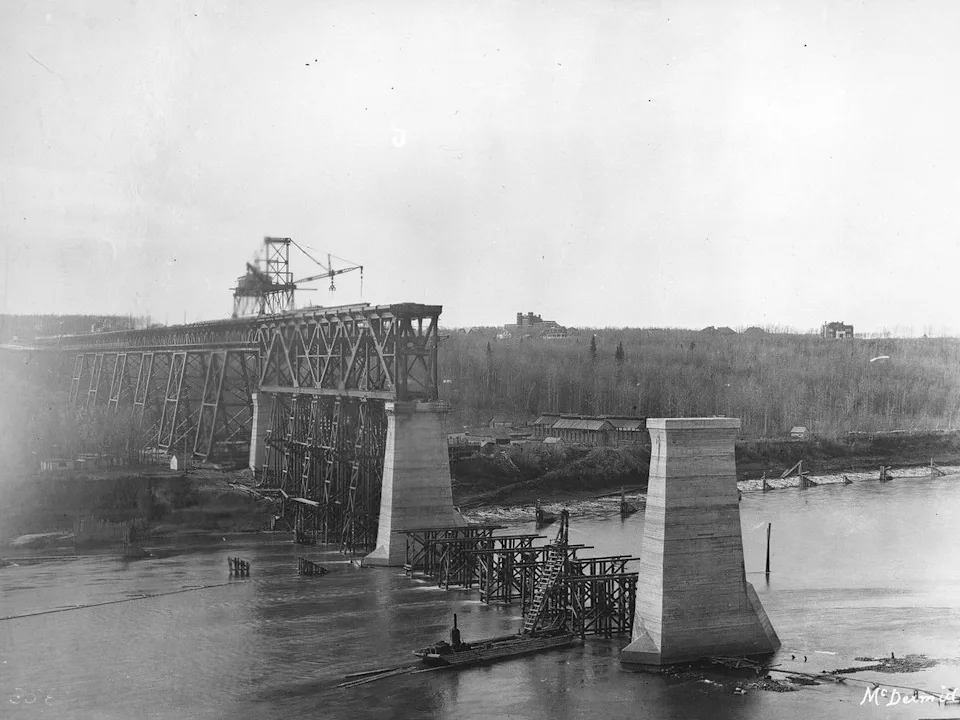
The High Level bridge under construction in 1911. Nearly 1.4 million rivets fasten the steel girders.
Functional vs signature
Where things could get more controversial is that administrators, hoping to keep costs down, are pushing for “functional” bridge replacements that would be built in more or less the same locations.
Under that scenario, the crossings would be constructed to modern standards — no more semi-trucks getting stuck — and probably with more lanes to accommodate Edmonton’s growing population. But the designs would be relatively simple as opposed to the more dramatic aesthetics of a “signature” structure like the Walterdale Bridge.
Even with those restraints, the estimate for replacing both bridges is $1.3 billion.
To break this down a little, let me first say I admire the instincts of city managers to keep things as simple and inexpensive as possible for the cash-strapped municipality, which is also facing a monstrous renewal bill for aging infrastructure all over Edmonton.
That said, I think city council is going to want to look at more options beyond basic replacements built in the same locations.
And they are right to seek that information, because this is, potentially, a historic opportunity to create something as iconic and meaningful for the city as the High Level Bridge was to Edmonton back in 1913.
To be clear, this is just the beginning of a very long process. For the High Level, it could be 10 to 15 years before a new crossing appears above the North Saskatchewan River, which means the final decisions will fall to the next council or the one after that.
However, it is this council’s responsibility to get the process started in the right way, and that means looking at all the possibilities for different bridge designs in different locations. Why not ask the question, “If we could start from scratch, what is the ideal bridge alignment for Edmonton?”
Either way, whether the choice is “functional” or “signature,” the costs are going to be considerable. This is now the city’s major expense of the coming decade, and all other spending decisions will have to be filtered through that lens.
Already thin hopes of funding a new LRT line, recreation centre or sports stadium, for example, are now even slimmer. And the city will need to find ways to sock away money and reduce its debt load.
It will also need to secure major contributions from the provincial and federal governments.
We know the UCP government wants to create a high-speed rail line between Calgary and Edmonton. If they proceed, they will need some way to get those trains across the river, which suggests there is a deal to be made for a bridge that also serves the city’s traffic needs.
Though likely an unpopular idea, I also think the city should at least look at the possibility of private financing that could potentially see a toll system set up on one or both of the crossings.
I know for many in this city, the announcement of the bridges’ fate is tragic news, akin to the death of part of Edmonton’s identity.
I also know this is not a time when people are inclined to take risks. But if we can get past those feelings, I think there is a chance to do something special for our city that will last for a century or more, just like the icons we are losing.
When talking about “generational infrastructure,” it is not necessarily the right moment to be thinking small.
Related
Bookmark our website and support our journalism: Don’t miss the news you need to know — add EdmontonJournal.com and EdmontonSun.com to your bookmarks and sign up for our newsletters here.
You can also support our journalism by becoming a digital subscriber. Subscribers gain unlimited access to The Edmonton Journal, Edmonton Sun, National Post and 13 other Canadian news sites. Support us by subscribing today: The Edmonton Journal | The Edmonton Sun.