
With United States President Donald Trump increasing pressure on Cuba, his country’s State Department is looking to Canada to build support for regime change in Havana.
Foreign Affairs deputy minister Arun Thangaraj was at the U.S. State Department last week where he met with U.S. Deputy Secretary of State Christopher Landau. During that meeting, the topic of Cuba came up, according to a State Department readout.
“Deputy Secretary Landau … urged support for the Cuban people who are in desperate need of change from the corrupt Communist dictatorship that has held absolute power in Cuba for the past 67 years,” the May 26 readout noted.
The U.S. Embassy didn’t expand on what that support could entail. Global Affairs Canada didn’t release a readout of the meeting, nor did it answer questions about the U.S. urging Canada to offer “support.”
Former Canadian ambassador Mark Entwistle, who served as Ottawa’s top diplomat in Havana in the 1990s, said that the readout shows an attempt by the Trump administration to build a collection of countries that wouldn’t condemn the U.S. if it were to take action against Cuba, or that would otherwise support regime change in Cuba.
“They won’t get that from the Europeans, they won’t get that from the Mexicans,” he said. “My read of that language was that they were seeking some kind of demonstration or expression of support of regime change.”
 Prime Minister Mark Carney has been reluctant to criticize U.S. actions on the world stage. The Hill Times photograph by Andrew Meade
Entwistle said that such support would be counter to Canada’s decades-long position to Cuba.
“I’m not totally sure what the Americans believe or think that they would have an expectation of what Canada can do in this situation,” Entwistle said. “Partly because when you go back to the basics, Canada’s relationship with Cuba is just totally different than that of the United States.”
For decades, Canada’s relationship with Cuba diverged with how the U.S. engaged with the island country, as Ottawa’s diplomatic links with Havana continued after the U.S. put an embargo in place.
“I would be absolutely stupefied if there was any consideration of going any way along the road to supporting some kind of regime change posture in Cuba,” he said.
Trump has suggested that Cuba is “ready to fall,” and remarked that he will be the American president to intervene in Cuba after decades of others considering such an action. U.S. Secretary of State Marco Rubio said a diplomatic solution is preferable, but added that the likelihood of that happening is “not high.”
Last month, the U.S. charged former Cuban president Raúl Castro, 94, for his alleged involvement in the 1996 downing of two planes operated by a group opposed to the Cuban government.
Canada’s strategic silence
When the Trump administration conducted a raid in Venezuela and launched airstrikes in Iran, Prime Minister Mark Carney (Nepean, Ont.) and Foreign Affairs Minister Anita Anand (Oakville East, Ont.) offered no condemnation of the actions. Carney initially supported Iran strikes, noting that he did so “with regret.” After the raid in Venezuela, Carney said he “welcomes the opportunity for freedom, democracy, peace, and prosperity for the Venezuelan people.”
At stake is the balance between Canada’s support for territorial integrity outlined in Carney’s Davos address and an unwillingness to find itself offside with the Trump administration as the review of the Canada-U.S.-Mexico Agreement (CUSMA) approaches.
“Cuba, in a way, is the classic case of where the expectation of a world order that the prime minister outlined to such effect and created such global resonance when he did that speech in Davos … That aspiration hits the real rocky shoals of the reality of everything around—I believe—the trade relationship with the United States,” Entwistle said, remarking that if Canada wasn’t in the middle of a CUSMA review period, the country may have taken a more “robust” approach.
“In a way, watching what’s going on in Cuba should give the Government of Canada considerable pause and even raise alarm bells because it demonstrates what this current United States government is capable of doing,” he said. “Cuba is a bit of a canary in the coal mines.”
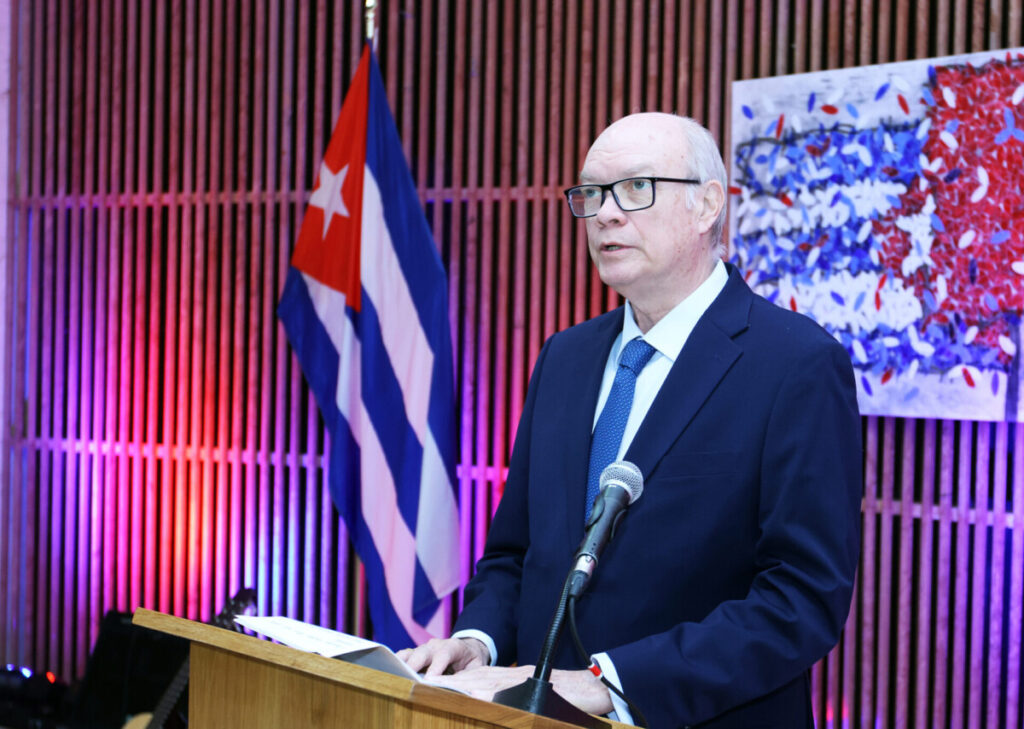 Cuban Ambassador to Canada Rodrigo Malmierca Díaz told the House Foreign Affairs Committee in November that his nation ‘deserves’ the support of the international community and countries like Canada. The Hill Times photograph by Sam Garcia
The former ambassador said he has no expectation that Canada would take a strong stand against the U.S. if it targeted Cuba.
Entwistle said that while the Cuban relationship is not fundamentally important for Canada’s economic well-being, it is “loaded with symbolic importance.”
“But in the current state of play on the economic front, whether those types of arguments are even important right now [is] probably doubtful,” he said.
He said that he would imagine that the Carney government doesn’t place a high importance on its relations with Cuba.
In February, Cuban Ambassador to Canada Rodrigo Malmierca Díaz appeared before the House Foreign Affairs Committee.
“We believe that our cause is just and deserves the support of the international community and of countries like Canada, which have defence of international law among the pillars of their foreign policies,” the envoy said on Feb. 24.
Canada’s symbolic relationship with Cuba still looms
St. Francis Xavier University professor emeritus Yvon Grenier, an expert on Canadian foreign policy in Latin America, said that it remains to be seen what Trump wants in regard to Cuba.
 The topic of Canada’s approach to Cuba was on the agenda during a meeting between Foreign Affairs deputy minister Arun Thangaraj, pictured, and U.S. Deputy Secretary of State Christopher Landau. Photograph courtesy of LinkedIn
“I don’t think he’s particularly interested in democracy in Cuba,” Grenier said. “I think he’d be more interested in getting a few concessions.”
He said that Canada is in a similar position with the Trump administration, which is to “wait and see what happens.”
Get Today’s Headlines Newsletter
Wake up to the day’s top political and policy headlines. Weekday Mornings.
By entering your email address you consent to receive email from The Hill Times containing news, analysis, updates and offers. You may unsubscribe at any time. See our privacy policy
“I don’t think they need to get out there and say, ‘We condemn in advance this or that, or we support this or that,’” he said.
If the U.S. were to conduct a military operation in Cuba, Canada would likely take a similar line as it did after the Venezuela raid, Grenier added.
“They would probably be very cautious not to spend a lot of political capital blasting Trump over something that is not a top priority for national interests in Canada,” he said.
Grenier noted that the Cuban relationship holds some symbolic value for Canada by offering an example of an independent foreign policy.
“Any Canadian government would try to preserve that symbolic dimension,” he said, but remarked that will be less of a priority than not ending up offside with the Trump administration.
nmoss@hilltimes.com
The Hill Times

Neil Moss is a reporter with The Hill Times who covers federal politics, foreign policy, international trade, Canada-U.S. relations, and defence, as well as leading the newspaper’s annual Top 50 list of foreign policy influencers. See all stories BY NEIL MOSS