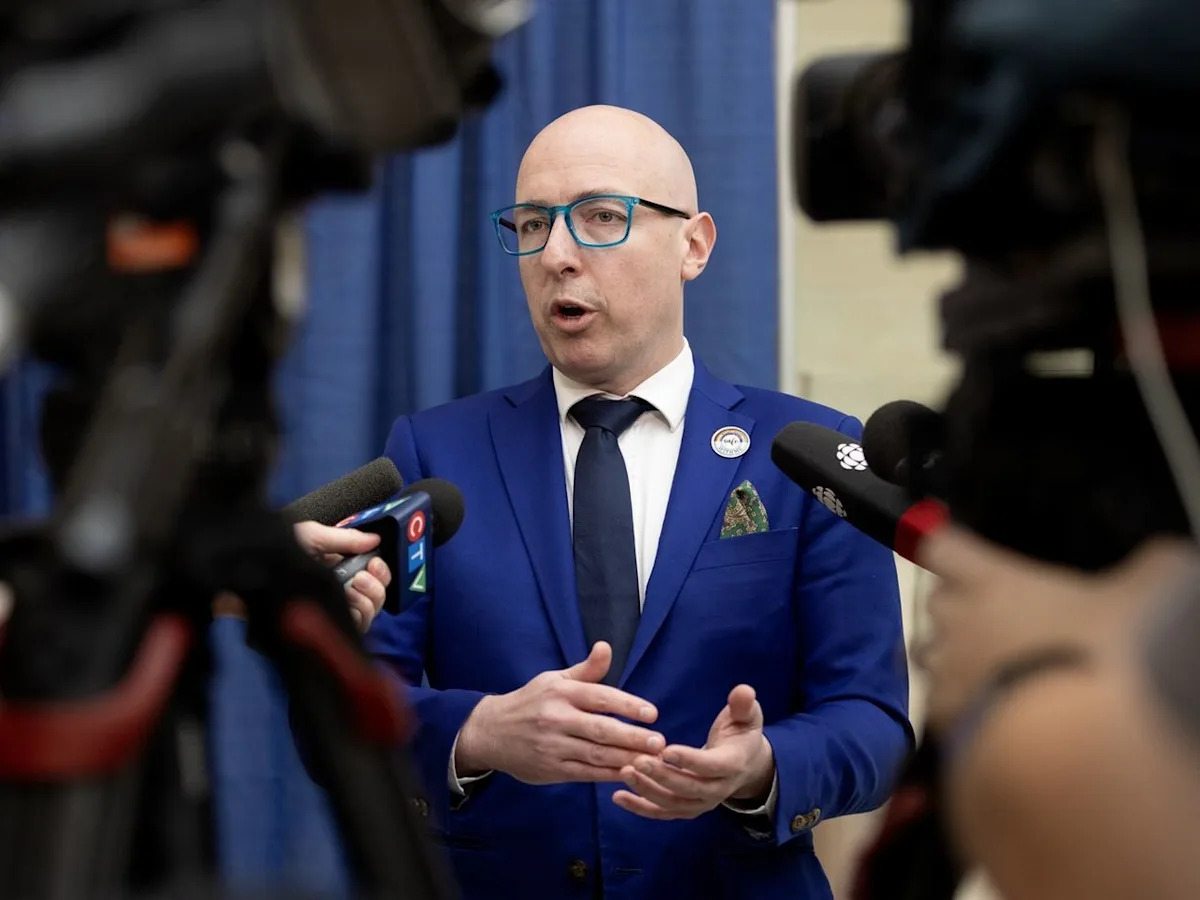
Mayor Andrew Knack is fully aware that there’s a widespread perception that city hall is unfriendly to business.
Construction projects obstruct business rather than help it. The city’s industrial and commercial tax base is bleeding away to the surrounding areas. There are issues when it comes to safety, and questions about how to improve the nighttime economy. There’s a perception that business permits and licensing take too long.
As the city’s executive committee pondered the need to refresh Edmonton’s economic development strategy, Knack admitted the city has to do a whole lot better when it comes to creating a business-friendly environment.
“I don’t think we’ve been as serious about economic development as we need to be,” Knack said Wednesday.
“If you went and asked every municipality, every leader in every municipality, do you believe in economic development? Is that important for any municipality? I think everyone would, of course, say yes. But, at the end of the day, words are one thing, actions are something entirely different, and that’s where I feel like the city has not been doing as much as we’ve needed.”
The plan to refresh the city’s economic development plan is really a collection of smaller initiatives, ranging from streamlining the permitting and licensing process to ensuring the city’s facilities can continue to host major international events. There’s a focus on Downtown safety and cleanliness, and on consolidating business support to key areas of economic strength in the city. And, the city needs to do more to build its brand.
City staff met with 37 different organizations over 15 different business sectors before hitting the “refresh” button.
“When we set our strategic priorities in January, we’re clear that economic development needs to be a core priority, and there need to be clear and measurable outcomes within that, and so that’s why I’m encouraged that actually we’ll be taking this seriously in a way that maybe we haven’t been for quite some time,” said Knack.
A big concern is the residential tax base carries a disproportionate burden when it comes to supporting the city’s budget. Knack and the councillors acknowledged the need to increase the commercial and industrial base, which means more needs to be done to attract businesses, and to make sure they’re not lost to Leduc or Strathcona County when the time comes for them to expand.
The revamp has the support of BILD Edmonton Metro, which represents builders and developers across the city.
“We encourage continued attention to the factors that influence investment decisions and business confidence,” wrote Kalen Anderson, BILD’s chief executive officer. “Throughout our industry, we regularly hear the perceptions of safety, vibrancy and overall quality of place influence where investors choose to commit capital, businesses choose to locate and employees choose to work.”

Crews lay down plastic flooring as they begin the process of creating an outdoor hockey rink at Commonwealth Stadium for the Heritage Classic in Edmonton on Oct. 17, 2023.
Attracting events
One of the major actions is for the city to continue to try and attract a dozen “world-class” sporting and cultural events throughout the year.
But there’s an understanding that, outside of Rogers Place, the venues that can host these events are aging. So, from 2027-2030, the city will look at the requirements needed at venues like the Kinsmen Fieldhouse and Commonwealth Stadium, which is racing towards its 50th birthday.
And, make no mistake, Commonwealth is a big stadium, but not a modern one.
Rob Notenboom is the president of the Voyageurs, the Canadian soccer supporters’ group. Hundreds of their members came from across the country for the June 1 Canada-Uzbekistan match at Commonwealth Stadium. More than 46,000 tickets were sold for the game.
Notenboom, who came in from Regina, said the sightlines at Commonwealth are “fine,” but the concourses can’t handle the crowds when the stadium is close to selling out.
“At halftime, you can’t move, can’t get to the washroom, can’t get food or beverages,” said Notenboom. “I’d say it’s even unsafe.”
Knack said there likely won’t be any money in the next four-year budget to address Commonwealth, but it will eventually need to be on the table.
“It’s an incredible stadium, but it’s also an aging stadium, and so there will be a point at which further renewal work will be needed, and so that will be something that we do,” he said.

Free-of-charge Downtown Winterval on 104 Street north of Jasper Avenue.
Nighttime economy
Improving the nighttime economy is not an overt part of the economic development refresh, but administration told councillors that making Edmonton more vibrant after dark is part and parcel of many of the recommendations.
In 2024, city council received a report on how to improve the nighttime economy. But Downtown business leaders have blasted the city for what they see as inaction that followed.
During a 2025 mayoral debate, Puneeta McBryan, the then-CEO of the Edmonton Downtown Business Association, called the city’s work on vibrancy in the core an “absolute disaster.”
Tyson Cale Boyd, a partner in the Starlite Room, a Downtown concert venue, said the previous council fumbled the nighttime economy strategy.
“They shelved the project at the time it was needed most,” said Boyd. “But, for this council, I guess we’ll see.”
McBryan, who is now a private business owner, said there is often money for non-profit arts organizations, but when it comes to private businesses that contribute to the city’s cultural life and vibrancy, there isn’t much. She said the Starlite Room and Aviary, two privately run Downtown venues, don’t get the support they need. As well, she targeted the city’s plan to introduce licensing fees to bars that have sidewalk patios as a problem.
Renee Williams, the executive director of the Edmonton Arts Council, said more needs to be done to include the creative communities in the city’s economic development plan.
“Too often, arts and culture are framed as ‘nice to have,’” said Williams, reminding council that city arts organizations generate more than $170 million a year, and create 1,400 jobs.

The Edmonton Downtown Farmers Market on Jan. 20, 2024.
‘Shop local’ isn’t enough
The city does have a shop-local promotion, and there is a push to make it easier for local businesses to do business with the city itself.
But two neighbourhood business improvement associations said that these economic development refreshers don’t do enough to help small-business owners. And there’s a worry that there may be too much focus on Downtown.
The Canadian Federation of Independent Business found that “nine out of 10” small business owners feel that the city is not doing enough to support them.|
Luwam Kiflemariam, the executive director of the 124 Business Association, said that the shop local is “insufficient on its own.” She said what’s needed is real support for small-business owners to help them overcome their daily and long-term challenges. She said more support is needed for the business improvement associations, which know what their members need.
“What’s missing is a dedicated business improvement area (BIA) investment program,” said Kiflemariam.
“The plan is to study BIAs, not invest in them.”
Todd Janes, the executive director of the Stony Plain Road and Area Business Association, said the city needs to do more at the business grassroots level.
“Business attraction and retention is competitive,” said Janes. “And Edmonton is losing its edge to surrounding municipalities.”
And, while investment in Downtown is important, he said more needs to be done to help business areas in other parts of Edmonton.
“There has to be better quality in how to support a larger city,” he said.
The committee debated a motion that would see administration create a currently unfunded service package to assist business associations.
Knack said there simply isn’t money in the budget to address the full wish list from the BIAs.
“Let’s focus on the areas that we can really lean into,” he said.
Coun, Keren Tang worried the plan calls for new staff to be hired in 2027 to support the economic development initiatives. She worried that the pace of change is too slow.
“Could we not wait two years to strike that up?” she asked.
Coun. Aaron Paquette bristled when he was told by city manager Eddie Robar that it could take 20-25 years for the city to hit the long-term goals.
Paquette said the city is in “an existential state” and has to right the ship in short order, not a two-decade timeline.
Related
Bookmark our website and support our journalism: Don’t miss the news you need to know — add EdmontonJournal.com and EdmontonSun.com to your bookmarks and sign up for our newsletters here.
You can also support our journalism by becoming a digital subscriber. Subscribers gain unlimited access to The Edmonton Journal, Edmonton Sun, National Post and 13 other Canadian news sites. Support us by subscribing today: The Edmonton Journal | The Edmonton Sun.