
Progress on Calgary’s Green Line LRT has stalled for years over disagreement on how the train would travel through the city’s downtown.
But Mayor Jeromy Farkas floated ideas on Wednesday to push the project forward, including temporarily pausing development on the downtown segment while the rest of the train line is built, or cutting the provincial government out as a funding partner for the project’s downtown portion.
City council directed administration on Tuesday to present alternative options this fall for how the Green Line connects to downtown, after the province’s preferred option of an elevated line met strong opposition from people living and working near where the tracks would be built.
Before 2024, the city favoured tunnelling through downtown. Then, the province pushed back and presented an alternative elevated track along 10th Avenue and Second Street Southwest.
After the province reiterated this week a downtown tunnel is off the table, Farkas suggested the federal government could be the city’s sole funding partner for the project’s downtown segment, while continuing to build the southeast portion with provincial support.
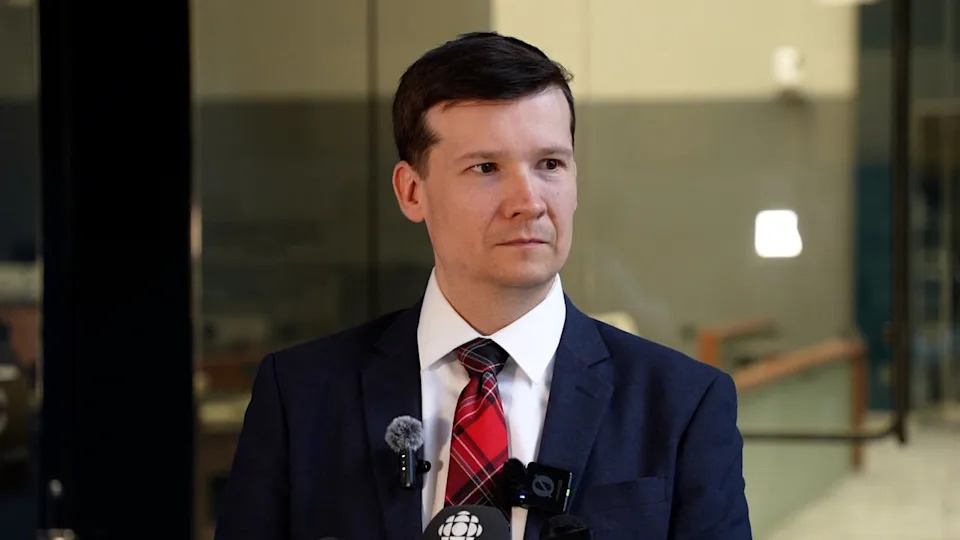
Calgary Mayor Jeromy Farkas said on Wednesday the city could consider partnering with only the federal government to fund the downtown segment of the Green Line, or pause its development while the city builds the rest of the project north and south. (Brendan Coulter/CBC)
He suggested another option the city could explore is pausing development of the downtown segment temporarily, and using the cost savings to build the Green Line farther south to Seton, while beginning construction of the LRT’s northern leg. Until the city finds a solution to the downtown connection, buses could transport riders between the north and south legs, Farkas said.
“For us to get construction as quickly as possible on the far north and the far south, we have to have some flexibility in terms of what the downtown looks like,” said Farkas.
Northern leg needed to justify Green Line’s cost
The city broke ground last year on the Green Line’s southeast portion from Shepard to the new event centre near Victoria Park, after more than a decade of planning.
The project’s northern leg and southern extension to Seton are necessary, Farkas said, because the project otherwise wouldn’t have enough ridership to justify its cost. The $6.25-billion project is the largest infrastructure investment in Calgary’s history.
WATCH | Calgary administration to present new downtown options for Green Line:
“Let’s not let the perfect be the enemy of the good. If we continue to spin our tires here, if we continue to try to chase something that’s going to get 100 per cent support, I don’t think that we’re ever going to build the Green Line,” Farkas said on CBC Radio’s Calgary Eyeopener on Wednesday.
Farkas said he sees the Green Line as the most important project the city will undertake in the next half-century.
When asked to respond to Farkas’s ideas, Alberta’s Ministry of Transportation referred to its previous statement on Tuesday, saying it is open to discussing changes to the downtown alignment, but an underground tunnel is not on the table.
Elevated track could be detrimental
Ward 7 Coun. Myke Atkinson, who represents downtown Calgary, said he’s open to adjusting how the Green Line is completed, as long as it eventually delivers on the city’s commitment to take the train downtown, across the river and farther north.
But Atkinson said the elevated alignment would be detrimental to downtown Calgary, and the city should listen to the opposition it’s hearing from people in the area.
“To not do this properly, it jeopardizes a key element of our city,” said Atkinson.
“It is very difficult to justify the trade-offs that I’ve been hearing.”
The city has heard criticism of the elevated line from downtown residents worried it could crater property values, create noise and dampen downtown vibrancy, development and business.
Farkas added that if billions of dollars are lost through declining downtown property values, the city may need to make up the slack through a tax increase across the city.
‘Rehashing the same ideas’
Andrew Yule thinks his ward in north Calgary needs more transit options. But the Ward 3 councillor said residents in his area don’t believe they will see the project’s north leg in their lifetime.
“We’re spitballing a project that’s been in process since 2014, and spitballing now when we’ve studied this alignment to death just feels irresponsible,” said Yule.
“We have an alignment, and we just need to follow it.”
The north line of the project would travel from Ninth Avenue North up to the future Keystone Hills neighbourhood at 160th Avenue, including 11 new stations.
Yule said any talk of new plans for the Green Line without a commitment on paper is just hearsay and, ultimately, when it comes to the options on the table, “We’re just rehashing the same ideas.”