On the international stage, a soccer team’s style can become synonymous with a nation.
Joga Bonito will always be at the heart of Brazil’s style of play, an identity with a flair for the dramatic and a penchant to make even the most neutral of fans feel what the beautiful game is all about. Spain’s La Furia Roja failed time and time again until a transition to Tiki Taka close range passing and movement brought its first World Cup win in 2010 and became a watershed moment that has since taken on a tactically transcendent nature across the globe.
The Italians aren’t around for a third consecutive World Cup but even remotely casual fans know the Azzurri for its resolute, sturdy defence that caters to the exquisite touches and artistic brilliance of Andrea Pirlo and Roberto Baggio’s ilk.
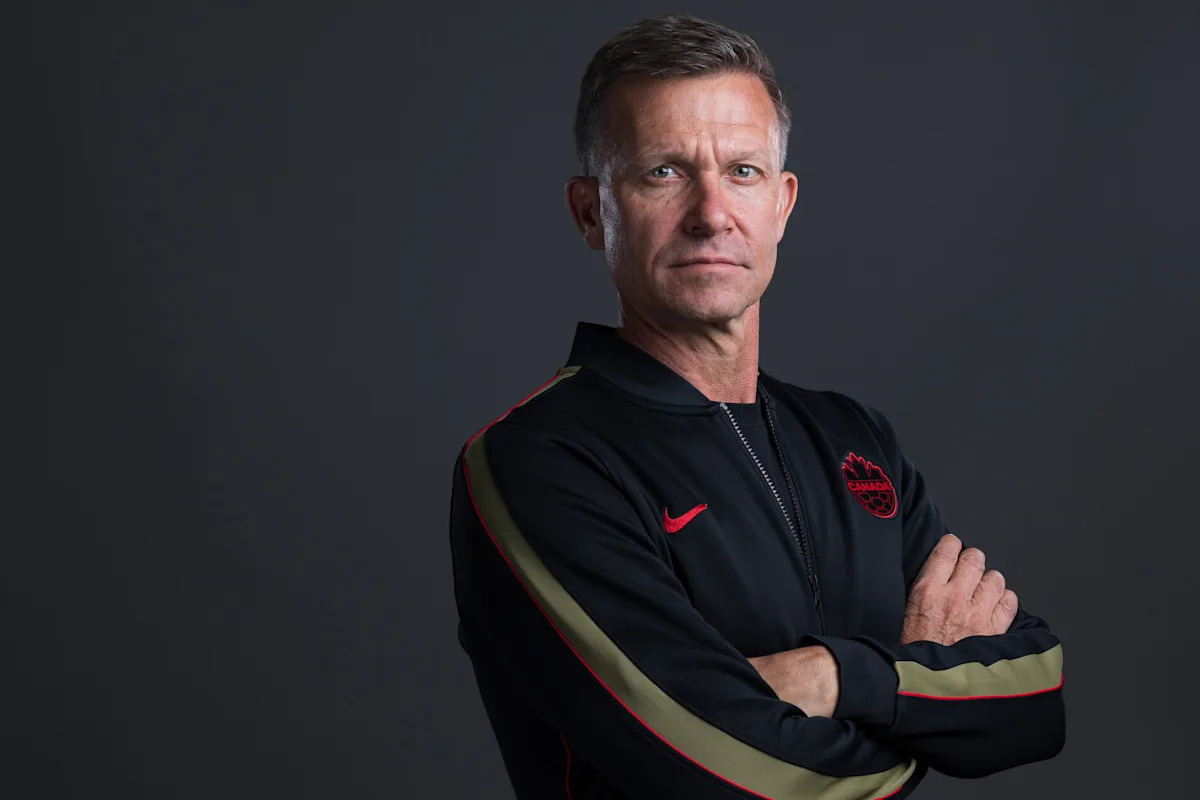
Canada is a developing football nation and Jesse Marsch is an energetic, radiantly positive American man assured in who he is, trying to help the Canada men’s national team be known for what it should be in the world’s most popular sport.
“We’re trying to ingrain into the football in the country this idea that we have incredible athletes,” the Canada head coach told Yahoo Canada. “And with those athletes, the best way to benefit their development and the overall football is this idea of intensive, aggressive football.”
Marsch will guide Canada at the World Cup for a first time, but in signing a four-year extension, his tenure with the team is about much more than what happens over the next month or so. Some may view this job post as a stepping stone to greater heights, Marsch sees it as a legacy maker.
When all is said and done, he wants Canadian soccer to be renowned for its physicality, intensity, and yes, even some arrogance in being unapologetically great at what they do.
Pace and Precision are the key ingredients of ‘Marsch Ball’
MONTREAL, CANADA – JUNE 05: Tajon Buchanan #17 of Canada runs the pitch in the first half during the international friendly match against the Republic of Ireland at Saputo Stadium on June 5, 2026 in Montreal, Quebec, Canada. (Photo by Minas Panagiotakis/Getty Images)
(Minas Panagiotakis via Getty Images)
Before joining Canada, Marsch worked with eight players in his entire career who had clocked at least 37 km/h. On this Canadian World Cup squad alone, there are nine led by captain Alphonso Davies.
Marsch’s first meeting with the team was about providing a vision for how it could maximize its potential. He looked around at the players in the room, detailing exactly why Canada needed to tilt things more to the idea of being dynamic and aggressive. If there was a path to becoming respected in the world’s most popular sport and increasing both the visibility and recognition of the players, superior athleticism was something he felt could help Canadian players stand out.
He delivered a similar message when meeting with Canada Soccer CEO and General Secretary Kevin Blue and other Canada Soccer higher ups in New York City to make his case for the job. It was the buy-in from some of the most prominent former national team players including captain at the last World Cup Atiba Hutchinson that convinced him he found Canada’s man.
“When they were able to understand Jesse’s tactical philosophy and some of his ideas, they confirmed Jesse’s thesis that our player pool is perfectly suited to the style of play that he brings to the table,” Blue said. “That was a very important synergy and determinant of the hire in the first place, in addition to all of the qualities that he brings as a leader and an ambassador which are also part of the job of being a national team head coach.”
A former workhorse of a midfielder himself, Marsch won three titles in 14 MLS seasons before serving as an assistant coach under Bob Bradley at the 2010 World Cup, who was a massive influence on his desire to be a coach. Marsch was the inaugural head coach of the Montreal Impact before his most formative years as a Red Bulls coach either in a head role or assistant across New York, Salzburg, and Leipzig.
The most crucial of those eight years spanning three cities came as an assistant at RB Leipzig, where he worked under the tutelage of Ralph Rangnick in 2018-19. Marsch always gravitated toward an aggressive, pressing style but learning Rangnick’s level of detail was a major inflection point.
Marsch reflects and considers his thoughts on pressing upon first arriving at the club more straightforward. While he knew he wanted his players to apply pressure and cause panic in his opponents, Rangnick exposed him to what genuinely great pressing meant.
“He would talk about the timing of when you release the sprinting, the last steps you have to make, the technical aspect of what actual pressing means,” Marsch explained. “And then the automation of everyone within that system doing it together, and the synchronicity, and the tactical connections, and then with the ball, the same kinds of things.
“I was like, holy shit, it all makes sense. It fit with my personality and it fit with my idea of what I wanted the game to be. At that time, it challenged me and inspired me to think of what the game could be. I’m very thankful I met him and then I kinda took it and went with it and made it my own.”
Those are the details Marsch is steadily instilling across Canada. This isn’t just about building the senior teams. He meets with the different levels of the national program including with women’s head coach Casey Stoney, he makes time for local clubs to help them understand the type of soccer player Canada wants to build with, and pushes the envelope at every opportunity to enhance the infrastructure of the sport in the country.
“I enjoy running, pressing, enjoy playing with the ball as well,” Ali Ahmed, a left-winger born and raised in Toronto who has found his stride under Marsch and increasingly become a poster boy of Marsch’s system, said. “When we don’t have the ball, I’m a player that wants the ball back right away and that’s the way we play. He’s definitely helped me take my game to another level.”
Uniting players in readiness to unite a country
TORONTO, ON- JUNE 9 – Ismaël Koné #8 of Canada and Derek Cornelius #13 of Canada share a laugh as Canada’s FIFA 2026 World Cup team trains ahead of their game on Friday against Bosnia-Herzegovina at TFC Training Ground in Toronto. June 9, 2026. Steve Russell/Toronto Star (Steve Russell/Toronto Star via Getty Images)
(Steve Russell via Getty Images)
Marsch pulls no punches when it comes to standing up for his players.
There has been no greater example of Marsch’s willingness to stand up for his Canadian players than when Ismaël Koné, a player who may well go down as Canada’s best performer at this World Cup, was lambasted by former club team coach Roberto Di Zerbi during his time with France’s Olympique de Marseille. During a training session, Di Zerbi chastised Koné for taking too many touches but the player tried to make the case that the pass wasn’t there to be made yet.
De Zerbi then snapped and demanded he leave training, and as Koné began to do so, the coach further derided him in front of his teammates and staff, even telling him to “call his agent” to leave the team. That nearly brought about an altercation, and Koné was soon out of the club.
Incredibly, Marseille released footage of the incident as content at the end of the 2024-25 season. A month ago, Marsch didn’t mince his words on what he thought of what went down in France.
“It wasn’t easy with De Zerbi in Marseille and De Zerbi was a real asshole with him,” Marsch told the “Call It What You Want” podcast on CBS Sports. “He stayed strong, he never doubted himself, he found a new situation and now he’s flourishing.
“Let me reiterate, De Zerbi was a real asshole with him.”
None of this is to say that Marsch doesn’t challenge his players. In fact, after a June 1 friendly against Uzbekistan, Marsch wasn’t happy with Koné’s performance and challenged him to give more.
“To be fair, Jesse has a lot of trust in me,” Koné said reflecting on that moment in Toronto a couple days ahead of Canada’s World Cup opener. “He believes in me a lot, so, whenever he gives me a message, whenever he criticizes me, sometimes it’s positive, but he’s always trying to raise the little stuff. He’s someone that’s big on details.
“I know he comes from a good heart, someone who wants me to progress and for us to be a better team.”
Marsch has been forced to rely on a deep roster of players due to injury but hasn’t let it get in the way of what he expects in terms of performances. He has pushed the likes of 20-year-old Luc de Fougerolles to grow up pretty quickly in the face of a fractured tibia for star defender Moise Bombito, been direct with both Ali Ahmed and Tani Oluwaseyi in his early days on what they need to improve to be serious contributors to the national programs, and he waited until one match before the World Cup to choose between Maxime Crépeau and Dayne St. Clair as his starting goalkeeper believing that was the best way to push them to their limits.
“I’m more looking at the overall group and the health of the group and thinking, ‘How do I help these guys be their best?'” Marsch explained. “How do I use who they are to feel most rewarded and feel most fulfilled and be challenged the most to be the best that they can be. Then, I find the football part winds up being pretty easy because you’ve created a trust and a bond that’s about real things.
“It’s based in friendship and love and trust and then you’re able to challenge people to be their best.”
Win now and win later
TORONTO, ONTARIO – JUNE 11: Jesse Marsch, Manager of Canada during the training session of Canada one day ahead of the FIFA World Cup 2026 Group B match between Canada and Bosnia and Herzegovina at Toronto Stadium on June 11, 2026 in Toronto, Ontario. (Photo by Alex Pantling – FIFA/FIFA via Getty Images)
(Alex Pantling – FIFA via Getty Images)
Marsch wears many hats as the national team head coach, but what he loves most is wearing a lab coat and working with his staff that includes both Canadian influences as well as those who have seen the game up close in more soccer traditional countries so they can help expedite the learning process. Marsch identifies most with being a high performance analyst and that can involve anything from the tactical aspects to the sports science and the psychological. He knows he can’t ace all of those aspects alone.
As he draws on all his and their previous experiences to help Canada take steps it hasn’t taken before at this World Cup, one of the key lessons that has stuck with Marsch and influenced how he has built over the last two years to the World Cup squad he has now came from former U.S. men’s national team head coach Bruce Arena.
“If you wanna meet the standards of the game at the World Cup, Bruce Arena was the first one that said it’s a young man’s tournament,” Marsch said. “It’s changed a little bit because of the gaps between games and there’s more players and more teams so there’s more time to recover but teams are strong, fast, and powerful.
“If you go with a slow, old team, you’re gonna get run over.”
That’s part of why, despite the injury concerns, Alphonso Davies and Moïse Bombito are present. It’s why he has backed dynamic winger Jacob Shaffelburg through his injuries and developed the likes of Niko Sigur and Oluwaseyi. Marsch understands the weight of this moment for Canada and that the best way to maximize it is to swing for the fences.
He hasn’t picked a squad that can play it safe and get passable results, he’s picked one that can resonate with the people of Canada for generations to come.
And when those future generations come to play, they can expect a National Training Centre waiting for them, a legacy project for which a formal Request for Proposals was made four days ago. It will be a year-round hub for Canada’s national teams, player development, coach and referee education, and more.
“As these players pave the way, I think that all of the ones watching them will be like, ‘I wanna be the next Alphonso Davies, I wanna be the next Jonathan David, I wanna be Ismaël Koné, Moïse Bombito. The amount of role models they can have now is pretty incredible,” Marsch said.
“The boost from this generation of players is gonna only make this sport stronger along with our ability to create a professionalism around it.”