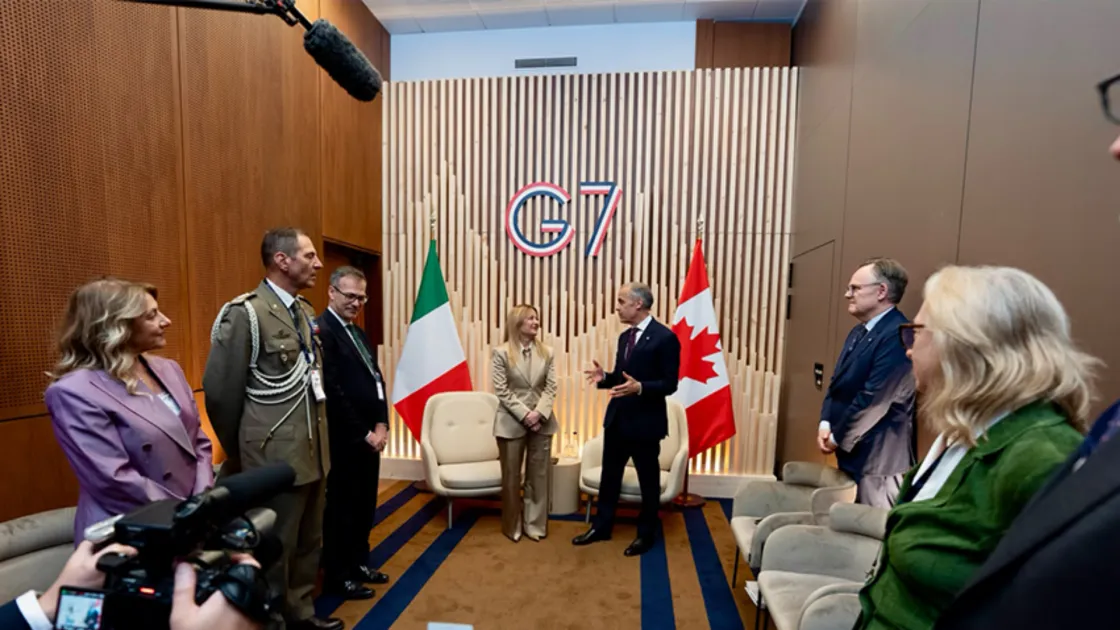
At the annual G7 summit taking place this week in Évian-les-Bains, France, critical minerals have returned to the spotlight, with stockpiling and supply chain diversification emerging as leading strategies under discussion.
The G7 has framed its agenda around the theme of reducing global imbalances — a direct reference to curbing China’s dominance in critical mineral supply chains and ensuring more equitable access to strategic resources.
Since the commencement of this week’s meetings, the G7 has made an overarching statement for the group’s support and promotion of supply chain resilience and diversification across the energy, digital infrastructure, and transportation sectors.
The G7 has highlighted that shared global prosperity hinges on reliable critical mineral value chains and that the group aims “to harness the economic potential of critical mineral value creation through international cooperation along the supply chain and mutually beneficial partnerships based on high standards, transparency, and local value creation”.
It urges global leaders to work collaboratively and monitor supply chain disruptions in order to stay alert on key supply gaps of essential inputs, such as fertilisers, and to mobilise key resources to support countries in need.
Looking at supply chains, Japanese Prime Minister Sanae Takaichi has proposed a new framework with which to coordinate critical mineral stockpiles both among the G7 group and other like-minded countries, as a strategy to loosen China’s control of key supply chains.
Takaichi has called for the diversification of supply sources, with a goal for participating countries to hold at least 90 days’ worth of critical minerals, and to coordinate with the International Energy Agency (IEA) in times of supply disruptions.
Strategic alliances
A new strategic alliance between Canada and Italy has been forged this week, with Canadian Prime Minister Mark Carney meeting with Italian Prime Minister Giorgia Meloni. Occurring on the sidelines of the G7 summit, the meeting notes a deeper cooperation between the two countries, led by significant investments into Canadian resources.
In April 2026, Italian energy company Eni made a significant investment of US$70 million ($99.1 million) into Nouveau Monde Graphite (TSX:NOU), as part of a broader US$213 million private placement by the company. This investment supports the advancement of Nouveau Monde Graphite’s Phase-2 Matawinie Mine project, a project slated to be “the first and largest ore-to-advanced-graphite-materials production of the G7”, according to the company.
In 2026, Italy has started a major push for critical minerals, becoming a member of the Critical Minerals Production Alliance (launched at the 2025 G7), and cooperation between the two countries has seen a Canadian Trade Mission to Italy as well as a Canadian Critical Minerals Investment Forum in Italy.
Carney says that he welcomes Italy’s collaboration with Canada, noting that “these efforts will catalyse further partnerships between the two countries in energy and industry.”
The G7’s focus on critical minerals underscores the urgency of building resilient supply chains and forging strategic alliances to balance the control of strategic supply channels.
With proposals for coordinated stockpiling, frameworks for diversification, and fresh bilateral partnerships, the 2026 G7 Summit signals a clear shift toward collective action, with a focus on transparency, local value creation, and international cooperation.
Write to Amy Rotman at Mining.com.au
Images: Italian Government, Presidency of the Council of Ministers
Add to Watch List:International Energy AgencyCritical Minerals