Voters in Switzerland recently rejected a proposal to cap the country’s population at 10 million by a margin of 55% to 45%.The country has a system of direct democracy, which allows citizens to express their opinions on decisions made by parliament and propose amendments to the Federal Constitution.The World Economic Forum has been based in Geneva, Switzerland, for more than 50 years. Here’s what you need to know about this cornerstone of Swiss life.
Here, we look at that system – an important part of public life in Switzerland – and what other countries could take from it.
How direct democracy in Switzerland works
Switzerland allows its citizens to express their opinions on decisions made by parliament and propose amendments to the Federal Constitution.
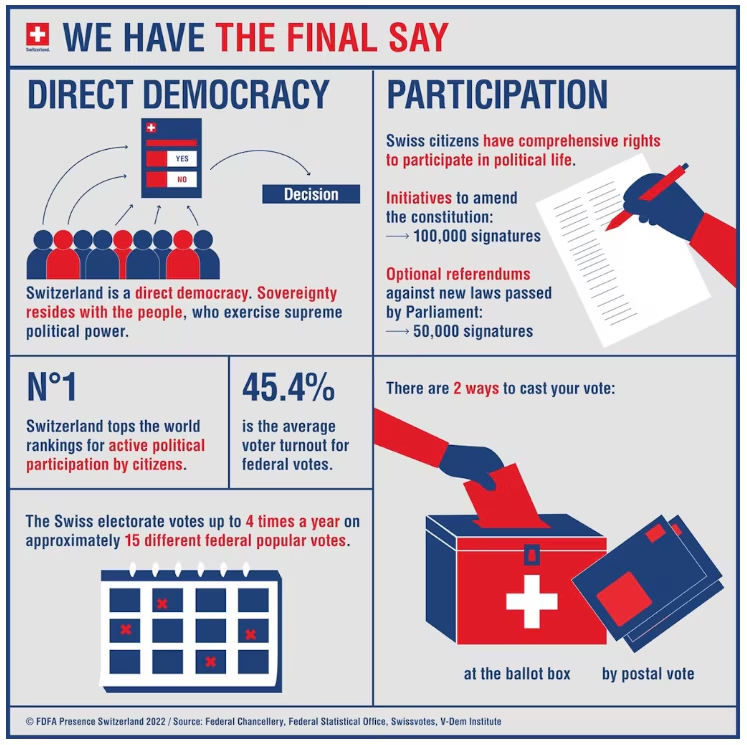
A maximum of four times a year, all citizens aged 18 and over are called on to vote on an average of 15 specific issues at federal level.
There are the three key instruments in this system. People can propose votes on issues themselves – to amend the constitution via a popular initiative or an existing law through an optional referendum. Certain government decisions, meanwhile, automatically go to a mandatory referendum.
 Image: Swiss Federal Department of Foreign Affairs
Swiss popular initiatives and optional referendums explained
The popular initiative allows citizens to propose an amendment or addition to the constitution – the highest level of Swiss law. For an initiative to be put to a vote, it needs 100,000 supporting voter signatures within a period of 18 months. If a majority of voters and a majority of the cantons (Switzerland’s administative divisions) vote in favour – known as a double majority – the constitution will be amended. The recent referendum on capping the population was initiated this way, through a popular initiative called ‘No to a Switzerland with 10 million! (Sustainability Initiative)’.
Citizens can challenge a law that has already been passed by parliament through an optional referendum, which allows them to demand approved bills go to a nationwide vote. This requires 50,000 valid signatures within 100 days of the legislation’s publication.
The effects of putting issues to public vote
Since the optional referendum was introduced in 1874, 219 have been held, with 91 proposals being rejected by the electorate.
The government says that these two instruments still have a big impact, even if most initiatives are unsuccessful and few laws are stopped by referendum.
Alongside sparking public discussion, they can influence legislation, as groups likely to launch a referendum are taken into consideration when new laws are being drafted.
Supporters believe the system strengthens democracy by encouraging participation and giving citizens a direct voice in decisions that affect them, better reflecting what they want. This is significant when global research shows the majority of people believe political leaders do not care what ordinary citizens think.
The system, ultimately, remains a cornerstone of Swiss national identity.