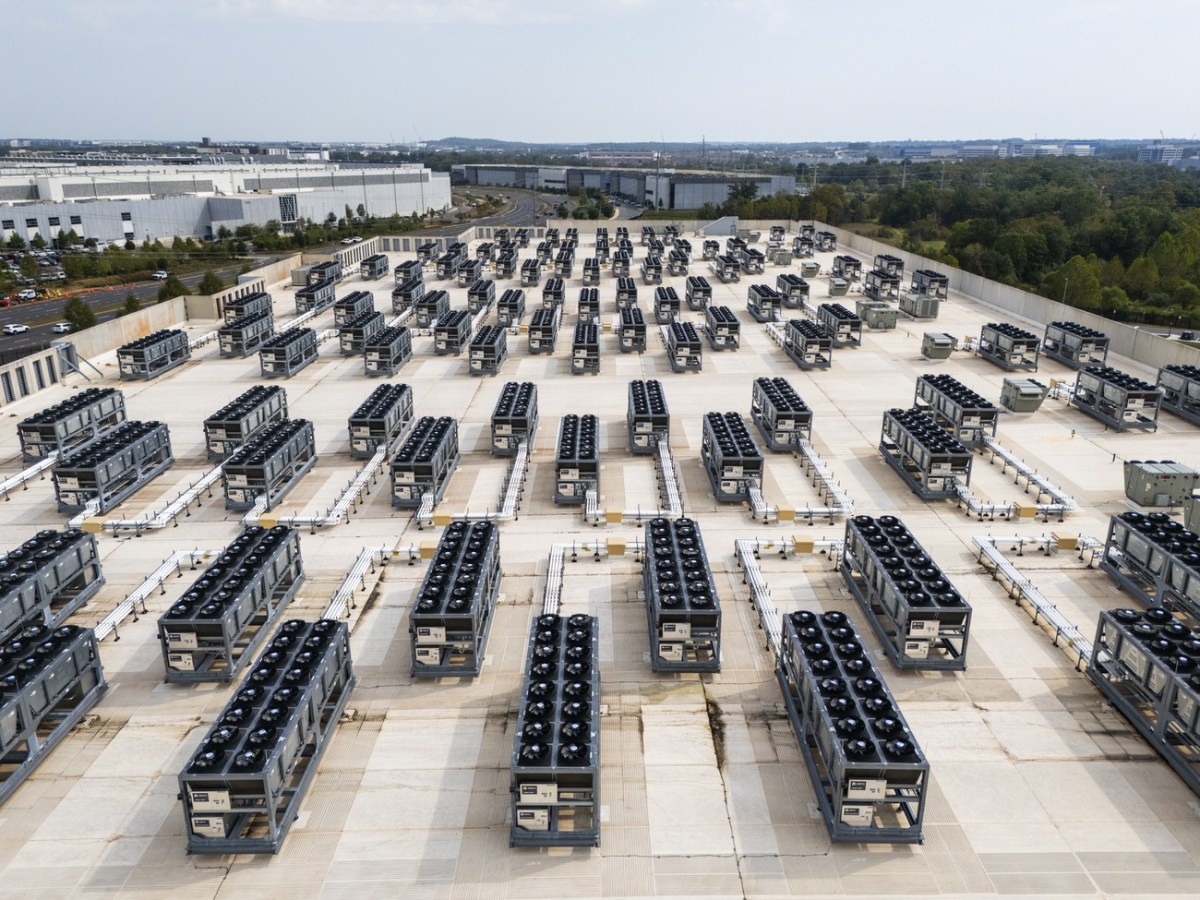

Cooling data centres in a sustainable way is the biggest challenge for the future.
Keystone
The AI boom is forcing the industry to rethink how data centres are cooled. Researchers in Switzerland are developing technologies that promise to reduce energy and water use. But can better cooling really solve AI’s growing environmental footprint?
Listen to the article
Listening the article
Toggle language selector
English (US)
English (British)
Generated with artificial intelligence.
This content was published on
July 21, 2026 – 09:27

I analyse the risks, opportunities and concrete impacts of artificial intelligence on society and everyday life. Since joining SWI swissinfo.ch in 2020, I translate the complexity of science and technology into stories that speak to a global audience.
Born in Milan to an Italian-Egyptian family, I have been passionate about knowledge and writing since childhood. I worked between Milan and Paris as a multilingual editor for technology magazines before transitioning to international journalism with SWI swissinfo.ch.

I am an experienced video journalist passionate about making complex topics accessible and engaging through compelling multimedia storytelling. Focused on social and environmental issues, I produce various video formats on a wide range of topics, specialising in impactful explainer videos with motion graphics and stop-motion animation.
During my studies in cinema, English literature and journalism, I’ve gained experience in radio, television, and print across Switzerland. After working with the Locarno Film Festival’s image & sound team, I joined SWI swissinfo.ch in 2018 to produce local and international reportages.
Inside the data centre of the Swiss Federal Institute of Technology in Lausanne (EPFL), powerful fans push cold air through rows of servers. A constant hum fills the room, but Remco van Erp, co-founder and CEO of Swiss start-up Corintis, says this facility is relatively quiet.
“In a large data centre, you need ear protection,” he says. That’s not the case here.
Van Erp attributes the lower noise to the fact that the facility relies less on high-speed ventilation than conventional data centres. Finding alternatives to traditional cooling methods is precisely what brought Corintis to EPFL. As artificial intelligence (AI) drives a global data centre boom, the Swiss start-up and the university are working together to reduce the electricity and water needed to keep the facilities running.
“People think AI is basically a free service with a relatively small footprint. In reality, its environmental footprint is significant,” says Mario Paolone, professor at EPFL.
Data centres currently account for around 1.5% of global electricity consumption, and demand is expected to grow to under 3% by 2030, according to the International Energy AgencyExternal link. A recent United Nations studyExternal link predicts data centres’ water footprint will more than double in the same time span.
Paolone describes a data centre as a giant machine that transforms electricity into heat. Every time we ask AI a question, electricity is consumed – and almost all of it eventually becomes heat that must be removed with air or, increasingly, water-based cooling systems.
The growing demand for electricity and water has fuelled opposition to new data centres around the world, including Switzerland. Recently, New York became the first US state to impose a one-year construction banExternal link on new large data centres.
“We can’t live without data centres. They power almost every digital service we use,” van Erp says. “The challenge is making them much more efficient.”
The EPFL and Corintis researchers believe that reducing the demand for power and water starts with one of the smallest yet hottest components inside a data centre: the computer chip. Their goal is to cool processors more efficiently, then harness the remaining heat to warm buildings or generate electricity.
>> Mario Paolone (EPFL) and Remco van Erp (Corintis) explain how they are trying to make data centres more sustainable:
Starting at the chip
For decades, forcing huge volumes of cold air through servers has been the standard way of preventing processors from overheating. But now AI servers pack unprecedented computing power into increasingly dense racks, generating far more heat than conventional systems.
Since water transfers heat much more efficiently than air, the industry is shifting to liquid cooling for its servers.
Van Erp has been part of this transition; he began working in chip cooling about ten years ago.
“I was basically a plumber working with chip designers,” he says. “As chips became more powerful, I was trying to understand what limited their cooling.”

“Every chip is like a unique cityscape.” Remco van Erp, co-founder and CEO of Corintis, is working to make the direct cooling of each individual chip more efficient.
EPFL
One limiting factor, he says, is a one-size-fits-all approach to chips.
“Every chip is like a unique cityscape,” he explains. Some areas become much hotter than others depending on the processor’s architecture and workload. Instead of using identical cooling channels for every processor, van Erp says that Corintis designs cooling systems to match a chip’s thermal “fingerprint.” According to Van Erp, this can reduce the electricity required for cooling with chillers by around 20%.
The Lausanne-based start-up, founded in 2022, is testing its technology at EPFL and with some of the world’s largest technology companies. Microsoft is the only publicly disclosed partner.
Van Erp says Corintis will ramp up production to one million cooling plates a year and expects large-scale deployments from 2027. He argues that the company’s solution costs less than 1% of the price of a cutting-edge AI chip.
>> Five charts show why data centres are so controversial, even in Switzerland:
More

More
Swiss AI
These five charts explain why nobody wants a data centre next door
This content was published on
Jul 5, 2026
Around the world, communities are increasingly concerned about the amount of electricity, water and land these facilities require.
Read more: These five charts explain why nobody wants a data centre next door
Turning waste heat into a resource
Cooling the chips, which can reach temperatures of up to 100°C, is only the first step. The next question is how the heat is removed from the data centre.
Today’s liquid-cooled data centres typically circulate water through sealed loops at around 20°C to 30°C. The heat collected inside the servers must then be removed from the building. In many data centres, it is transferred through heat exchangers to evaporative cooling towers. There, a separate stream of water – not the one circulating inside the servers – is evaporated to release the heat into the atmosphere.
How does EPFL cool its data centre?
EPFL’s cooling system uses several interconnected liquid circuits.
Water pumped from Lake Geneva supplies the campus cooling network. It never comes into contact with the servers: instead, it exchanges heat with the data-centre cooling system through heat exchangers. The lake water is then discharged into the Sorge stream, which eventually flows back into the lake. Its flow and temperature are continuously monitored through a publicly accessible online portalExternal link.
Inside the data centre, water or other coolants circulate through sealed loops, carrying heat away from the chips before returning to repeat the cycle. Under normal operation, these fluids are neither consumed nor discharged, explains Xavier Ouvrard, IT systems specialist at EPFL’s EcoCloud research centre.
Because evaporative cooling is highly water intensive, the industry is moving toward higher cooling temperatures (around 45°C). This enables a better use of dry cooling, which relies on ambient air to cool down fluids.
But Paolone and van Erp want to go further. “We are intentionally controlling the direct cooling of the chips to extract heat at around 70 to 75 degrees,” Paolone says. The higher temperature makes the heat easier to reuse or convert, he explains.

“People think AI is basically a free service with a relatively small footprint. In reality, its environmental footprint is significant,” says Mario Paolone, a professor at EPFL.
EPFL / Alain Herzog
Cooling a processor with warm water sounds counterintuitive. But according to van Erp, the more efficiently heat is transferred away from the chip, the warmer the cooling liquid can be.
Instead of being released into the atmosphere as waste, that heat can be put to another use. This is the idea behind Heating Bits, an EPFL project led by Paolone that tests ways to reduce the carbon footprint of data centres while the servers continue to perform real computing tasks for researchers on campus.
During winter, the recovered heat can feed EPFL’s district heating network. In summer, when heating demand falls, part of that heat can be converted back into electricity, using a dedicated technology able to generate power from heat, called Organic Rankine cycles.
>> How the AI boom risks putting pressure on Switzerland’s water supplies:
More

More
Swiss AI
How AI data centres risk straining Switzerland’s water resources
This content was published on
May 16, 2026
Switzerland’s rapidly expanding data centre sector is consuming ever‑greater amounts of water, driven by AI and the push for digital sovereignty.
Read more: How AI data centres risk straining Switzerland’s water resources
Liquid cooling: inevitable but not enough
The technologies developed at EPFL appear promising. But can they be scaled up and significantly reduce the global environmental footprint of AI data centres?
Jonathan Koomey, an independent researcher in the US who has studied data-centre energy use for decades, agrees that liquid cooling is becoming unavoidable for AI. “Once you get to the power densities of current AI nodes, air just isn’t good enough to transfer heat.”
But he cautions that cooling the chips is only half of the equation. A data centre may use highly efficient liquid cooling inside the servers while still relying on water-intensive cooling systems for the facility itself.
As a result, water consumption varies enormously from one data centre to another. Koomey cites a recent scientific review that found annual water use can vary by a factor of 10,000 depending on a facility’s design, location, workload and operating conditions. “It’s a complex area with many trade-offs,” he says.
Shaolei Ren, professor at the University of California, Riverside, reaches a similar conclusion. Direct-to-chip cooling can reduce energy and water requirements, he says, but only if the entire facility is designed to manage heat efficiently. “It is not accurate to claim that direct-to-chip cooling alone will necessarily reduce energy and water use,” he says.
Koomey also warns that another problem may overshadow these efficiency gains. AI companies continue to reinvest into more powerful models and greater computing performance at a cheaper price, helping drive an increase in demand for AI services.
“What we’re seeing is a massive increase in demand for AI compute services that is swamping energy efficiency gains,” he says. “Can that continue? Nobody knows.”
Even if every data centre becomes more efficient, no technology can control how quickly demand for AI computing will grow.
“We have to ask ourselves a fundamental question,” Paolone says. “Can we afford the current growth of AI and data centres during the energy transition?”
Edited by Gabe Bullard/vm/ds
Articles in this story