Wall Street pulled back on Thursday after the S&P 500 had spent recent weeks trading near record territory. The index fell 1.2%, while the Nasdaq dropped 2.15%, as investors digested disappointing earnings from several large tech companies, heavier AI spending plans, higher oil prices, and rising Treasury yields.
Despite Thursday’s decline, the broader economic backdrop remains supportive. The U.S. economy continues to benefit from a healthy labor market, steady credit growth, and fiscal spending that has supported business investment and consumer demand. Those factors have also helped strengthen earnings outside the tech sector, leading many market strategists to believe the expansion still has room to continue.
That is the conclusion reached by the Chief Investment Office (CIO) at UBS. While the firm remains constructive on the long-term outlook for AI, it believes improving economic conditions should allow a broader group of companies and sectors to participate in the market’s next move.
“The US economy remains resilient, and a solid labor market, strong credit creation, and fiscal support should all help boost earnings outside the AI complex and enable this year’s equity rally to broaden further… While we remain confident in AI’s growth story and continue to see attractive opportunities in semis and hardware, we have also highlighted that the next leg of equity gains is likely to be marked by a broadening of market leadership. Investors should ensure diversified exposure across sectors and regions,” the CIO team noted.
UBS isn’t just encouraging investors to diversify; it is also pointing them toward specific opportunities. The bank’s analysts have highlighted two stocks they believe can benefit as market leadership broadens. Using the TipRanks platform, we looked up the names to see whether the rest of the Street shares that bullish view.
dLocal Limited (DLO)
The UBS CIO emphasized the importance of diversifying across both sectors and regions, and the firm’s first pick fits the bill. Uruguay-based dLocal operates in the fast-growing payment processing industry and has grown into a $4 billion company in over a decade. Its success is built on the idea that global commerce still depends on local payment systems. Specializing in cross-border payments, dLocal enables businesses to seamlessly collect and send funds across emerging markets through its pay-in and payout platform. Its customers range from small businesses to global brands such as Amazon, Mailchimp, Shein, Shopify, and Dropbox.
Global payment processing is a huge business, and dLocal processed $41 billion worth of payments in 2025. The company handled over 1,000 payment methods, for more than 760 merchants in over 60 countries. dLocal’s business is prominent in fast-growing regions, including Latin America, where it has a presence in 17 countries; in Asia, where it is used in the world’s two most populous countries, India and China, along with Japan and smaller markets such as Thailand and Vietnam; and in Africa, which, as the company itself notes, will be home to one-fourth of the global population by 2050, and where the Sub-Saharan region already has the world’s largest number of mobile money accounts.
This is dLocal’s niche, then; the developing world, where buyers and sellers need flexible payment solutions, where middle classes are starting to integrate into the world’s economies, and where future growth will be concentrated. By selecting dLocal as a stock for investors to buy, UBS is making good on something its chief investment office said: ‘Investors should ensure diversified exposure across sectors and regions.’ dLocal is the business personification of diversified exposure across regions.
One measure of dLocal’s strength is its recent addition to the Russell 2000 index. The addition was effective on this past June 29, and marked an important recognition of the company for its platform, its scale, and its strong execution.
That execution was visible in the company’s 1Q26 report. dLocal processed $14.1 billion in the first quarter – stated in US currency – and generated revenues of $335.86 million. That revenue total was up an impressive 55% year-over-year, and beat expectations by $4.67 million. At the bottom line, the company’s non-GAAP EPS of $0.17 was in line with the estimates.
Those strong fundamentals and long-term growth opportunities have made UBS analyst Kaio Prato bullish on the stock.
“We see a combination of strong growth path, with improving operating leverage and re-rating potential given the rising market confidence after a series of solid results. Growth should be supported by rising global digitalization and still lower e-commerce penetration in EM, expansion into new geographies and deeper relationships with clients, implying higher share of wallet. At the same time, we believe profitability should expand in 2H26, as DLO reaps fruits from the investment cycle deployed during 2024-25. We incorporate those trends and increase our earnings estimates by +15%, on avg., over 2026-30E… Adjusting for growth, we believe the stock trades at a compelling multiple,” Prato opined.
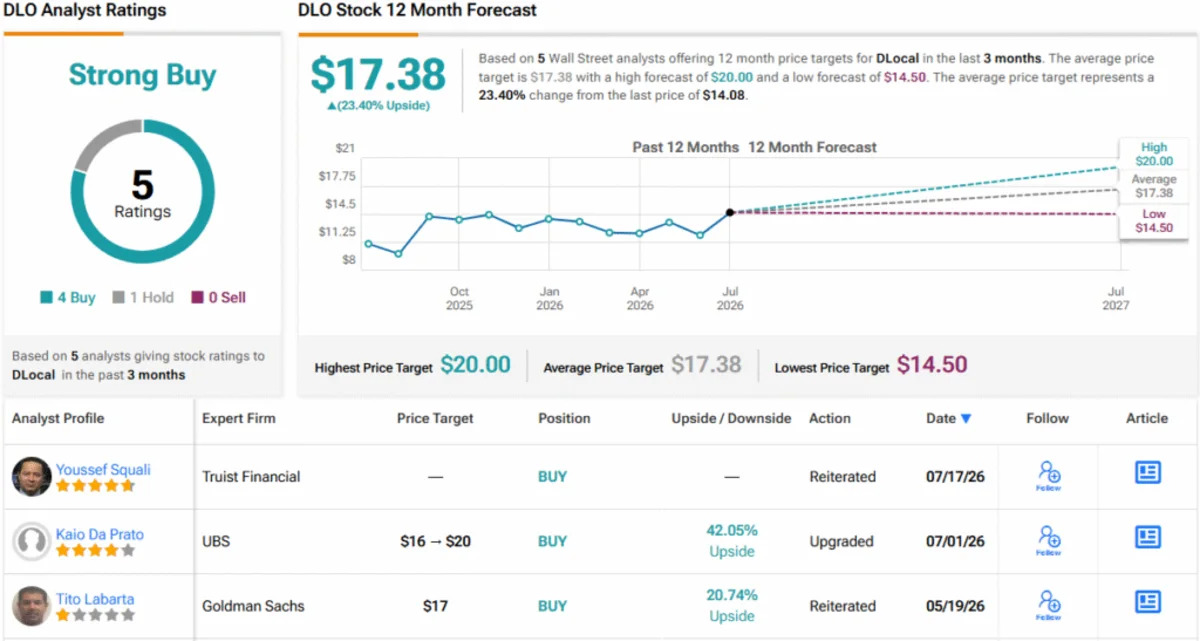
Prado goes on to put a Buy rating on DLO shares, along with a $20 price target that implies a one-year upside potential of 42%. (To watch Prato’s track record, click here)
Wall Street is largely on board with the bullish outlook. DLO earns a Strong Buy consensus rating based on 5 recent analyst reviews, including 4 Buys and just one Hold. The stock is priced at $14.08 right now, and its $17.38 average target price indicates room for a gain of 23% by this time next year. (See DLO stock forecast)

FuelCell Energy (FCEL)
AI may be grabbing most of the headlines, but UBS’s next diversification idea comes from a very different corner of the market. As its name suggests, FuelCell Energy specializes in fuel cells, a technology that will almost certainly have an important place in the coming green economy. Fuel cells use electrochemical reactions, rather than combustion, to extract energy from a mixture of fuel and air, avoiding the pollutants typically associated with burning fuel. The result is a cleaner, more efficient way to generate electricity, and FuelCell has developed a modular system that allows individual cells to be stacked, making it easy to scale power output to meet a wide range of customer needs.
Using its fuel cell technology, FuelCell is working to achieve its own stated commitment to help develop a net of zero carbon emissions by 2050. The company has 188 plants in operation around the world, and boasts that 93% of its plants’ materials can be recycled when their useful lives end – that is, in addition to providing clean energy, the company also avoids producing large-scale industrial waste.
FuelCell is working with the data center industry to provide on-site, off-grid power at large scale. The company has built a successful track record of putting power plants into operation at 10 megawatts, 20 megawatts, and 58 megawatts, and of keeping them in operation for more than five years. That combination of output and longevity is what the fast-growing data center industry needs. In addition, FuelCell can meet needs for modular scalability, high-level efficiency, and fast deployment of power generation capacity.
In recent weeks, FuelCell has announced two important moves that caught the attention of investors and analysts alike. On June 24, the company announced a strategic agreement with Fit Energy USA to provide up to 380 megawatts of power installations – ‘clean, baseload on-site power for data centers.’ And, on July 9, the company announced a collaboration with Siemens to speed up the growth of large-scale fuel cell power generation. Under the agreement, Siemens will build out electrical balance of plant systems for fuel cell power installations to be provided by FuelCell.
This company has recently released its 2Q26 results (the quarter ending this past April 30), and we should note that FuelCell missed expectations at both the top and bottom lines. The company’s revenue, at $35.6 million, was down almost 5% year-over-year, and came in $4.92 million below estimates; the earnings, expressed as non-GAAP EPS, came to a net loss of ($0.53). While this was a significant improvement from the ($1.53) reported in 2Q25, this figure still missed the forecast by a dime. The company’s backlog declined 10% year-over-year, but remains hefty at $1.14 billion.
The stock has gained significantly this year, though it hit a setback earlier this month after the company announced a large public stock offering. The offering raised $225 million in gross proceeds, before any exercise of the underwriters’ option, with the funds earmarked to expand manufacturing capacity and support the company’s rapid growth. The shares are now down about 35% from their late-June peak. Even so, the stock remains up an impressive 219% for the year.
Laying out the UBS case for this stock, 5-star analyst Manav Gupta writes: “We see upside to sales estimates driven by recent order from Fit Energy. We also see technical innovation driven by collaboration with Siemens making the offering more competitive. While the market remains focused on FCEL’s challenges around project execution and profitability, success in medium-scale deployments could represent a meaningful source of incremental revenue. The key catalyst will be the company’s ability to consistently secure and execute commercial projects that demonstrate repeatable customer demand rather than isolated transactions… We would be buyers ahead of any capacity expansion announcement, which we believe could serve as a meaningful catalyst and drive a re-rating of the shares.”
Gupta’s comments support his Buy rating on FCEL, while his $27 price target suggests a ~16% gain for the shares on the one-year horizon. (To watch Gupta’s track record, click here)
Gupta’s optimism exceeds that of most of his peers. While FCEL carries a Moderate Buy consensus rating based on 4 Buys, 2 Holds, and 1 Sell, the average analyst price target stands at just $22.83, slightly below the current share price of $23.30. (See FCEL stock forecast)

Disclaimer: The opinions expressed in this article are solely those of the featured analysts. The content is intended to be used for informational purposes only. It is very important to do your own analysis before making any investment.