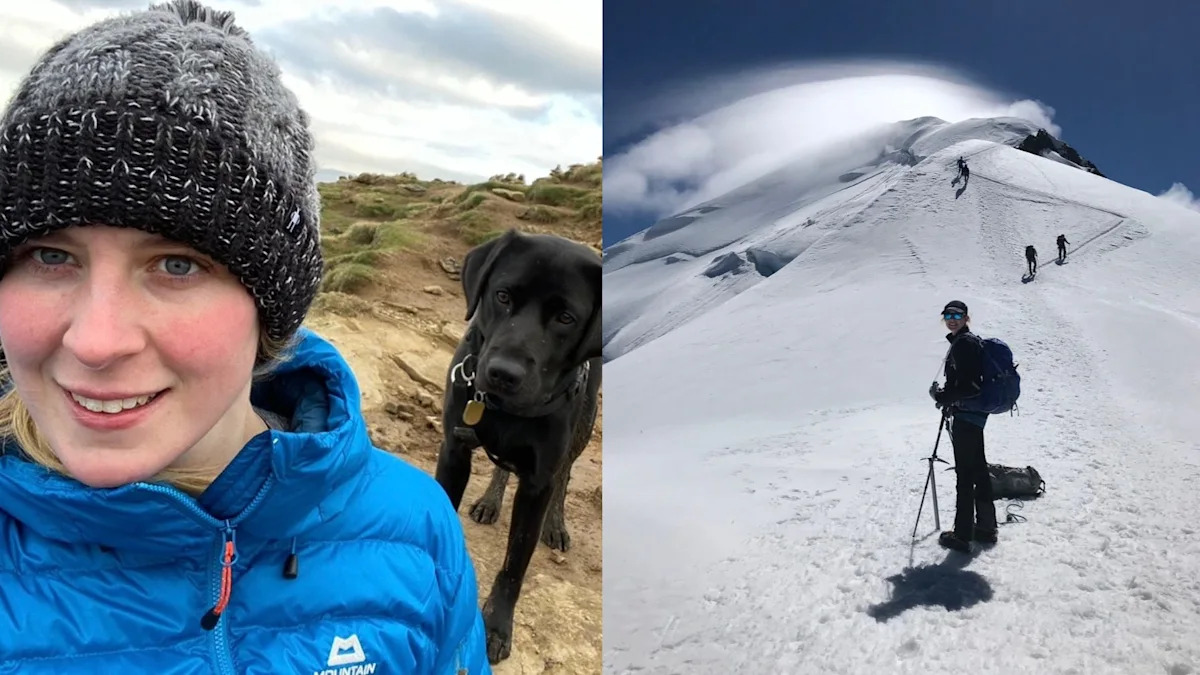
A visually impaired mountaineer is hoping to become the first woman with sight loss to summit a towering mountain in the Swiss Alps.
Lucy Hobson, 33, who lives in Stockport, Greater Manchester, has optic atrophy, a genetic condition where the optic nerves shrivel rather than form, which causes permanent vision loss. Her condition has progressed since childhood, where she had struggled to read the board in school, to developing blind spots in her 20s which have left her with little central vision and loss of peripheral vision.
But Lucy has found solace in hiking and climbing, going from simple day hikes in the Peak District to tackling Everest Base Camp in Nepal and Mount Kilimanjaro in Tanzania, bouldering at her local climbing gym, and taking on some of Europe’s most technical mountain climbs.
This August, she will attempt to summit the Zinalrothorn, a 4,221-metre peak in the Pennine Alps of Switzerland, and hopes to become the first woman with sight loss to reach the summit.
Lucy had originally planned to climb the 4,478-metre Matterhorn in Switzerland, a feat that would make her the first female climber with sight loss to reach the top, but was forced to change to Zinalrothorn because of adverse weather forecasts.
She is excited and trepidatious about her attempt, and maintains that “once you take that first step, you’ll never look back”.

Lucy on an alpine adventure (Collect/PA Real Life)
Lucy’s love for hiking and climbing really took hold at 22, when she started working at the North Face store in Manchester’s Trafford Centre and heard colleagues discussing a hiking trip to Edale in the Peak District. She had hiked when she was younger, going on trips to the Peaks and Lakes as a child, but had not been for years – certainly since her eyesight had begun to deteriorate further.
“I went out the next weekend with some friends, and then it became a bit of an addiction,” Lucy told PA Real Life.
“I liked being outside, I liked being surrounded by the open spaces, and although I can’t see the details of the scenery, I can see the contrast in the sky and the hills and darker shadows. I just really enjoyed it.”
Navigating varying terrains can be a challenge, Lucy admits.
“I can’t see my toes, so I can’t see the details of the ground, which makes it quite difficult – there are a lot of trip hazards,” she said.
“When I’m going up, it’s not too bad because you use your hands more and the ground is closer to you. But coming down, I find it really difficult because I just can’t see the ground properly. So I don’t know if I’m putting my foot down, and it’s going to be flat, or whether it’s rocky or got edges.”
Lucy’s friends are always happy to support her, helping her to navigate tricky terrain and mitigate the risk of injury.

Lucy said hiking became ‘a bit of an addiction’ (Collect/PA Real Life)
In day-to-day life she is also supported by her guide dog Jenny, who she got in 2021. Lucy said that having Jenny around has lifted a weight off her chest, helping her safely navigate places she does not know well, and helping her to get out and about with more confidence.
After that first trip, Lucy started hiking more regularly, and by 2019 she decided to join a multi-day trek with some friends to do the Tour du Mont Blanc, a 105-mile hiking circuit that passes through France, Italy, and Switzerland. She loved the challenge of hiking for days on end, and knew she wanted to take her hobby even further.
She trekked to Everest Base Camp, which sits at an altitude of 5,364 metres on the world’s highest mountain, in 2020, and climbed the 5,895-metre Mount Kilimanjaro in 2022.
Since she climbed Kilimanjaro, Lucy has had her sights set on the Matterhorn in the Swiss Alps. A highly technical and demanding climb, the peak demands scrambling, alpine rock climbing and excellent stamina, but Lucy was keen to take on the challenge.
She began training in rock climbing, first in bouldering, which is done on shorter walls without ropes, in 2023, taking her guide dog Jenny to the climbing gym and taking part in socials for disabled climbers. In 2025, she was forced to take a step back from bouldering after a bad fall left her with fractured vertebrae, but she has since moved to top-rope climbing and is part of Team GB’s Paraclimbing team.

Lucy and Jenny in the climbing gym (Collect/PA Real Life)
In 2023, to prepare her for the demands of the Matterhorn, Lucy completed a gruelling ascent of Mont Blanc in France, raising funds for the Guide Dogs charity alongside her guide, Catalin. She reached the highest altitude she had ever been to in October 2025, when she climbed Mera Peak in Nepal, which stands at 6,476 metres.
Feeling as ready as she would ever be, she planned her trip to the Swiss Alps for August 2026, where she would tackle the Matterhorn alongside Catalin.
She also took a trip to Wales in early July to work on her scrambling skills, where climbers use their hands and feet to move up steep, rocky slopes, and she felt the training weekend was “either going to make or break me”.
“This is either going to be like: ‘OK, it’s a possibility, and you’re as ready as you’re ever going to be’. I mean, there’s always room for improvement,” Lucy smiled.
“Or it’s going to be like: ‘Why have I signed up for this?'”
Thankfully, Lucy came away feeling confident, with the full backing of her guide, and felt prepared for her monumental attempt on the Matterhorn in August.
However, at the end of July, Lucy learned that adverse weather forecasts meant the mountain could not be summited when she was hoping to.

Lucy at the summit of Mont Blanc (Collect/PA Real Life)
While she was devastated to not be able to tackle the Matterhorn this year, she is instead planning to climb Zinalrothorn, another peak in the Swiss Alps which also features high-alpine climbing routes, sharp ridges, and plenty of challenges.
If she is successful, Lucy believes she will be the first visually impaired woman to summit Zinalrothorn.
Through all of her feats, Lucy has set out to make herself proud, to push her limits, but also to show other people that they can achieve anything they set their minds to.
“When I started doing these kinds of challenges, it was just for myself, really,” she said.
“It is what I enjoyed, and it is what made me happy. I always suffered a lot with depression, and this helps me a lot.
“And then, aiming a bit higher… (I can) show people that if I can do it, if you’re thinking about wanting to do something and there’s something stopping you, just go and do it.
“Because once you take that first step, you’ll never look back.”
To find out more about Guide Dogs, visit: www.guidedogs.org.uk