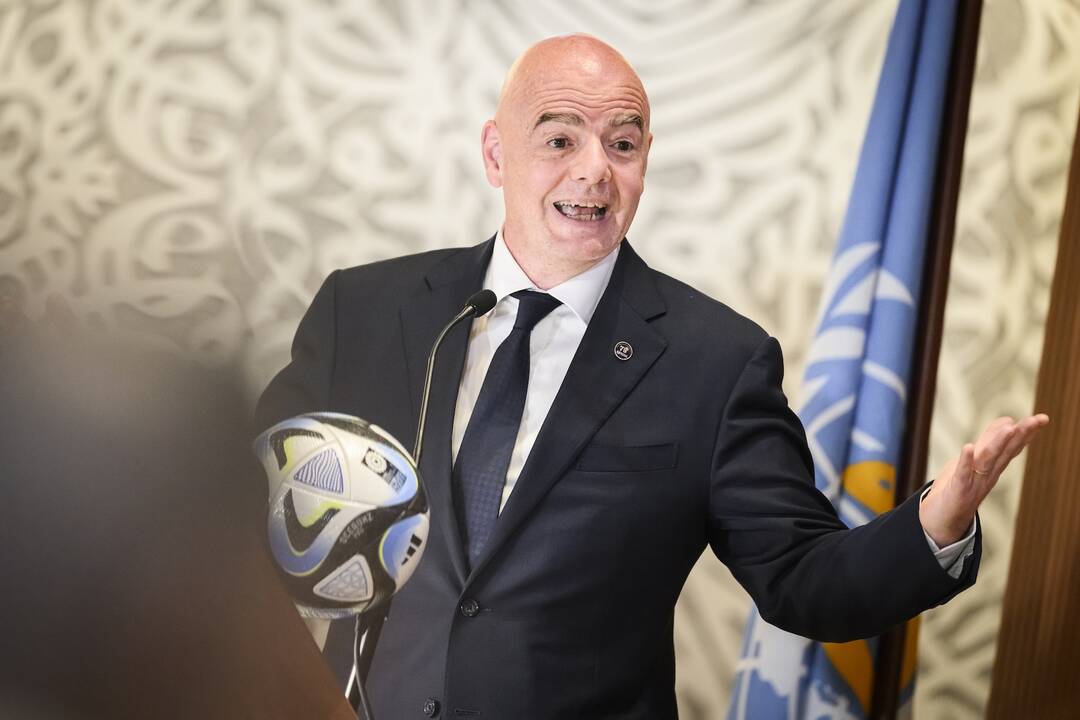
Amid the ongoing fallout from Fifa’s governance crisis, international agencies are not saying much about how this reflects on cooperation deals signed in recent years as the football organisation sought international legitimacy, including some that have come under fire.
Roughly 200 kilometres from the Zurich headquarters of the global football body Fifa, international Geneva is reckoning with the fallout from years of ties to the football organisation and its peripatetic president, Gianni Infantino, now at the centre of its biggest governance crisis in a decade.
Following his election in 2016, the Swiss-Italian became a fixture at United Nations agencies and other international organisations, courting directors and trading on the football body’s outsized membership – bigger than the UN’s own – to secure multiple cooperation agreements.
But cash-strapped UN organisations cooperating with Fifa are now trying to avoid facing scrutiny as Infantino comes under increasing pressure to step down following the announcement of a controversial plan to open up Fifa to private investment. The investment plan, allegedly backroom-crafted and since withdrawn, would be reportedly led by Joshua Kushner, the brother of president Donald Trump’s son-in-law, Jared Kushner.
The move, which comes just months before Fifa presidential elections, added to a list of grievances against the organisation’s leadership. It comes on the heels of a much-criticised World Cup that included Infantino’s alleged role in overturning a US player’s red card after a phone call with Trump on the subject, accusations of price-gouging, game rule changes to suit commercial interests and silence over immigration hurdles faced by fans, players and staff from Iran, Somalia and other countries. Just months before, Infantino had already raised eyebrows by awarding Trump a special peace prize.
‘Not theirs to take’
In the early days of the Covid-19 pandemic in 2020, Infantino’s appearance with the World Health Organisation director general, Tedros Adhanom Ghebreyesus, at press briefings at WHO headquarters provided an early glimpse into the relationship Fifa was building with the UN.
The two organisation heads announced plans to cooperate on fighting the virus through awareness campaigns. Infantino later returned to Geneva in February 2021 to say that the 2022 World Cup in Qatar will allow for in-person attendance, despite epidemiologists warning of the risk of a new Covid spike. Then, in 2024, Fifa provided $5 million to a WHO initiative to help World Cup organisers and communities cope with extreme heat from its newly launched 2022 World Cup Qatar Legacy Fund. Human rights NGOs accused the initiative of failing to assist those most impacted by the tournament.
The UN refugee agency, UNHCR, and the World Trade Organization (WTO) also benefited from the fund, together receiving $45m.
“It wasn’t theirs to take,” says Nick McGeehan, director of FairSquare, a human rights advocacy group often reporting on violations relating to international sports organisations, about the agencies receiving the funding. “It’s hard for organisations to turn down money when they’ve got budget shortfalls. Far more thought should have gone into that decision. They took that money from the families of migrant workers who either died or lost livelihoods.”
An investigation by The Guardian newspaper found that at least 6,500 immigrant workers had died during the construction of the Qatar World Cup venues, though the emirate and Fifa insisted that only three people died as a direct result of their World Cup-related work. The International Labour Organization (ILO) also reported a limited number of deaths, while defending Qatar’s labour reforms. More recently, the ILO proposed moving its regional hub to the Gulf state, as part of its cost-cutting measures following deep US funding cuts, citing “support from host government”.
Read more: With WTO, Fifa scores one more in Geneva
Meanwhile, Fifa’s Legacy Fund support to the WTO has gone to a programme benefiting some 300 women entrepreneurs in developing countries, providing them with technical assistance and grant funding. Another WTO-Fifa partnership assists cotton-producing countries in West Africa move up the supply chain to produce textiles and sportswear.
The UNHCR also has an ongoing agreement with Fifa to help displaced people and their communities through access to sports, education and other opportunities. The refugee agency told Geneva Solutions it has not quantified funding from Fifa, which was “up to the donor to specify”, nor was it able to say where it goes. Fifa did not respond to questions regarding funding to the refugee agency and WTO from its controversial Legacy Fund.
Cooperation and neutrality
When asked whether they would continue their partnerships with Fifa in light of the various governance and other issues at the football body, international organisations would not comment on the specifics.
The UNHCR wrote: “We remain strictly neutral, impartial and independent in service of people forced to flee…we continuously monitor partnerships to ensure they deliver positive impact for the people we serve.” The Geneva-based agency assured it screens partnership proposals according to “UN due diligence principles” and their impact on refugees before entering into them.
For its part, the WHO, whose four-year memorandum of understanding with Fifa was last extended in 2023, said that its collaboration, including during the World Cup in Qatar, had delivered “practical results” and that Doha had supported its Healthy FIFA World Cup Qatar project with $6 million.
A spokesperson for the agency noted that with regard to current and future collaborations, “partnerships are subject to WHO’s internal review and oversight processes and are conducted in accordance with applicable regulations, policies and strategic priorities.”
The WTO said that it “regularly reviews all of its partnerships to ensure they continue to serve the organisation’s mandate and institutional priorities”.
Nonetheless, observers still wonder how the UN agencies had signed deals with Fifa, in view of its legacy.
“There’s this broader view among serious policymakers that football is a fun and a great way to generate headlines, and that wholesome initiatives benefitting children are a good thing, and therefore Fifa must be a good thing,” McGeehan says. “But it is absolutely not. If you are concerned about political neutrality, then why get into bed with an organisation that appears happy to be a handmaiden to authoritarian states and leaders from Russia to Saudi Arabia to Qatar and the US?”
Funding needs and hubris
Simon Rofe, professor of sports diplomacy and management at Leeds Beckett University, says that in recent years, as a counterweight to Fifa’s growing commercial activities, Infantino has sought to build the kind of international legitimacy that the International Olympic Committee gained when, in 2009, it obtained permanent observer status at the UN General Assembly in 2009.
“When the opportunity arose with the Covid pandemic, Infantino and Fifa sought engagement – even refuge – in the relationships with lots of the UN family of organisations,” he says. “Partnerships are more like ally-ships, where there may be a commercial benefit, but there’s also a legitimising benefit.”
Just like the UN, Fifa depends on external funding to carry out its mandate of developing and promoting football worldwide.
According to Rofe, Infantino’s privatisation plan echoes strategies used by his predecessors, including Sepp Blatter, who was forced out of office in a leadership-wide corruption scandal. Rofe argues he may have taken a gamble to raise funds while “playing more to the masses”, with tens of millions of dollars at stake for national member football associations that would endorse it.