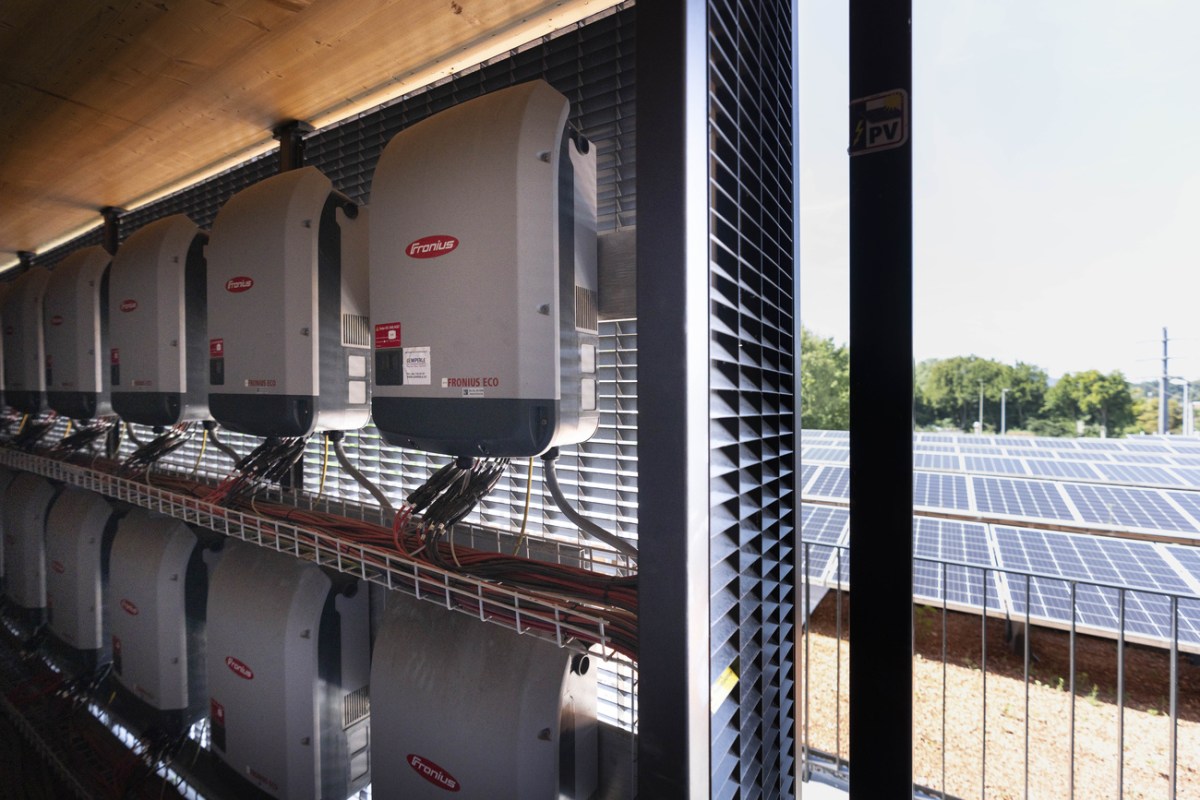

Batteries are an essential part of home solar energy systems
Keystone / Gaetan Bally
Summer 2026 is shaping up to be one of the hottest ever recorded in Switzerland. These are ideal conditions for driving solar energy production, which is reaching record levels. The related market of home batteries, designed to store photovoltaic electricity, is also experiencing strong growth.
Listen to the article
Listening the article
Toggle language selector
English (US)
English (British)
Generated with artificial intelligence.
This content was published on
August 5, 2026 – 15:52
Céline Fontannaz and Raphaël Dubois, RTS
Compared to July 2025, clean solar energy production jumped 43% last month, according to data from Energy-Charts. This increase is explained by exceptional sunshine, but also by the continued growth in the number of photovoltaic installations across the country.
As rooftops become covered with solar panels, a new challenge emerges: making the most of this electricity. Because at midday, when the sun is at its highest point, production often exceeds consumption, and the grid cannot absorb all the surplus. Some of this energy is then lost.
More

More
Climate solutions
I went solar in Switzerland – I now know why many people don’t
This content was published on
Feb 11, 2026
Swissinfo journalist Kristian Foss Brandt shares his experience with rooftop solar, which showed him what’s preventing other people from embracing the technology.
Read more: I went solar in Switzerland – I now know why many people don’t
For the industry, storage batteries are now an increasingly relevant solution. “We often produce more energy in the middle of the day, while consumption is higher in the morning or evening,” said Anna Plancherel, director for French-speaking Switzerland at Swissolar.
Batteries complementary
“The solution is to bring flexibility to this electrical system.” Storage is not essential for the installation of photovoltaic panels, says Anna Plancheral, “but it is a complementary solution.”
For Jérôme Menoud, director and founder of Sungrid, a small company specialising in photovoltaics, batteries have become an almost natural complement to photovoltaic installations. “We produce energy during the day, but that’s not necessarily when we consume it. So it’s important to be able to store it for use when needed.”
More

More
Climate adaptation
Science podcast: the 2000-watt society – a Swiss experiment in sustainable living
This content was published on
Mar 6, 2026
Join us as we delve into the 2000-watt society and its significance for energy efficiency and environmental responsibility.
Read more: Science podcast: the 2000-watt society – a Swiss experiment in sustainable living
The economic appeal of battery storage has increased significantly in recent years. On the one hand, the price at which homeowners sell their electricity back to the grid has fallen sharply. On the other hand, the cost of batteries has dropped.
The evolution of prices further reinforces this logic. “The cost has been halved. Just a few years ago, it was CHF1,000 per kilowatt-hour. Today, it’s half that.” At the same time, “the buyback price for the excess energy produced during the day has decreased significantly. Installing batteries has therefore become very profitable,” said Menoud.
Today, according to the electricity supplier Groupe E, approximately one in two new photovoltaic installations is sold directly with a battery. And many homeowners who already have installations are now adding batteries to their existing systems.
More

More
Climate adaptation
Switzerland sees battery boom as homes and firms store more solar power
This content was published on
Mar 25, 2026
A rapid but mostly invisible energy transformation is taking place in Switzerland: households and businesses are installing batteries at record pace, rising roughly 400% over the past four years.
Read more: Switzerland sees battery boom as homes and firms store more solar power
Cantons subsidise home solar energy
Public authorities are also supporting this development. The canton of Neuchâtel has been subsidising battery installations at a rate of 15% since March. Other forms of assistance are available, notably in Payerne, Bulle, and via Geneva Industrial Services.
And it’s already proving successful. “In about five months, we’ve received some 140 applications. That’s satisfactory,” notes Neuchâtel cantonal politician Laurent Favre. The goal is “to encourage homeowners to better manage their photovoltaic production to boost self-consumption,” while also relieving pressure on the electricity grid. He indicates that, in the long term, if prices continue to fall, these subsidies could disappear. The industry is forecasting growth in solar power by 2026. It anticipates a 17% share of photovoltaics in the Swiss energy mix, compared to 14% in 2025. This increase will be driven by both new panels and improved utilisation of the energy produced.
+ How we produce English news
Translated from French, reviewed by an English Department journalist.
Articles in this story