Your support helps us to tell the story
From reproductive rights to climate change to Big Tech, The Independent is on the ground when the story is developing. Whether it’s investigating the financials of Elon Musk’s pro-Trump PAC or producing our latest documentary, ‘The A Word’, which shines a light on the American women fighting for reproductive rights, we know how important it is to parse out the facts from the messaging.
At such a critical moment in US history, we need reporters on the ground. Your donation allows us to keep sending journalists to speak to both sides of the story.
The Independent is trusted by Americans across the entire political spectrum. And unlike many other quality news outlets, we choose not to lock Americans out of our reporting and analysis with paywalls. We believe quality journalism should be available to everyone, paid for by those who can afford it.
Your support makes all the difference.Read more
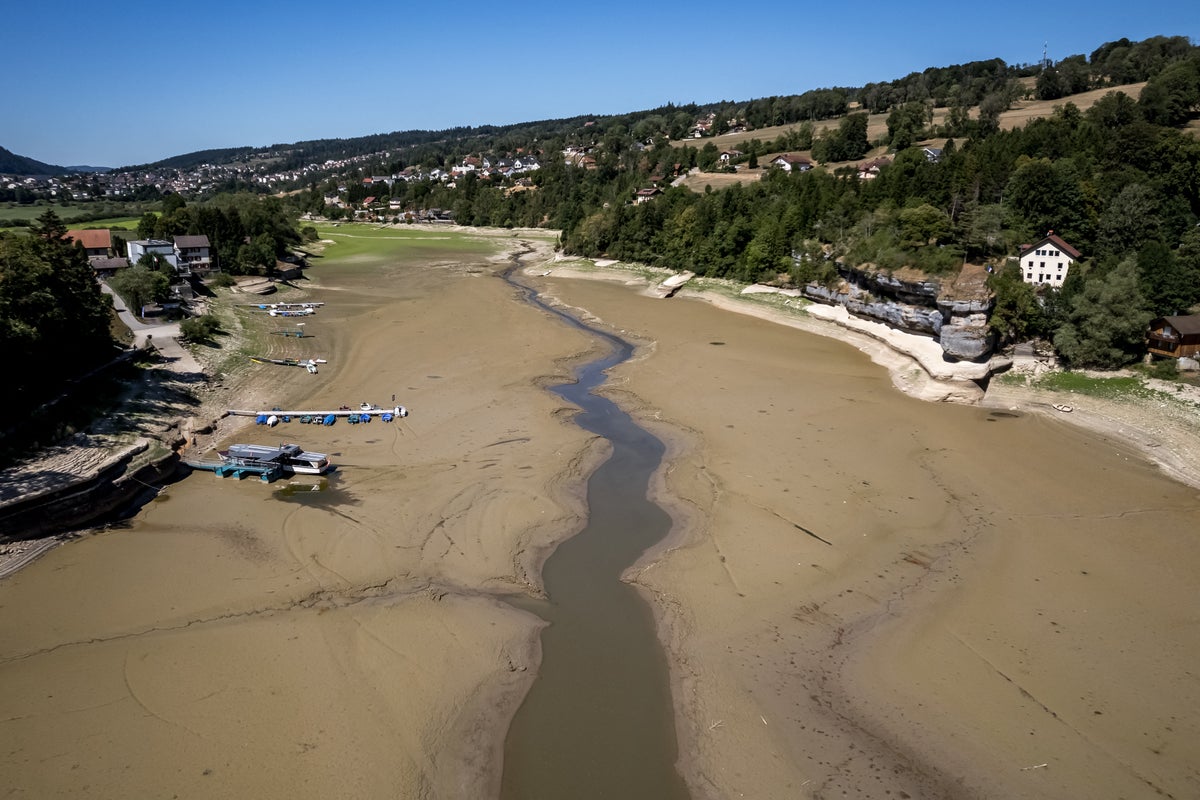
A lake that is famed for it’s beauty, often starring in tourists’ Instagram snaps, has been left almost drained by a prolonged drought across Europe.
Lake Brenets, a winding lake on the Swiss-French border, is normally packed with campers, swimmers and canoeists in the summer.
Boat companies also ferry thousands of tourists across it each summer season, but not this year.
The lake has been left virtually deserted as water levels in the River Doubs, which feeds it, have fallen sharply following months of scant rainfall and three successive heatwaves, the latest of which is still under way.
Dozens of boats are stranded high and dry on the cracked mud, including “Jumbo”, a tourist vessel operated by Yvan Durig, owner of the Societe de Navigation des Brenets.
“It’s hitting us hard because we’re powerless in the face of this phenomenon,” he said.
 A French flag is pictured on a cliff at the nearly empty Lake Brenet, as drought conditions affecting the Doubs River lower water levels at the Swiss-French border in Les Brenets, Switzerland, July 30, 2026 (Reuters)
Already, he has had to lay off his team and is concerned about making a loss for the year, with water levels now more than 9 metres (30 feet) below average and falling by around 22 centimetres (9 inches) a day.
With rainfall about half of the usual levels since April, the MeteoSuisse weather agency says this year’s drought is comparable to some of the country’s worst in 1976, 2003 and 2018. Its long-term forecasts suggest below-normal rainfall will continue until mid-August.
While the lake has experienced droughts in the past that have hit business, Durig said that their frequency has increased.
 Yvan Durig, owner of the Societe de Navigation des Brenets, poses in front of a moored boat on the nearly empty Lake Brenet, as drought conditions affecting the Doubs River lower water levels at the Swiss-French border in Les Brenets, Switzerland, July 30, 2026. REUTERS/Denis Balibouse (Reuters)
“These droughts are occurring in rapid succession, something we’ve never seen before,” he said.
The lake’s remaining water is brown and reduced to a thin central ribbon, where fish are now confined and a couple of swans paddle. A nearby waterfall that flows out of the lake, the Saut de Doubs, has virtually dried up, residents say.
“It’s so beautiful when there’s water, when it’s flowing. It’s an idyllic, wonderful place,” said Martial Beyeler, a 69-year-old resident. “It makes me sad to see the place like this.”