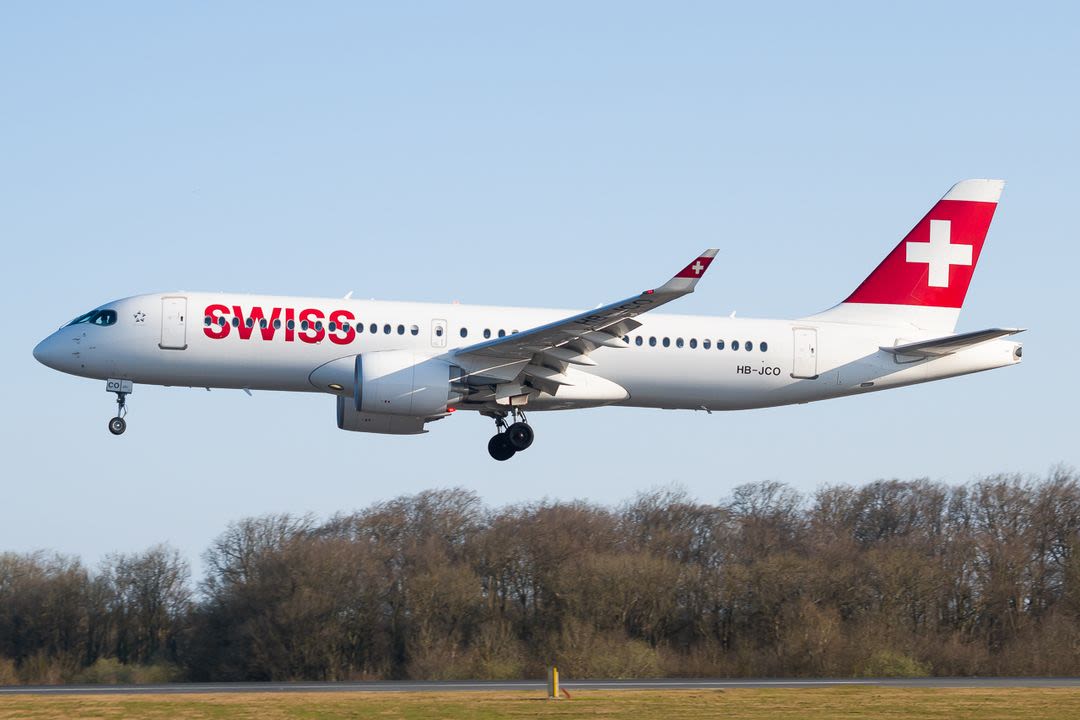
Swiss International Air Lines (SWISS) has confirmed plans to retire its entire Airbus A220-100 fleet by the end of 2027, closing a chapter that began just a decade ago. The Lufthansa Group subsidiary will remove all nine of the smaller A220 variants from service, while retaining and expanding its fleet of the larger A220-300 model.
Photo: AeroXplorer / Lucas Wu
A Short-Lived Chapter
SWISS became the launch operator of the A220-100 (originally known as the Bombardier CS100) in 2016, when the aircraft entered commercial service on a route from Zurich to Paris. The carrier positioned itself as a pioneer of the type, playing a central role in bringing the Canadian-designed jet into service before Bombardier sold the program to Airbus in 2018.
Now, just ten years after that inaugural flight, the airline has decided that operating two subvariants of the same aircraft family no longer makes economic sense. The airline will consolidate around the larger A220-300, which offers greater seating capacity and improved unit costs on the regional routes SWISS operates from its Zurich hub.
Reasons Behind the Decision
According to SWISS, the retirement decision stems from a combination of factors. Operating a mixed subfleet of A220-100s and A220-300s creates complexity, and the smaller variant carries fewer passengers while incurring similar crew and operational costs. Consolidating to a single subtype simplifies scheduling, maintenance planning, and crew rostering.
The airline has also faced well-documented reliability challenges with the Pratt & Whitney PW1500G engines that power the A220. Engine availability issues have grounded aircraft across multiple operators worldwide, forcing carriers to reassess their fleet strategies. SWISS has been among the airlines most affected, with capacity constraints influencing planning across its short and medium-haul network.
What Replaces the A220-100
SWISS plans to grow its A220-300 fleet to compensate for the retirement of the smaller variant. The A220-300 seats roughly 149 passengers in the airline’s configuration, compared with approximately 125 seats on the A220-100. That additional capacity allows the carrier to carry more travelers per departure without significantly higher operating costs.
The move also aligns SWISS with broader Lufthansa Group fleet planning. The parent company has been reshaping its short-haul operations across multiple subsidiaries, focusing on efficiency and standardization as it works to restore profitability at its European operations.
Impact on Operations
The retirement will not happen all at once. SWISS intends to phase the aircraft out gradually through 2026 and 2027, matching the arrival of replacement capacity to avoid disruptions to its network. Passengers should not notice significant service changes during the transition, as the airline will continue operating the same routes with different equipment.
For the wider industry, the decision raises questions about the long-term future of the A220-100. As the launch customer, SWISS held a symbolic position in the aircraft’s history. Its exit from the smaller variant leaves fewer operators flying the type, with Delta Air Lines remaining the largest A220-100 operator globally.

Photo: AeroXplorer / Sebastien Gigot
Looking Ahead
Airbus continues to market the A220 family as a strong performer in the 100 to 150 seat segment, and the manufacturer has focused most of its sales efforts on the A220-300. Reports suggest Airbus is also studying a potential stretched A220-500 variant, which would push the family further into competition with the A320neo.
For SWISS, the retirement marks the end of a distinctive era. The airline that helped launch the A220 program will soon fly only one version of the aircraft it once championed.