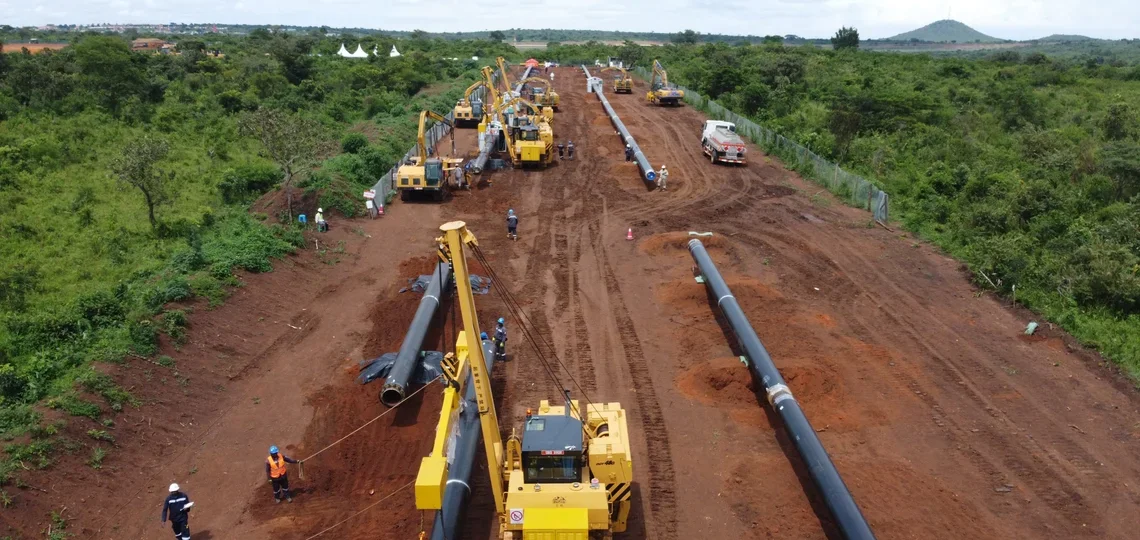
Uganda is seeking to diversify its oil import and export routes through a new Tanzanian energy hub located in Tanga. The Tanzania Petroleum Development Corporation (TPDC), the Uganda National Oil Company (UNOC) and international trader Vitol Bahrain E.C. signed a non-binding memorandum of understanding in Dar es Salaam on Thursday, August 6, 2026 to develop the site, named the “Tanga Regional Energy Hub.” The project comes as global oil markets remain marked by price volatility, a backdrop that has also helped lift quarterly earnings at ExxonMobil and Chevron. The stated goal is to reduce Uganda’s dependence on Kenya’s Mombasa corridor, the only maritime access route the landlocked country has used until now.
A long-standing dependence on the Kenyan corridor
Uganda has no direct access to the sea. Historically, the vast majority of the country’s fuel imports have transited through the Kenyan port of Mombasa and the network of the Kenya Pipeline Company (KPC), the Kenyan state-owned operator of petroleum transport and storage, partially privatized in 2026. A commercial and regulatory dispute with Kenya temporarily disrupted Uganda’s access to this infrastructure, prompting Kampala to file a case with the East African Community’s court. A compromise was eventually reached a few months later.
The episode left a lasting mark on relations between the two countries and accelerated Uganda’s search for alternative supply routes. It is against this backdrop that the memorandum of understanding on the Tanga energy hub, on Tanzania’s Indian Ocean coast, was signed. The site is already the planned endpoint of the heated pipeline linking western Uganda’s oil fields to international markets, known as the East African Crude Oil Pipeline (EACOP). The agreement signed in early August remains non-binding at this stage.
Refining, storage and logistics under consideration
The memorandum aims to complement this crude export infrastructure with refining, storage, logistics and distribution capacity for petroleum products. The stated goal is to prevent Uganda from simply exporting crude oil only to reimport refined products at a premium. A separate national refinery project is also under way in Kabaale, in the west of the country. Its timeline, however, remains later than the start of crude production, and its financing still depends on a final investment decision expected in the near term.
The memorandum brings together the Tanzania Petroleum Development Corporation, the Uganda National Oil Company and Vitol Bahrain E.C., a subsidiary of international trader Vitol. The latter is playing an increasingly prominent role in the region’s energy architecture. It is already Uganda’s exclusive supplier of refined petroleum products, under a separate agreement signed after the rupture with Kenya.
Financing and a stake in KPC
Vitol Bahrain E.C. has also extended financing to UNOC for investments in the country’s petroleum and road infrastructure. Part of that financing allowed Uganda — not the trader itself — to become a minority shareholder in the Kenya Pipeline Company, as part of the company’s partial initial public offering. The exclusive fuel supply contract and the more recent infrastructure loan are two distinct transactions, and confusion between them ranks among the frequent errors found in media coverage of the deal.
The memorandum was signed under the authority of Ugandan President Yoweri Museveni, in power since 1986, and Tanzanian President Samia Suluhu Hassan, in office since 2021. On the Ugandan side, the file is now overseen by Dr Monica Musenero Masanza, Minister of Energy and Mineral Development since the cabinet reshuffle at the end of May 2026. She succeeded Ruth Nankabirwa Ssentamu, who had held the post since June 2021 and was appointed senior presidential advisor shortly before the Tanga memorandum was signed. On the Tanzanian side, Energy Minister Deo Ndejembi is also associated with the project.