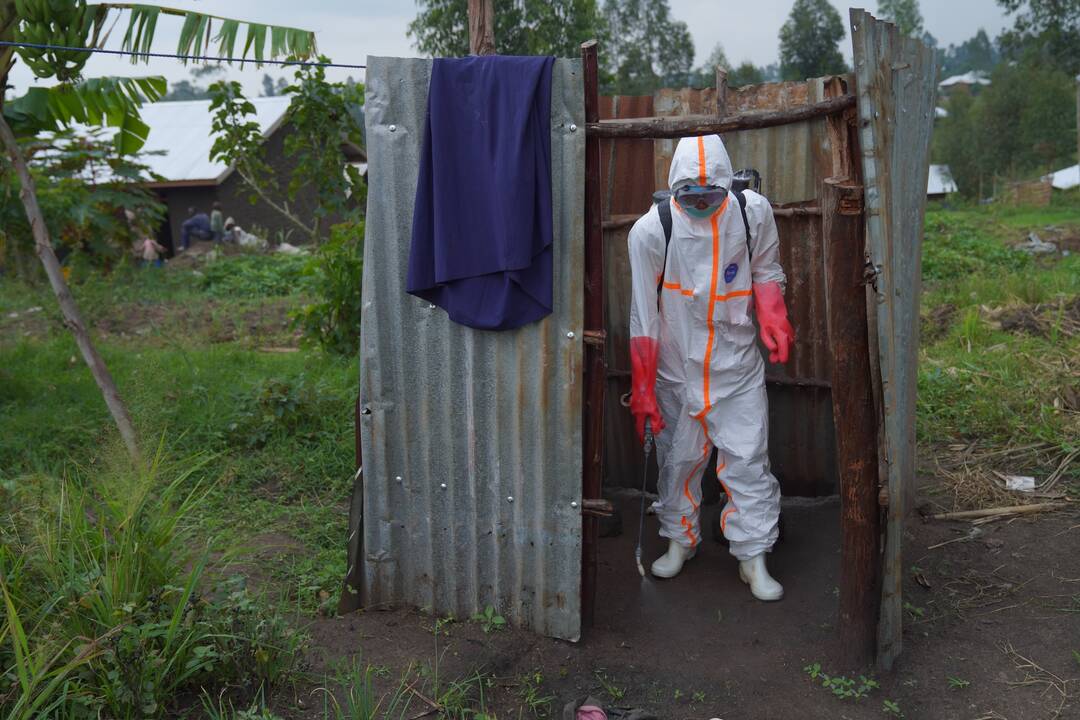
The race to develop a vaccine to help stem the Ebola outbreak is intensifying as it becomes the world’s second-largest on record and the fastest-spreading. Aurélia Nguyen, deputy CEO of Cepi, the non-profit leading vaccine efforts, appears nonetheless optimistic.
The World Health Organization warned last week that the Ebola outbreak in the Democratic Republic of the Congo is now the second largest on record, only behind the 2014-2016 outbreak in West Africa that infected 28,000 people and killed 11,000. But this one is moving at an unprecedented speed: more than 4,000 people have been infected, and 1,800 have died nearly three months after the UN health agency declared it a Public Health Emergency of International Concern.
Elsewhere, the race is on to develop a vaccine before the epidemic spreads regionally. “Every countermeasure is going to be essential – diagnostics to identify, therapeutics to treat and vaccines ultimately to prevent,” says Aurélia Nguyen, deputy chief executive officer of the Coalition for Epidemic Preparedness Innovations (Cepi), an Oslo-based non-profit leading vaccine development efforts.
Geneva Solutions spoke to Nguyen about whether efforts are moving fast enough to avert a further catastrophe – and how Ebola is testing global commitments on pandemic preparedness six years after Covid-19 upended the world.
A race against the clock
First detected in Uganda in 2007, the Bundibugyo strain now quickly spreading across north‑eastern and eastern DRC has no approved vaccines. Cepi is currently backing four vaccine candidates through their testing phase.
“It’s a bit of a portfolio approach,” Nguyen says. “As with any portfolio, you want to diversify your assets to diversify your chances of success, and choose candidates with different strengths and weaknesses.”
Two have recently launched first-stage clinical trials, testing for tolerance and efficacy on healthy volunteers – Oxford University and the Serum Institute of India’s ChAdOx1 BDBV, and Moderna’s mRNA-1469, both built on technologies proven in Covid vaccines. Initial results are expected in late September or early October, with larger in-country trials to follow if they succeed, Nguyen explains. Another top contender, modelled on Merck’s Ervebo vaccine for the Ebola Zaire strain, holds great potential, though it would take months to produce.
“That shows how fast and flexible the combination of working with established partners and us doing our bit to mobilise the funding can be,” Nguyen says. “Of course, the science needs to be done rigorously, and if the candidates don’t work, we would stop them promptly. But if they do, they have real potential to help stem the epidemic.”
The Ebola outbreak has quickly become a live test case of the 100 days mission, a Cepi-led initiative endorsed by the WHO and the G7 that aims to rapidly deliver vaccines, diagnostics and therapeutics when a new pathogen emerges.
Hitting that ambitious target this time appears unlikely, but Nguyen argues there is progress. “Every time we have an outbreak, we get better and faster. Even looking at how quickly Oxford and Serum were able to produce a vaccine and get into the clinical trials, we have surpassed the Covid-19 timelines.”
Cepi’s new strategy focuses on understanding critical scientific and logistical bottlenecks to speed up vaccine delivery but also building a response that can adapt to any threat – whether from an accidental leak from a lab or a deliberate manipulation of pathogens with the help of AI.
“How do we understand the families the viruses live in, and the technologies and platforms we have? And how do we put in place the networks to rapidly connect these, and be better and faster than last time, whatever is thrown at us – a Bundibugyo, a hantavirus or a climate-induced disease spread that we didn’t expect.”
Fighting mistrust
The WHO has praised the pace of vaccine development. But can it beat the virus spread? The Africa Centres for Disease Control and Prevention and the World Health Organization have raised concerns that it may be mutating and have called to scale up the response within the communities.
But with the epicentre of the epidemic gripped by civil war, health authorities and aid actors have been struggling to keep up with the virus and treat those infected. Mistrust among the population following years of neglect has further complicated the response, including for a future vaccine rollout.
“As a funder of R&D, we have a strong obligation to make sure that the best information is available and that we act in a way that’s absolutely transparent,” says Nguyen. “And as difficult as it may be sometimes, we explain what the risks are, what the benefits of the interventions are.”
In places like the DRC, Cepi relies on organisations like the Geneva-based International Federation of Red Cross and Red Crescent Societies (IFRC) to work with communities on building trust. “When we get to rolling out the clinical trials, we are thoughtful of making sure that we take the time to really explain, engage community leaders, talk in a way that’s socially and culturally acceptable, and ensure that it’s not just about the trial, but also the broader picture, such as safe and dignified burials,” she says.
Slow-moving diplomacy in Geneva
On the diplomatic front, things are not moving any faster. A year has passed since countries adopted a pandemic agreement hailed as historic at the WHO, but negotiations on the specifics of a system under that deal for governments to exchange pathogen data collected for benefits stemming from vaccines and other countermeasures developed by industry as a result have stalled.
Cepi is one of the technical experts advising negotiations. Nguyen offers a first-hand perspective: “If we let market forces apply naturally, there’s no commercial return for epidemic pandemic diseases because they’re so unpredictable, and predictability is one thing that the private sector needs.” She believes a deal is necessary “even if it isn’t perfect”.
Cepi’s own funding agreements require manufacturers to guarantee vaccine access for low-income countries, typically through capped prices – an experience she hopes will help negotiators reach a minimum framework that sets standards and “helps all boats rise with the tide”.
A hefty bill for the future
Global health has also been struggling from aid cuts. Cepi’s own funding, largely from western donors like Germany, the United Kingdom and Norway but also philanthropic powerhouses like the Gates Foundation, has held steady. Even the US Congress has fought back against the Trump administration’s budget cuts for the organisation. Still, Nguyen worries about the wider sector.
“The chances of another pandemic in our lifetimes are more than not. So at some point, money will need to be spent in response to an epidemic or pandemic – whether you spend it now in preparedness or multiple times later in the response,” she says, citing a study from the International Monetary Fund’s economic review journal that put the annual cost of pandemic risk at over $700 billion going forward. “That’s annualised, but when an epidemic or pandemic happens, it’s all in one go. The Covid pandemic was $14 trillion just in direct costs!”
While Ebola may not attract the attention of a pandemic, UN experts warn of the economic fallout it will have for a population battered by decades of health crises and conflict.