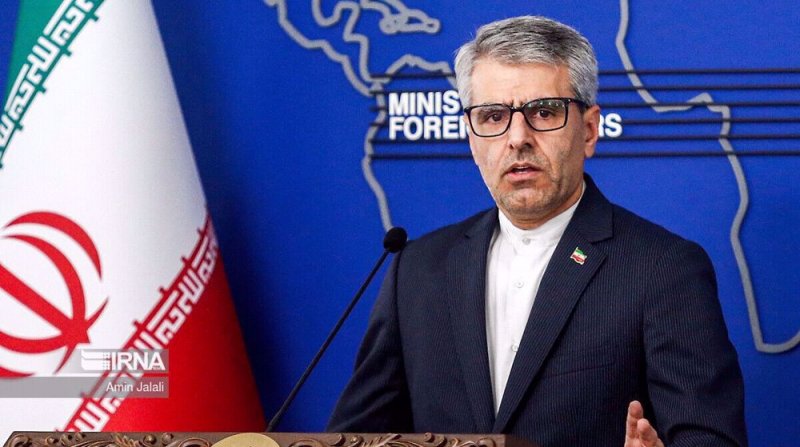
Iranian Foreign Ministry spokesman Esmaeil Baghaei has condemned US threats and airstrikes against Iran’s civilian infrastructure as clear war crimes, warning that normalising such “unprecedented violations” of the Geneva Conventions would erode the international legal order.
In a post on X on Wednesday marking the 77th anniversary of the adoption of the four Geneva Conventions, Baghaei said the architects of the treaties could scarcely have imagined that decades later, the United States, as the host of the United Nations and a permanent member of the Security Council, “would repeatedly threaten to attack the infrastructure, bridges and power plants of another country, and would in fact commit such crimes”, Iran’s English-language Press TV reports.
He said the conventions established fundamental rules governing armed conflict, including “humanity”, “distinction”, “military necessity” and “proportionality”, as well as the prohibition of “unnecessary suffering”, with the aim of “civilising humanity and humanising war”.
Adopted in 1949, the four Geneva Conventions establish international rules for the protection of civilians, wounded and sick combatants, and prisoners of war during armed conflicts.
The Iranian diplomat urged the international community, the states party to the Geneva Conventions and Switzerland, as their depositary, not to “remain indifferent to such unprecedented violations, which constitute clear war crimes”.
Baghaei also invoked Common Article 1 of the conventions, stressing that it requires states not only to respect the treaties but also to ensure that they are respected.
“Silence in the face of explicit threats against civilian objects is not mere political passivity,” he said, warning that such silence erodes one of the fundamental legal achievements of the post-World War II era.
Baghaei warned that airstrikes or threats targeting civilian infrastructure posed a broader threat to the security of all states, stressing that if the destruction of bridges, power plants, hospitals, electricity grids and water facilities became normalised, no country could be certain that its vital infrastructure would remain protected from external aggression.
“Wherever the law falls silent before power, what collapses is not merely a bridge or a power plant, but humanity’s confidence in the possibility of the rule of law in international relations.”
He also warned that the consequences of such threats would extend far beyond Iran, saying they represented “a regression of the entire legal order that humanity has built in its pursuit of civilisation and the restraint of violence”.
Baghaei further stressed that Iranians remained resolute in the face of such threats, reiterating that “no number of trials can break those who stand firm on the path of resolve”.
In remarks to the press on Tuesday, the Foreign Ministry spokesman said the Islamic Republic was standing up not only to defend its sovereignty and territorial integrity against US aggression, but also to uphold the humanitarian values and principles that humanity had developed throughout history.