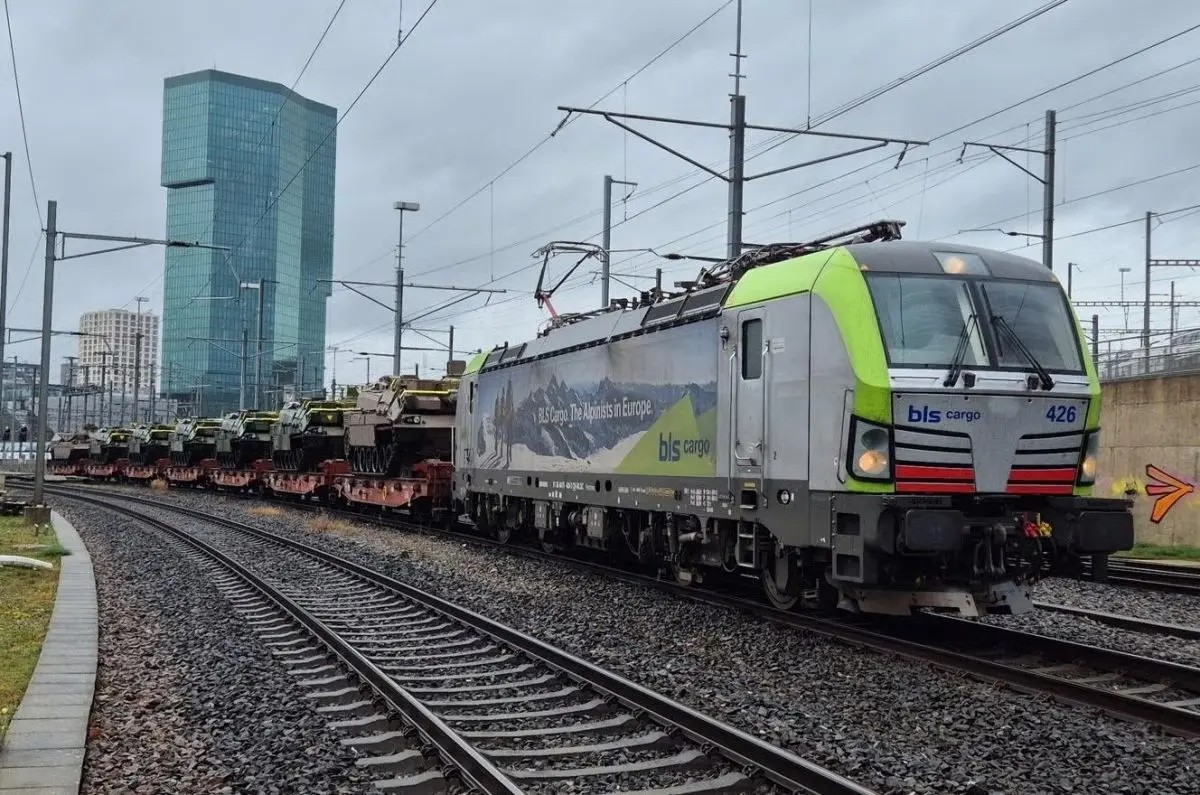
 Switzerland wants to extend financial support for rail freight transport through the Alps until 2035, after the rail sector’s market share fell for the fourth consecutive year. BLS Cargo supports the measure and warns that construction work, line closures and rising costs are causing significant losses for rail operators.
Switzerland’s policy of shifting freight transport from road to rail is facing an increasingly evident setback. The Swiss Federal Council is proposing to extend financial support for transalpine rail freight until 2035, with the total amount earmarked for the period 2027–2035 amounting to approximately EUR 515 million.
The measure comes after several years in which rail has lost ground to road transport.
In 2025, trains accounted for 68.6 per cent of freight transport crossing the Swiss Alps, marking the fourth consecutive year in which rail transport has lost market share to road transport.
The Swiss authorities estimate that a reversal of this trend is not expected before the end of the current decade.
Germany, one of the main challenges for freight trains
Among the main causes cited by the Swiss authorities are the insufficient quality and reliability of rail freight transport on the north–south European corridors, particularly due to engineering works and service disruptions in Germany.
The Swiss rail freight operator BLS Cargo describes the situation in even harsher terms.
The company cites construction works, line closures announced at short notice and total service suspensions lasting several weeks as factors leading to a high number of cancellations and delays.
According to BLS Cargo, these disruptions have become unacceptable to customers and are leading to both revenue losses and operational inefficiencies, as well as additional costs for rail operators.
Added to this are rising energy prices and increases in rail infrastructure charges in several countries.
BLS Cargo to post a loss in 2025
BLS Cargo states that these issues have had a direct impact on its financial results. The operator recorded a significant loss in 2025 and expects a similar situation this year.
The company’s traffic was further affected by the discontinuation, at the end of 2025, of the RAlpin service.
This service accounted for over 3,000 trains in 2025 for BLS Cargo, and its discontinuation led to a significant drop in the volumes transported by the company in 2026.
The outlook for the coming years remains challenging. BLS Cargo points to forthcoming partial and total closures on the Rhein Valley railway line in Germany, as well as the long-term disruptions expected on the Simplon route.
Approximately EUR 515 million by 2035
To prevent an acceleration in the shift of freight to road transport, the Federal Council is proposing amendments to the legislation on the modal shift in freight transport.
The operating subsidies granted to unaccompanied combined transport, which are currently set to expire in 2030, would be extended until 2035.
At the same time, the authorities intend to abandon the phased reduction in subsidies provided for in the current legislation by 2029. From 2030, the level of support is set to be gradually reduced.
For the period 2027–2030, the Confederation is set to allocate the equivalent of approximately EUR 58–63 million annually, after which funding is set to amount, on average, to approximately EUR 53 million per year.
In total, the operating support planned for the period 2027–2035 amounts to approximately EUR 515 million. The funds will come from taxes levied on petroleum products.
BLS Cargo wants the money to go entirely to rail operators
BLS Cargo welcomes both the extension of funding until 2035 and the decision to maintain higher contributions until the end of this decade.
However, the company is calling for the additional funds earmarked for the period 2027–2030 to go entirely to the rail freight operators who actually bear the additional costs.
BLS Cargo’s preferred solution would be for the Swiss Federal Office of Transport (BAV) to pay the compensation directly to the railway companies.
If funding continues to be channelled through combined transport service operators, BLS Cargo is calling for the full transfer of these sums to railway companies to be made mandatory by law or regulation.
The company believes that a mechanism based solely on the voluntary transfer of these funds would not guarantee that the support reaches the operators who actually bear the costs.
Rail is losing ground after years of modal shift policy
This development is all the more significant for Switzerland given that shifting heavy freight transport from road to rail has long been one of the country’s key policies in the field of transalpine transport.
However, figures for 2025 and, according to BLS Cargo, those for the first half of 2026 confirm that traffic continues to shift in the opposite direction, from rail to road.
In these circumstances, the operator believes that reducing financial support would place even greater pressure on the sector and advocates extending the funding mechanism until 2035.
Share on: 


