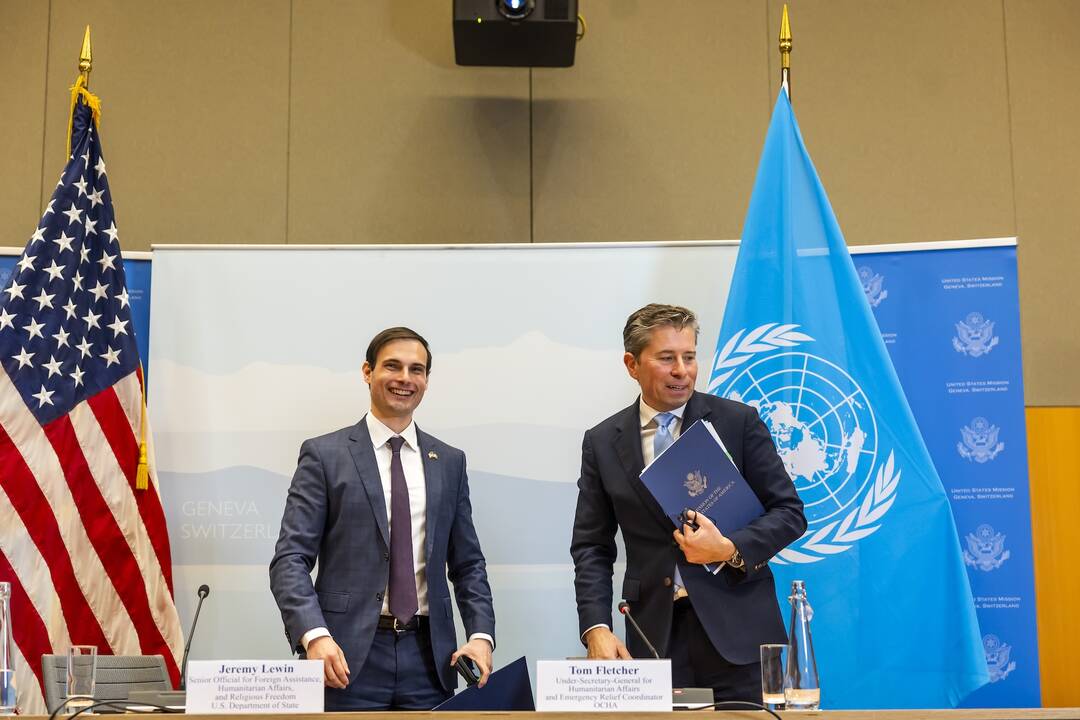
After steep aid cuts in 2025, the US has resumed funding to the UN and other organisations responding to mounting humanitarian crises. But conditions attached reveal a selective approach, and there is concern that other donors are not filling the gaps.
A year ago, as the United Nations scrambled to restructure after massive donor cuts, its aid chief, Tom Fletcher, was confident of the strides his sector had made toward adapting to the new funding realities. His plans to “hyper-prioritise” and reduce the number of people receiving aid– as part of the UN80 reform initiative – may have helped the former British diplomat reset the UN’s relationship with its largest donor, the United States.
Doubtful that funding would ever return to previous levels, humanitarians knew that some things had to change. “We were too dependent on grant financing and on the US as a donor,” says Elise Baudot, head of humanitarian funding at the International Council of Voluntary Agencies (Icva), a network of over 190 NGOs. Nonetheless, after Washington and other Western donors cut funding, “there was first shock, and then the realisation that we can’t fill that hole from other funding sources”, she recalls.
In recent months, as US funding has resumed, experts say it has set the UN aid sector’s reform plan in motion – albeit contoured by conditions imposed by the Trump administration, with few signs of other donors stepping in to compensate.
Setting the stage
In December, the US announced a $2 billion contribution to the UN Office for the Coordination of Humanitarian Affairs (Ocha) for life-saving assistance; a second $1.8bn commitment to the office followed in May. The aggregate paled in comparison to the funding needs for 2026, estimated at nearly $35bn, and to Washington’s $10bn in donations to UN agencies in recent years. Still, Fletcher expressed his deep gratitude to the Trump administration’s aid envoy, Jeremy Lewin, for the renewed financial engagement.
The pledges came with conditions, including disbursement to a select number of Ocha’s crisis-impacted countries, excluding Afghanistan, Somalia and Yemen, and required the UN to report any misuse or diversion of the aid to the US, according to the confidential memorandum of understanding seen by the online media Devex.
“This US administration has been very clear about how they’re going to fund humanitarian operations,” explains Baudot. That includes giving a central role to Ocha for distributing funds, “to provide a pipeline of quick-to-spend funding under its reset plan for hyper-prioritised life-saving needs”, she adds. Months earlier, the White House had entrusted a small team led by billionaire Elon Musk to dismantle USAid, which it accused of inefficiency and wastefulness.
Lewin – who had been part of Musk’s Doge crew – and the State Department were convinced that channelling funds through Ocha’s pooled funds mechanism would help cut bureaucracy, allowing the money to reach local organisations more directly while providing a transparent and accountable system.
Pooled funds and agency contributions
Damian Lilly, a humanitarian consultant and former Ocha and agency official, concedes that US funding has helped operationalise certain UN reform plans, including empowering UN humanitarian coordinators and directing money toward areas with the greatest needs.
Read more: A year after its launch, aid experts ask: humanitarian reset or rollback?
But other reform targets, such as localisation – ensuring that more funding is managed by local NGOs – have not materialised, and Lilly says it is not solely the White House’s fault. “The imperative – self-imposed by Ocha – was to spend the funds quickly with the rationale that ‘the quicker we spend the money, the more chance that we will get more money’,” he explains. But the short six-month timeline for disbursing the funds made it difficult for local NGOs to absorb the money directly, leading to the money instead being channelled through large international organisations and international NGOs, thereby emboldening their roles in the process. “It was quite irresponsible and inappropriate to give money just for six months and the next day, the assistance stops,” Lilly adds.
At a press briefing last week, Adhan Effendi, South Sudan country director for the World Food Programme (WFP), described the $32.5m in combined funding received from Ocha pooled funds this year as “a drop in the ocean”. He said that the UN food agency’s budget was expected to run out within the next two months, leaving hundreds of thousands of the most vulnerable people without access to food assistance.
Lilly explains that having US funding channelled through Ocha now, rather than directly to the UN organisations – including the WFP, the UN refugee agency, the UNHCR, and the UN’s children’s fund, Unicef, which previously received over two-thirds of UN aid funding – has upended the humanitarian power structure. “Many of them are now wondering: ‘why do we have Ocha as a gatekeeper?’” he says.
“Financially, Ocha has turned into a four- or five-billion-dollar organisation, larger than the International Organization for Migration, and nearly as large as UNHCR, Unicef and WFP,” Lilly notes, underscoring that, unlike the specialised agencies, it has limited staff to take on its expanded role, “even if it’s limited to processing all the US funding.”
More recently, Washington has pledged “macro awards” directly to UN agencies – bringing its total UN aid commitments to date since late 2025 to nearly $5bn. In June, the US allocated nearly $220m to Unicef and $800m to the WFP, a fraction of the $10bn the US contributed to the food aid agency at its peak in 2024. The State Department said backing agencies with “rigorous performance standards and deliver measurable results” would incentivise the wider aid sector to adapt to the expectations of US taxpayers.
An Ocha spokesperson confirmed that the “first tranche of funds ($2bn) has been fully received and allocated by Ocha”, while the signing and finalising of funding agreements for the second, $1.8bn instalment “is proceeding as expected and will be completed shortly”.
“The US Department of State has also been clear on their continued commitment to supporting this new model,” the spokesperson said.
US funding reaches Geneva organisations
Since early June, the pace of US aid announcements has picked up, broadening support to the wider aid sector. Amid rising concerns over disease outbreaks, just months after Washington pulled out of the World Health Organization, US pledges have included $50m to the Coalition for Epidemic Preparedness Innovations (Cepi) and the release of $661m in funding to the Global Fund to Fight Aids, Tuberculosis and Malaria that had been approved by lawmakers, but which had been withheld for months. Similarly, the US Congress announced that $600m in arrears would be paid to Gavi, the Vaccine Alliance, on condition that its funds wouldn’t go to the WHO.
Some $242m in direct Ebola response funding for the Democratic Republic of Congo was also announced, as talks between US and DRC officials on critical minerals from the worst-hit northeast region were affected by the country’s largest outbreak to date.
Over $200m was also promised in July to both the International Committee of the Red Cross, which had been forced in 2025 to cut its budget by 17 per cent, and the International Federation of Red Cross and Red Crescent Societies, for disaster relief and humanitarian aid. It is not clear when these are expected to be delivered.
Faith-based groups win
But some of the biggest winners in the Trump administration’s renewed aid strategy have been faith-based groups. Earlier this summer, Catholic Relief Services was awarded $240m in humanitarian funding. And then this month, the State Department announced nearly $2bn in “historic” financing to groups led by London-based international NGO World Vision, as well as US-based organisations Compassion International and Samaritan’s Purse, to support 2,500 faith-based hospitals in 17 countries, as well as emergency and humanitarian assistance.
The statement said the groups have the experience to ensure cost-efficient and transparent assistance. However, two of the organisations have faced scrutiny in recent years. A media report found that Samaritan’s Purse – whose CEO, Franklin Graham, is a vocal Trump supporter – had allegedly amassed unspent funds exceeding $1bn before stepping down from the independent oversight group, the Evangelical Council for Financial Accountability. When asked about the funds, its chief operating officer thanked God for the contributions, adding that it was “poor stewardship” to spend them hastily rather than take the time to spend them as needs evolve. Compassion International’s donor confidence score was affected after it reclassified itself in 2019 as a religious organisation, which meant it was no longer required to file publicly accessible financial reports.
Mind the gap
Earlier this year, Fletcher confirmed to journalists in Geneva that he would not accept any US funding under its global gag rule blocking aid to organisations that provide or advocate for abortion services. Meanwhile, Washington’s latest announcement privileging Christian organisations comes as a reminder of the administration’s aid agenda, restricting support to reproductive health, gender-focused assistance and climate finance.
But as funding gaps become increasingly apparent under Washington’s new humanitarianism, aid experts are growing frustrated with other countries’ inaction to restore the balance.
“The US is basically putting money on the table and saying ‘we will provide money, but just want things to be done a certain way’. You may disagree with it, but at least they are saying the humanitarian system needs to change,” Lilly says. Other donors, meanwhile, “are sitting on the sidelines and not providing an alternative vision of what the funding model should be.”
“There’s no donor coordination to provide an alternative, and therefore the US is sucking up all the space,” he says.
As for meeting growing humanitarian needs, Ocha’s spokesperson told Geneva Solutions it “welcomes US and other donors’ direct support to organisations providing principled humanitarian assistance as part of a wider financing ecosystem.”