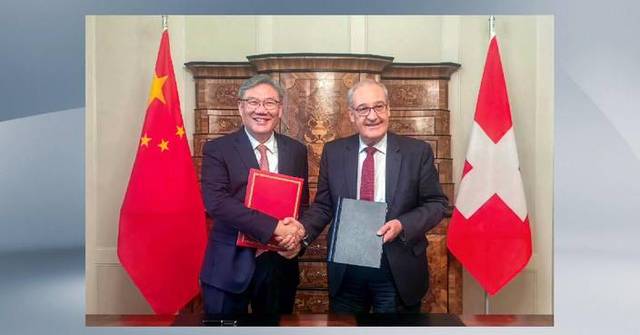
China and Switzerland have completed negotiations on an upgraded free trade agreement and signed a memorandum of understanding on Thursday.
Swiss Federal President and Minister for Economic Affairs, Education and Research Guy Parmelin and Chinese Minister of Commerce Wang Wentao announced the conclusion of the talks after a meeting in Bern.
The China-Switzerland free trade agreement was signed in July 2013 and came into effect in July 2014. It was the first free trade agreement between China and a major continental European country.
In September 2024, the two countries formally launched negotiations to modernize and expand the pact.

China, Switzerland reach agreement on upgraded free trade deal
U.S. Treasury Secretary Scott Bessent said Thursday that the government’s long-dated bond buyback could be more than the recently announced 4 billion U.S. dollars, sparking concerns over rising inflation and mounting pressures on the Federal Reserve.
The U.S. Treasury announced Wednesday that it would at least double the size of its buyback program for 10- to 30-year Treasury bonds, aiming to provide more liquidity support to the long end of the market and curb the unsettling surge of treasury yields.
Bessent revealed in an interview on Thursday that the size of the buyback could be more than 4 billion U.S. dollars per issue, but didn’t provide a specific number, saying the figure will depend on market conditions.
U.S. Treasury yields dropped following Bessent’s statement. However, for the whole day, the yield on the benchmark 10-year Treasury note rose 4 basis points to 4.69 percent, while the 30-year bond yield increased by 4 basis points to 5.24 percent.
Speaking of the national debt, which has more than doubled in a decade to surpass the 40-trillion-U.S.-dollar mark, Bessent downplayed the milestone by emphasizing long-term economic expansion.
“There’s nothing magic about the 40-trillion number,” he said, asserting the U.S. will grow its way out of this.
Market analysts have warned that the intervention risk fueling inflation and complicating the Fed’s monetary policy work.
They predict the Treasury will fund the buyback program by issuing short-term debt, an operation of replacing issuance of longer-term debt with shorter-term bills to curb long-term bond yields.
When the Treasury relies more on short-term debt, it becomes more sensitive to changes in interest rates. Once the Fed raises interest rates, the government’s interest payments will increase rapidly, further driving up the total size of the national debt.
Therefore, analysts believe the buyback program is not a good solution to market problems, as structural debt pressures have already been out of the control of the Treasury and the government.
Investors are also skeptical that the Treasury’s intervention can provide a lasting market relief. If the measure proves ineffective, it could further undermine the credibility the dollar and the Treasury.

US bond buyback expansion could fuel inflation, complicate Fed’s monetary policy work: analysts