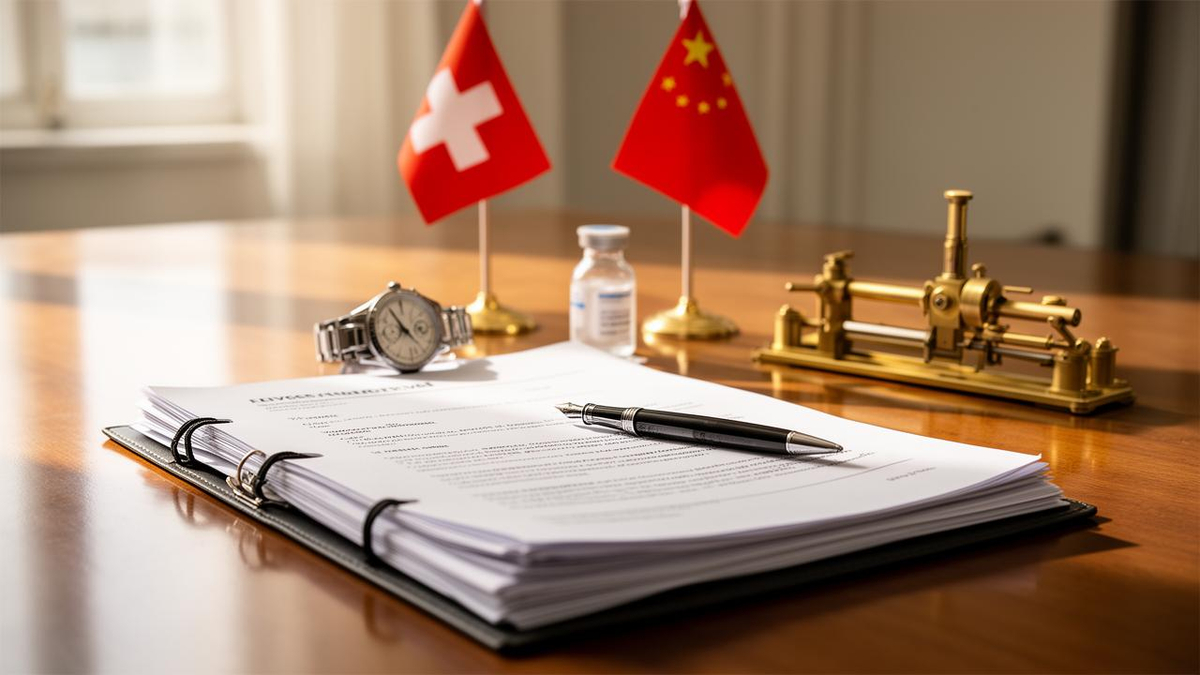
China and Switzerland completed negotiations on upgrading their free trade agreement in Bern on Thursday, with 99.8% of Swiss products currently exported to China set to enjoy duty-free treatment, covering signature Swiss exports such as watches, pharmaceuticals, and precision instruments. The agreement comes at a time when the global trade environment is fraught with uncertainty due to U.S. tariff policy, with China using the deal to strengthen economic ties with Europe, while Switzerland secures critical market-access guarantees for its export-driven economy.
Swiss President and head of the Federal Department of Economic Affairs, Education and Research, Guy Parmelin, met with Chinese Commerce Minister Wang Wentao in Bern, where the two sides jointly announced the completion of the upgrade negotiations and signed a memorandum of understanding. According to the Swiss government’s announcement, the agreement will grant duty-free treatment to 99.8% of Swiss products currently exported to China, and Swiss investors will also gain easier access to the Chinese market.
Wang Wentao said during the talks that Switzerland is an important partner for China and has consistently been at the forefront of cooperation with China. In the current international environment full of uncertainty, this agreement demonstrates both sides’ clear stance in favor of choosing certainty and supporting free trade. He noted that China’s Ministry of Commerce is willing to work with the Swiss Federal Department of Economic Affairs, Education and Research to implement the important consensus reached by the leaders of both countries, complete the formal signing and implementation of the upgraded agreement as soon as possible, and elevate the quality of bilateral economic and trade relations.
Parmelin said that China and Switzerland enjoy close cooperation and vibrant economic and trade relations, and that the Swiss government and business community attach great importance to economic and trade cooperation with China. Switzerland is willing to use the FTA upgrade as an opportunity to continue expanding trade and investment cooperation with China, deepen the innovative strategic partnership, and continue to provide an open, fair, and non-discriminatory business environment for Chinese companies operating in Switzerland.
Core Elements of the Agreement
The upgrade negotiations began in 2024 and concluded after five rounds of talks. Compared with the current agreement that took effect in 2014—under which only slightly more than half of Swiss exports could enter China duty-free—the new agreement dramatically raises the duty-free coverage rate to 99.8%. It is worth noting that Switzerland had already granted virtually comprehensive duty-free treatment to Chinese imports, meaning the new agreement effectively represents a unilateral gain for Switzerland in terms of greater access to the Chinese market.
The agreement’s scope extends far beyond tariff concessions, also covering rules of origin, trade facilitation, services trade, digital trade, competition policy, and economic and technical cooperation between the two countries. In addition, the new treaty strengthens provisions related to environmental issues and labor rights, reflecting Switzerland’s consistent emphasis on sustainable development in trade agreements.
According to Swiss planning, the formal signing of the new treaty is scheduled to be completed before the end of this year, after which it will enter the respective domestic approval processes of both sides.
Switzerland’s Strategic Calculus
For export-oriented Switzerland, the strategic significance of this agreement is particularly pronounced. The Swiss economy is highly dependent on international trade, and China is its third-largest trading partner, behind only the European Union and the United States. Against the backdrop of ongoing risks from U.S. trade policy, locking in preferential access to the Chinese market provides Swiss businesses with important stability and predictability.
Switzerland’s earlier preliminary agreement with the United States set a tariff ceiling of 15%, but Washington has consistently avoided signing a legally binding formal text, leaving the effectiveness of that agreement in question. By contrast, once the upgraded China-Switzerland agreement is formally signed and domestic procedures are completed, it will carry full legal force, offering Swiss exporters a more reliable safeguard.
China’s Strategic Implications
For China, the significance of this agreement is equally substantial. The China-Switzerland Free Trade Agreement, signed in July 2013 and effective from July 2014, was China’s first free trade agreement with a continental European country. Amid intensifying U.S.-China competition and global supply chain restructuring, China is deepening economic and trade relations with European countries such as Switzerland to demonstrate its posture of upholding the free trade system and expanding openness to the outside world.
As a major global financial center and a country with advanced manufacturing, Switzerland’s deepening economic and trade cooperation with China is also being interpreted by outside observers as part of China’s strategy to secure more economic partners in Europe.
Key Data at a Glance
ItemCurrent Agreement (Effective 2014)Upgraded Agreement (Pending Signature)Duty-free coverage for Swiss exports to ChinaSlightly over 50%99.8%Duty-free coverage for Chinese exports to SwitzerlandVirtually comprehensiveRemains virtually comprehensiveScope of coveragePrimarily goods tradeAdds services trade, digital trade, competition policy, environmental and labor provisionsNegotiation timelineLaunched in 2011Launched in 2024, concluded in five rounds
Note: Duty-free treatment will be fully applied after the transition period ends; formal signing is scheduled to be completed before the end of 2026.
Outlook
Both sides will now expedite their respective domestic procedures to formally sign the upgraded protocol as soon as possible. The Swiss side has clearly indicated that the formal signing is planned before the end of this year. For Swiss industries such as watchmaking, pharmaceuticals, and precision machinery, duty-free access to the Chinese market will directly lower product prices and enhance competitiveness; for Chinese consumers, it means access to high-end Swiss-made goods at lower prices.
From a broader perspective, the timing of this agreement carries considerable symbolic weight. In an environment of rising global trade protectionism and escalating tariff barriers among major economies, China and Switzerland have chosen to respond by expanding openness, injecting new momentum into bilateral economic and trade relations and providing a reference case for other European countries that remain on the sidelines.