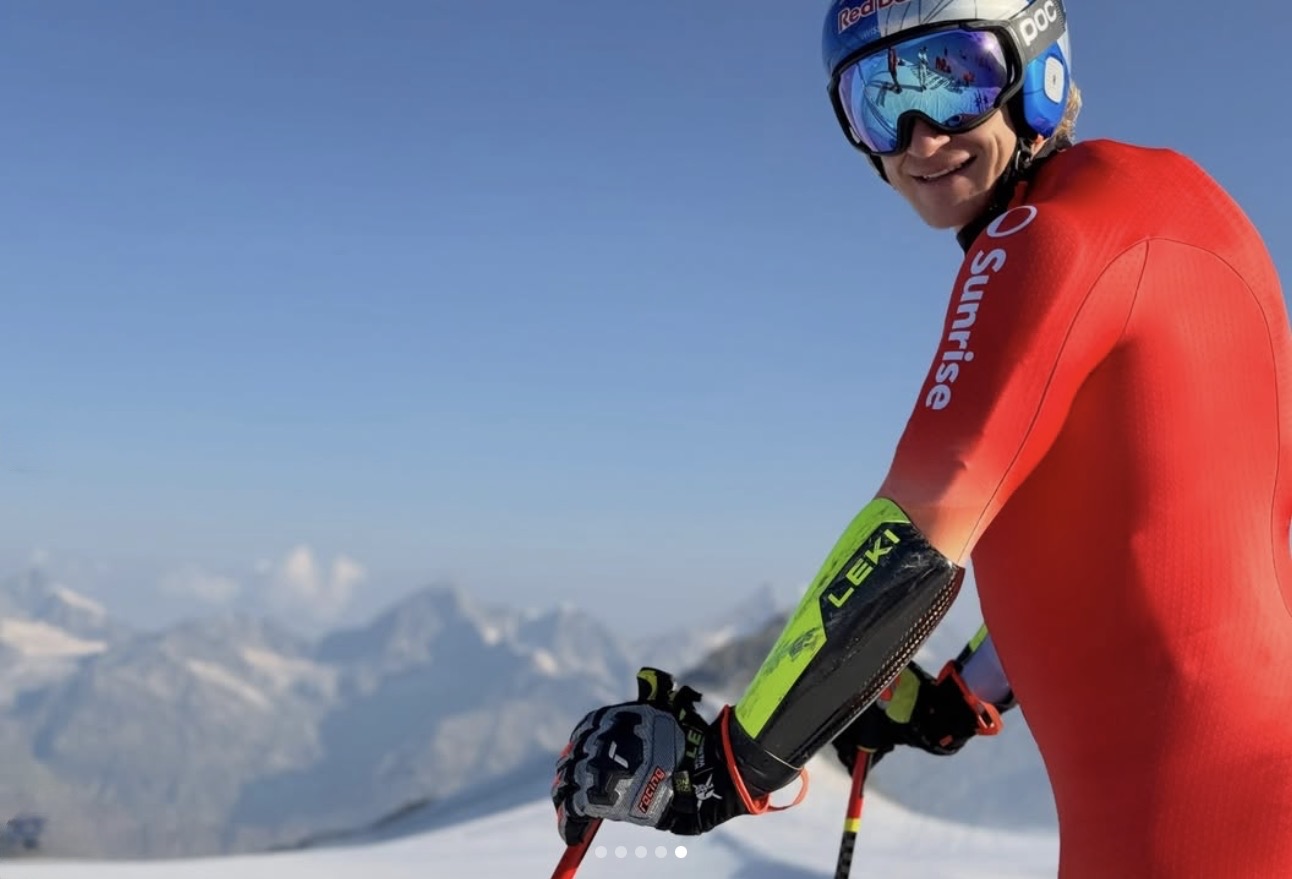
 Marco Odermatt in Zermatt. | Image: Rene van Engelen
This summer on Zermatt’s famous Theodul Glacier has been very different — and concerning. Typically, the glacier’s lifts spin throughout the summer, allowing skiers to enjoy summer laps under the sun. But this summer has been vastly different. Since early August, operations have been temporarily suspended on the Theodul Glacier due to extreme alpine heat and a lack of overnight freezing, causing the glacier to experience extreme melting. The conditions have even brought dangerous situations, with rocks scattered across the glacier and the stability of the lift towers being questioned.
Despite the closure to the public, select stars on the Swiss Ski team have enjoyed exclusive access to the glacier, continuing to train there throughout the summer in preparation for the World Cup season. This has been made possible due to a new partnership between Swiss-Ski and Zermatt, which guarantees the association exclusive training runs through 2034. Zermatt is currently allowing a maximum of 15 athletes per day to ski the glacier’s slopes, and big-time stars like Marco Odermatt are among those with this privilege.
“We are very grateful for this agreement. Being able to train even though the ski resort is closed is a real advantage,” Alpine Director of Swiss-Ski Hans Flatscher said in an interview with the Tagesanzeiger. “Despite this exceptional year of 2026, we expect our summer training to take place on the glacier until the contract expires in 2034.”
For Swiss Ski athletes, the arrangement allows them to get a head start on their preseason preparations. But for other skiing federations, this spells trouble.
Typically, ski federations from other countries head to Zermatt for their own summer preseason training regimens. But the closure of the glacier left them scrambling to find other training areas to prepare for the start of the World Cup season. The French team was forced to turn back while en route to Valais to train at Zermatt. Austria also canceled its scheduled training camp on Theodul. Now, these ski federations are turning to the southern hemisphere for their summer training. Chile and Argentina are the most popular destinations, closely followed by New Zealand. But for non-Swiss European federations that need summer training slopes, traveling to the Southern Hemisphere is much more costly and time-consuming than training at Zermatt, which is both familiar and closer. Athletes traveling to the Southern Hemisphere can have their training time limited by travel schedules and logistical issues, making season preparations less efficient at a crucial time for these athletes. In addition, Zermatt is one of very few summer training sites that allow for downhill training as most other resorts lack the vertical.
While other nations still have access to preseason ski training on other parts of the globe, debates have sparked on the international stage on whether exclusive access to glacier skiing in the Northern Hemisphere gives Swiss Ski an unfair advantage. Some members of the skiing community believe that Swiss Ski’s exclusive access is unfair, and others think the Swiss athletes are simply utilizing the resources present in their country. Some have even called for the International Ski and Snowboard Federation (FIS) to step in. Nonetheless, the recent training affairs have raised questions about whether summer skiing on glaciers should be banned to prevent individual nations — in this case, Switzerland — from gaining an advantage.
The questions surrounding summer training have also brought another venue form into the spotlight: indoor ski centers. Some countries, like Norway, have constructed year-round indoor ski centers to allow their athletes to train. Constructing indoor ski centers can save athletes from long travel days and unpredictable conditions. Indoor ski centers also offer predictable skiing conditions, letting skiers feel every mistake, technical component, and equipment change in a sport where just hundredths of a second can be the difference between first and second place.
“The consistency of the surface is a huge bonus,” Norwegian World Cup skier Eirik Hystad Solberg told Ski Racing Media. “Every run, if you see an improvement—or not—it’s pretty much always you and not the conditions changing.”
As of now, there are no plans for building indoor ski centers in Switzerland, but as glacier conditions continue to change, so could Swiss Ski’s summer training plans.
“This summer is an extreme situation — caused by the heat combined with low precipitation in the winter. We don’t expect this to become the norm,” Flatscher said. “And if it does, we’ll have entirely different problems than summer skiing on the glaciers.”
But for now, Swiss Ski will continue to train on the Theodul Glacier while other ski federations will head south to catch the end of winter in the Southern Hemisphere. Whether exclusive glacier skiing actually gives Swiss skiers an advantage will likely never be fully determined. But with the World Cup season on the clock, many will watch the Swiss team closely.
 Marco Odermatt smiles with the Giant Slalom Crystal Globe after winning 7 of the 10 Giant Slalom events in the 22/23 season. | Picture: Swiss Ski Team Instagram