By
AFP
Published
August 21, 2026
Swiss watch exports rose by 9.6% in July to 2.6 billion Swiss francs (2.77 billion euros), the watch industry federation announced on Thursday. “This performance pushes the seven-month cumulative total into positive territory, with a 0.9% increase,” the federation noted.
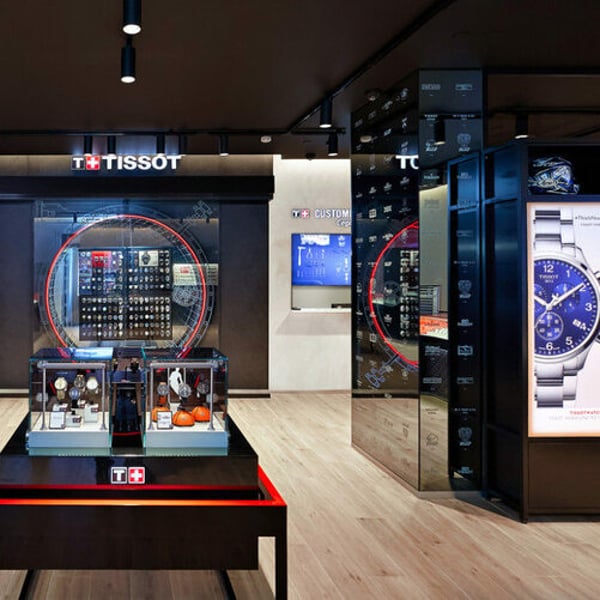
 Inside a Tissot store – Tissot
After reaching record highs in 2023, the Swiss watch industry has faced two more difficult years due to a slump in demand from China starting in 2024, compounded by the imposition of US tariffs in 2025. Watch exports are a key indicator closely monitored by financial analysts to gauge the short-term performance of the luxury sector. However, the shock of US tariffs last year complicates year-on-year comparisons.
In July, the United States (+26.5%) was the primary driver of overall growth, maintaining double-digit gains for the third consecutive month. The United Kingdom (+9.5%) also contributed significantly to this trend, while Japan (-3.7%), China (-18.5%), and the United Arab Emirates (-3.7%) saw declines. The European Union recorded a 12.4% increase, driven largely by Germany (+11.6%).
Announcements from Washington in early April 2025 had sparked panic within the sector, prompting watchmakers to rush to build up inventories in the US before the new tariffs took effect. Watch exports to the US had surged last year- rising nearly 145% in April and 45% in July- before collapsing from August onwards as tariffs were imposed, prior to an agreement being reached between the two countries setting the rate at 15%.
In late June, the consulting firm Bain & Company stated that it expected the luxury goods market to stabilize in 2026, following last year’s turbulence. However, it anticipates a “three-speed” market evolution: the US, where luxury spending is rising; China, where a gradual recovery is taking shape; and Europe, which appears to be the weak link due to uncertainties surrounding tourist spending- a major driver of luxury sales.
Copyright © 2026 AFP. All rights reserved. All information displayed in this section (dispatches, photographs, logos) are protected by intellectual property rights owned by Agence France-Presse. As a consequence you may not copy, reproduce, modify, transmit, publish, display or in any way commercially exploit any of the contents of this section without the prior written consent of Agence France-Presses.