
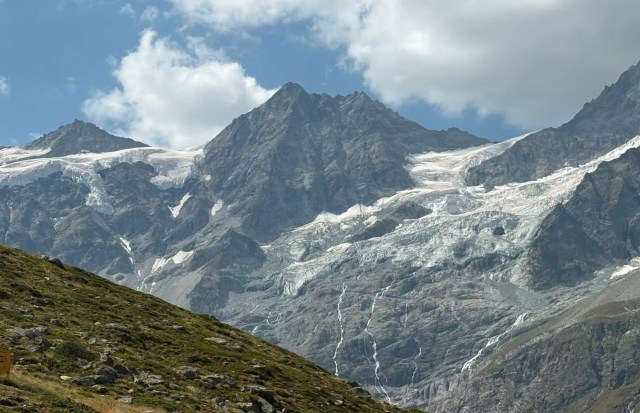
 Schalihorn near Zermatt. | Image: Cantonal Police Valais/Wallis
Three mountaineers have died in two separate incidents near Zermatt, Switzerland, within six days, as persistent summer heat continues to alter conditions across the high Alps. The latest death occurred on Wednesday, August 19, when rescuers found a missing mountaineer lifeless on the Glacier du Mountet after he failed to return from an attempted ascent of the Zinalrothorn.
The mountaineer had left the Rothornhütte on August 17 with a companion to climb the 4,221-meter (13,848-foot) Zinalrothorn. Shortly before reaching the summit, deteriorating weather conditions caused one of the two climbers to abandon the ascent. His companion continued toward the summit alone. When the mountaineer had not returned after approximately an hour, his partner alerted rescuers. The Valais Cantonal Rescue Organization launched a search operation, and rescuers located the missing climber two days later on the Glacier du Mountet. An emergency doctor flown to the scene by an Air Zermatt helicopter could only confirm that the mountaineer had died. The deceased’s formal identification is underway, while the Valais/Wallis prosecutor’s office has opened an investigation into the circumstances of the accident.
The Zinalrothorn death came just six days after two other mountaineers were found dead in the Schalihorn area near Randa, approximately 10 kilometers (6 miles) south of Zermatt. Relatives had not heard from the two climbers since August 12 and contacted the Valais Cantonal Rescue Organization (KWRO) the following day. KWRO deployed an Air Zermatt helicopter to search the Schalihorn region. The two mountaineers were located on August 13, but rescuers could only confirm their deaths.
Authorities have since identified the victims as two Swiss nationals aged 33 and 37. The circumstances of the fatal fall remain under investigation.
The deaths come as Switzerland’s high mountains continue to experience challenging conditions following a snow-poor winter, a very warm spring and repeated periods of heat since the beginning of summer. The Swiss Alpine Club (SAC) says the persistent heat has significantly altered conditions in the high mountains. Many glaciers have become heavily exposed as the protective snow layer melts, leaving bare ice, open crevasse zones and increasingly exposed mountain debris.
As a result, some classic high-alpine routes can be substantially more difficult than in previous years. The thawing of permafrost is also increasing rockfall danger in some areas and can destabilize individual sections of terrain. The SAC says conditions vary considerably between routes, with some tours currently offering good conditions while others have become exceptionally demanding or are no longer recommended.
Marcel Kraaz, a mountain guide and head of popular sports at the SAC, urged climbers and hikers to carefully assess conditions before setting out. “This includes obtaining particularly thorough information about the current conditions.”
The SAC recommends checking current condition reports and tour information before every outing rather than relying solely on descriptions or experiences from previous years. Hut wardens and local mountain-guide offices can also provide valuable information about current conditions.
The club also warns that mixed terrain containing rock, ice, firn and snow can be particularly challenging this summer, with more rock and ice debris expected in some areas and glacier crossings becoming more difficult as crevasses open. For inexperienced mountaineers, the SAC recommends undertaking high-alpine tours with a mountain guide or as part of an SAC section tour.
For those heading into the high Alps, the SAC’s message is straightforward: conditions this summer are changing rapidly, and route planning needs to be based on what is happening on the mountain now — not what a route description says it should be like.