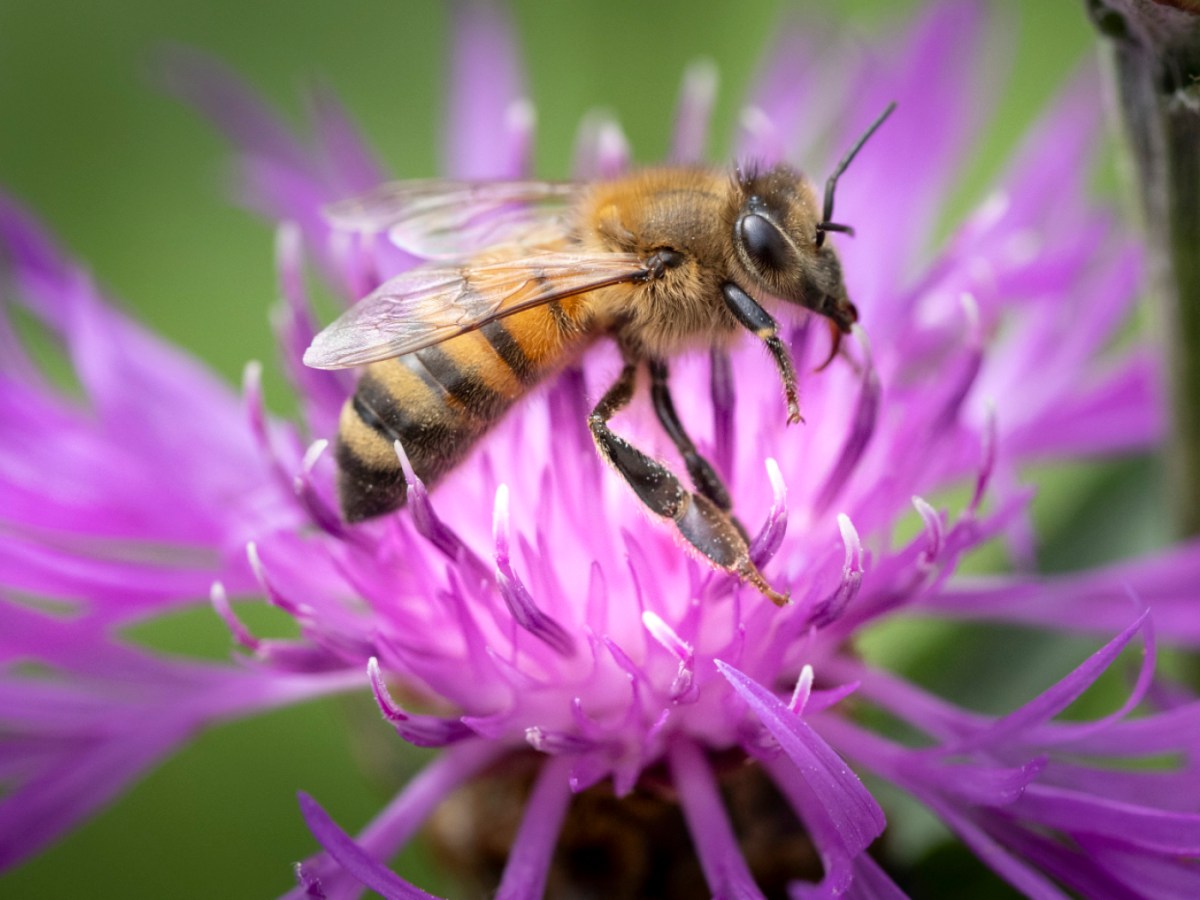

Glacier retreat could spread diseases amongst bees
Keystone-SDA
Changing fauna caused by melting glaciers could make it more likely for bees to pass diseases on to one another. This is shown by a new study led by the University of Lausanne in Switzerland.
Listen to the article
Listening the article
Toggle language selector
English (US)
English (British)
Generated with artificial intelligence.
This content was published on
August 24, 2026 – 11:15
Normally, wild bees and honeybees avoid each other whilst foraging by specialising in different plant species. This natural separation reduces the risk of cross-contamination with pathogens.
However, as a result of changes to the plant world caused by glacial melt, bees are increasingly using the same food sources. The flowers act as sources of infection. If a diseased bee leaves infectious particles there, these can be picked up by the next bee visiting the flower.
+ Glaciers of the world – local melting and global impactsExternal link
For their study, researchers from the Universities of Lausanne and Milan and the Italian research organisation Crea investigated bee populations at the Mont-Miné Glacier in the Val d’Hérens, canton Vaud. They focused on three viruses and two parasites.
In honeybees, the scientists found all five pathogens under investigation in the areas that had only recently become ice-free. Only two pathogens were detected among wild bees in areas that were still relatively well protected.
+ Why melting glaciers affect us all
However, a completely different picture emerged in the older ice-free zones, where the vegetation has already undergone significant changes. Here, the prevalence of the wing-deforming virus – a pathogen typically found in honeybees – increased significantly amongst wild bees.
The study thus sheds light on a less visible consequence of climate change. The retreat of a glacier not only means the loss of ice and water resources, but also alters the entire subsequent ecosystem and the complex interactions between organisms.
“Understanding these processes is crucial for developing effective strategies to protect pollinators and the ecosystem services they provide,” commented Gianalberto Losapio, co-author of the study at the University of Lausanne.
More

More
Switzerland’s battle of the bees
This content was published on
Jun 25, 2021
Do Swiss measures to support the domestic honeybee disadvantage the equally important wild bee?
Read more: Switzerland’s battle of the bees
+ How we produce English news
Translated from German, reviewed by an English Department journalist.
Articles in this story