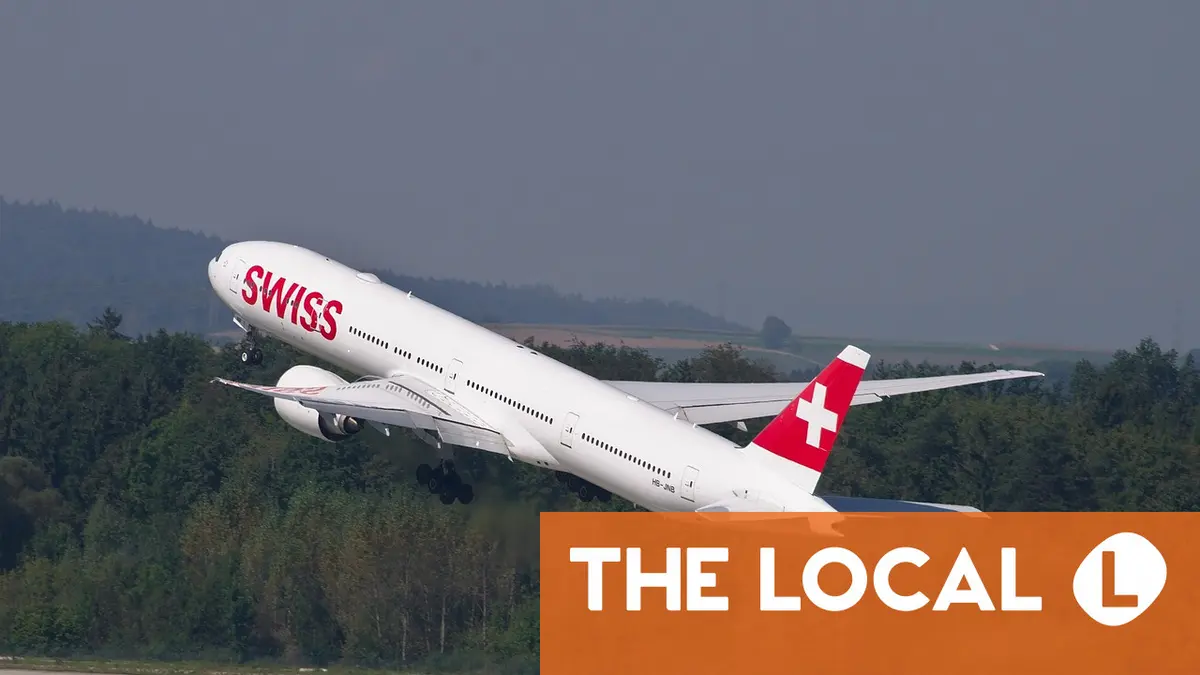
On the morning of Tuesday, August 25th, SWISS flight from Chicago to Zurich issued a distress signal over the Atlantic and landed safely on an Azore island off the coast of Portugal.
According to Oliver Buchhofer, director of operations at SWISS, the emergency landing was caused by “a chemical smell on board,” whose origin has not yet been identified.
Nobody was injured during the operation and the airline is sending another aircraft to pick up the stranded passengers and bring them to Zurich.
Déjà-vu
This is the third time in a span of a month that Switzerland’s national airline has experienced problems in mid-air between Switzerland and the United States – though the first two were caused by reckless passengers and were not due to technical glitches.
The first such incident happened on July 27th.
A headphone charging case fell between seat cushions and subsequently overheated on a flight from Zurich to New York, filling the Business cabin with smoke.
Not knowing immediately what the cause of the smoke was, the aircraft declared an emergency and landed in Bangor, Maine.
Then, on August 9th, another SWISS flight – this time from Zurich to Boston – had been en-route for three hours when smoke was detected in the cabin.
It made a swift U-turn and landed at the nearest airport, Dublin.
In this particular case (and unbeknownst to the pilots at the time), a smoking power bank had triggered the incident – even though the airline had previously issued restrictions on transporting these devices in carry-on luggage.
No injuries were reported in either of these emergency landings.
But that’s not all
It appears that SWISS does not hold monopoly over emergency landings on the Switzerland-US route this summer.
On August 20th, for instance, a United flight to Newark sent a distress signal when its engine shut down just 11 minutes after take-off, and returned to Geneva, where it landed safely.
Just days before, on August 17th, the same airline experienced mid-air “maintenance problems” on a flight from Washington DC to Zurich while still on the US territory and returned to its departure airport.
What should you make of this?
It does seem odd – not to mention disconcerting – that so many problems arose only days apart on planes flying on the same route.
However, on the positive side, all these incidents ended only in inconveniences to passengers but no other serious consequences.
And yes, flying still is – according to aviation experts – the safest mode of travel, especially in statistical comparison to driving.