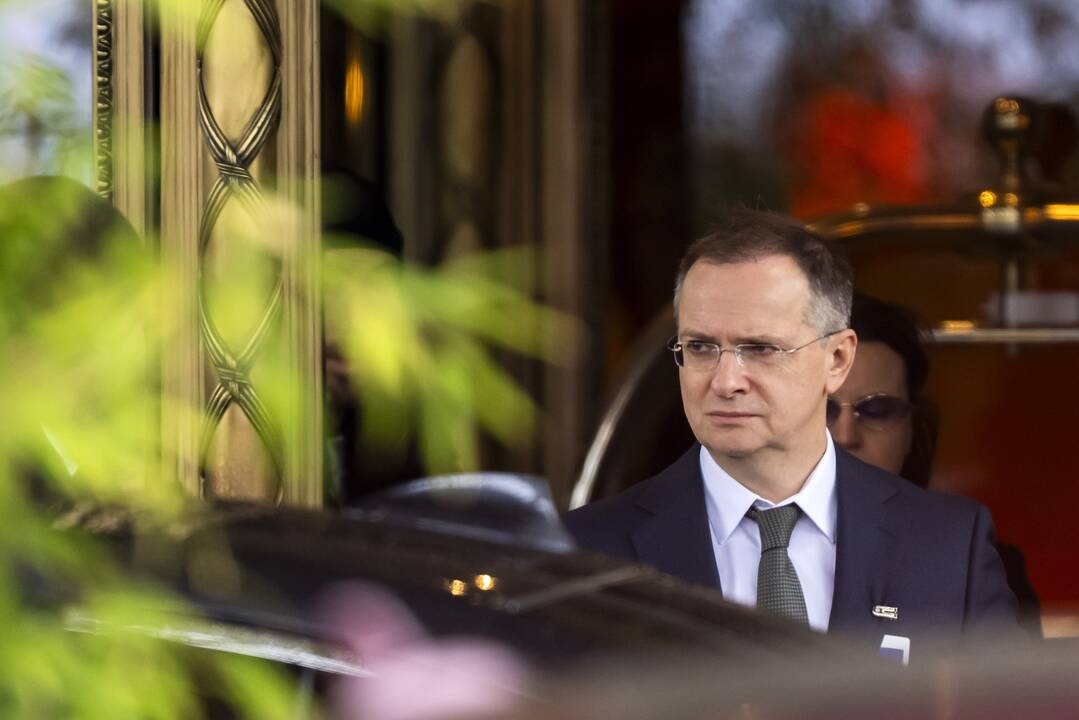
The abrupt halt to political negotiations between Russia and Ukraine in Geneva casts fresh doubts on the future of peace talks.
A second day of US-brokered negotiations in Geneva between Russia and Ukraine was abruptly cut short on Wednesday morning. The talks, which kicked off on Tuesday, were expected to last for the entire day. Only two hours into the deliberations, Russia’s lead negotiator, Vladimir Medinsky, announced through Russian media that the talks had ended.
Between Russia’s maximalist positions, a rift in the Ukrainian camp and Washington’s rushed manner, conditions for the US-brokered talks aimed at ending Ukraine’s four-year-long war were less than favourable.
‘Tense’ and ‘constructive’
Little to nothing was communicated about what transpired behind the closely guarded doors of the Intercontinental Hotel. European journalists waited in vain for three hours for a press conference that never happened on Tuesday. Shortly after the first day, US envoy Steve Witkoff assured in a post on X that the parties had agreed to “continue working towards a deal” on Wednesday.
The abrupt suspension took most by surprise. Medinsky described the talks as “difficult but businesslike”. On Ukraine’s side, the head of delegation, Rustem Umerov, told reporters that there had been “progress” but that “no details can be disclosed at this stage”. Ukrainian president Zelenskyy, who had accused Russia of “trying to drag out” negotiations, said key issues, namely the fate of Ukraine’s occupied territories and the Zaporizhzhia, remained unresolved. However, one positive outcome he noted was an overall agreement that any future ceasefire monitoring mechanism would involve the US.
But while lead negotiators called it quits before midday, technical working groups stayed behind to continue negotiating on specific issues, said Thomas Greminger, executive director of the Geneva Security Policy Centre, who has been following the negotiations. The groups are said to involve all parties.
Medinsky said another round of talks would be scheduled in “the nearest future” before holding a two-hour closed-door meeting with an undisclosed individual and heading off to the airport, according to Russian media RIA Novosti. The Ukrainian delegation is expected to fly out in the evening. This could signal that peace is still somewhere on the table. The key question is under which and whose terms.
Maximalist demands
Greminger was not surprised that the political track failed to deliver any major breakthroughs, given the many divergences remaining. However, “technical progress” seems possible, according to the Swiss diplomat, especially in two negotiation tracks expected to be Wednesday’s focus – military and economic interests.
But the return of Medinsky, Vladimir Putin’s aide and an ideologue known for his historical distortions, may have upended the dynamics for the military discussions, which had made good progress in Abu Dhabi, by bringing back to the table sensitive political issues such as the Russian language and the Russian Orthodox Church, exasperating many.
“Russian demands are more maximalist than I was expecting,” says Greminger. He cites the example of the American proposal to create a free economic zone in Donetsk, in the eastern Donbas, with Moscow entertaining the idea on the condition of the full withdrawal of Ukrainian forces – an idea firmly rejected by Kyiv.
Zelenskyy had also announced shortly before Wednesday’s meeting that humanitarian issues were on the agenda, namely “the exchange of prisoners of war and the release of prisoners” – a key area of interest for Ukrainians and one of the few issues where the warring parties have been able to reach an agreement in previous rounds.
A rift in the Ukrainian delegation may also have been a complicating factor. According to The Economist, one side, led by Zelenskyy’s former spy chief Kyrylo Budanov, is said to believe a quick deal, even if somewhat unfavourable, is best before the window of opportunity closes, while another, still influenced by former chief of staff Andriy Yermak, is much less yielding. Zelenskyy has been balancing the two while facing pressure from outside – and within – to hold elections, the English publication writes.
US envoys out of depth
The format of the negotiations, led by Witkoff and Donald Trump’s son-in-law, Jared Kushner, following high-stakes indirect talks between Iran and the US, had also sparked some scepticism. After discussions aimed at averting a full-blown war with Iran on Tuesday morning, the duo rushed to the other side of Geneva to oversee talks between Russia and Ukraine.
“In the past, they have been able to close the political gap, but they underestimate the professional expertise that is required to reach a sound agreement,” says Greminger, pointing to the flawed Gaza peace plan as a prime example.