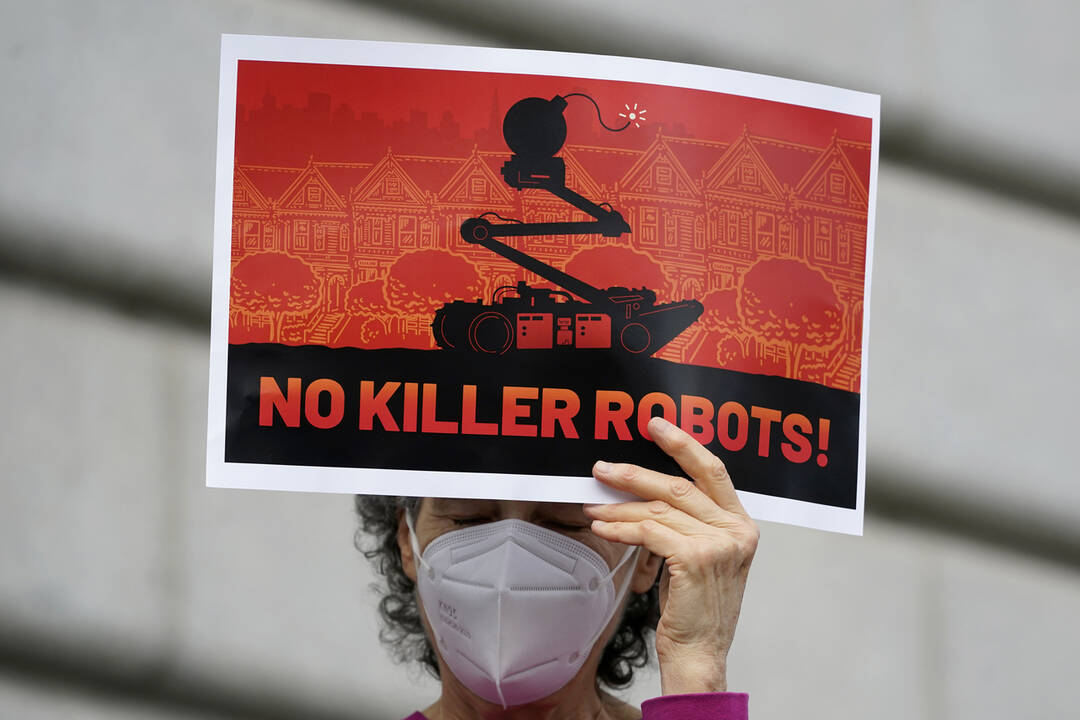
States will meet in Geneva this week to discuss new rules to rein in the development and use of lethal autonomous weapons, amid mounting concerns that humans could soon become the target of “killer robots”.
It could easily be overlooked as a routine UN meeting, but a little-known gathering of experts in Geneva this week is expected to capture the attention of governments, civil society, and experts in the military domain and international humanitarian law.
The topic on the table: Lethal autonomous weapons – often called killer robots – and the urgent need to regulate them, as governments and companies race to develop and use increasingly advanced war machines, powered by sensors, algorithms and artificial intelligence.
Autonomous weapons, capable of selecting and engaging targets without human involvement, have long existed, for example, on warships as defence against incoming missiles. New generation AI-assisted weapons with increasing autonomy are already emerging in conflicts, including in Sudan, Gaza and Ukraine. But experts are growing concerned at the prospect of handing over life-and-death decisions to machines as the technology behind them becomes ever more complex.
“We don’t currently have confirmed evidence that autonomous weapons have been used to directly target human beings on the battlefield,” Laurent Gisel, head of the arms and the conduct of hostilities division at the International Red Cross and Red Crescent (ICRC), told reporters in Geneva last week. “But that’s certainly the trajectory of the development that we see, even if they are not yet deployed. That’s why it’s so urgent to impose prohibitions.”
United Nations secretary general António Guterres and ICRC president Mirjana Spoljaric also sounded the alarm: “We are now dangerously close to crossing a moral red line: the autonomous targeting of humans by machines,” they said in a joint statement, calling on states to urgently adopt new international rules to restrict their use.
Playing catch-up
But as technology takes leaps into the future, the prospect of a treaty remains a distant prospect. The 125 countries that have signed up to the Convention on Conventional Weapons, a UN treaty covering specific weapons that pose a particular danger to civilians, have grappled with the regulation of killer robots since 2014.
A breakthrough came three years ago when states tasked a group of governmental experts with formulating “a set of elements of an instrument” – with this week’s meeting representing the final stretch. But it will ultimately be up to nations attending the convention’s Seventh Review Conference in November to decide whether to kickstart a formal negotiation process that could then take several years.
For Carolyne Mélanie Regimbal, head of service at the UN Office for Disarmament Affairs in Geneva, the opportunity should not be underestimated. “Review conferences only occur every five years and provide one of the most important opportunities to advance the work on this issue,” she said at a press conference last Wednesday at the Palais des Nations.
“Technological developments are not waiting for the diplomatic calendar. The widening gap between technological capacity and capability, and regulatory restraint is increasingly evident,” she added.
Regimbal and Gisel note that countries so far have shown a willingness to engage in discussions, even as some, including the United States, Russia and the United Kingdom, oppose the idea of a new legally binding instrument, arguing that existing international humanitarian laws are sufficient.
But human rights groups, international lawyers, and even tech companies argue that lethal autonomous weapons bring additional challenges not sufficiently covered by IHL. One crucial question is what constitutes meaningful human control.
“IHL requires human beings to make judgements about whether an attack would be lawful, taking into account all the circumstances at the time. But autonomous weapons make these judgments more difficult because the human operators do not know who or what will be targeted, or when or where the force will be used,” Gisel said. “This will depend on how the system responds based on the input it receives from sensors. And in conflicts, things can change very rapidly.”
An autonomous weapon may not be able to distinguish, for example, between an active combatant and a soldier who is injured and protected under international law, or a civilian suddenly entering an area of conflict.
“The further removed the human decision is from the moment of strike, the harder it becomes to ensure that the used force will actually comply with international humanitarian law,” he added.
The ICRC stops short of calling for an outright ban on all lethal autonomous weapons but says those that target human beings, such as autonomous anti-personnel weapons, or that cannot guarantee predictability, should be outlawed in line with IHL principles.
“Significant progress has been made toward a shared understanding of the human judgment and control required, and of the measures necessary to ensure compliance with international humanitarian law, address ethical concerns and reduce human suffering,” Guterres and Spoljaric said in their joint statement, referring to talks so far.
“States must show political courage and move beyond incremental discussions towards decisive action,” they added, warning that a failure to do so will cost lives.