
 23 year olds Mia Hugin and Jesper Gustafsson live in a van in the Alps for most of the winter in order to maximize their skiing. | Photo: Jesper Gustafsson
“If I ask, ‘Can I join you skiing tomorrow?’ the answer will almost always be ‘yes.’ But when Mia asks, the assumption that she’s a girl makes people hesitant. If we program to ski with someone, I usually send the message like, ‘Can I bring a friend?’ instead of ‘my girlfriend,’ because people get hesitant,” Jesper Gustafsson told SnowBrains over a video call in August 2026 as he sat next to his partner Mia Hugin in their Trondheim, Norway home. The two 23-year-olds are Norwegian steep skiers that live in a van during the winter, based mostly in Chamonix but traveling across the Alps to places like the Italian Dolomites and the Lyngen Alps of Norway to chase dangerous lines in good powder conditions. They’ve been doing this for the past 2 seasons, mostly just for fun. Now they are documenting their adrenaline-oriented lifestyle for their first ever ski film with Hugin as the main star. The film will follow the couple as they attempt a ski objective of mythical proportions while simultaneously breaking down long-held preconceptions about the type of people who ride these prized, high-consequence ski descents.
“We went to Zermatt a few years ago and we saw the West Couloir. Ever since that day Mia has been like, ‘Jesper, we’ve got to ski it!’ She’s talked about it probably once or twice a week for the past two or three years,” Gustafson said. The West Couloir of the 4,478-meter Matterhorn is carved into the highest, most isolated face of the picturesque peak. It is 800 meters long and easily one of the most enigmatic and visually striking steep-skiing lines in the Alps.
 The West Couloir of the Matterhorn. | Photo: planetmountain.com
Tucked far out of sight behind the jagged tooth of the Zmutt Ridge, the face is completely hidden from the postcard views and cable car stations of Zermatt. It requires an arduous approach deep into the high basin above the Zmutt Glacier just to set eyes on it. The line itself plummets down a dramatic funnel of dark gneiss rock, maintaining a sustained pitch between 45 and 50 degrees — steepening past 55 degrees near the upper choke and coasting directly above sweeping cliff bands where a single fall would prove fatal. Because of its western exposure, the couloir stays locked in a cold shadow for much of the day before catching the late-afternoon sun, turning any attempt into a delicate thermodynamic gamble: enter too early and the face could be wind-scoured, ski-edge-resistant ice; enter too late and the sudden solar warmth can instantly trigger heavy wet slides or loosen falling rock from the cliffs above.
That razor-thin margin for error has given the peak a near-mythic lineage in extreme skiing history. Ever since Italian mountaineer Toni Valeruz completed the first ski descent of the East Face in 1975 — followed by Jean-Marc Boivin’s famous 1980 feat where he skied the East Face, soloed up the North Face, and hang-glided off the summit — the Matterhorn has stood as an ultimate proving ground. Yet while the East Face cemented its place in steep-skiing lore, the West Couloir remained the mountain’s most reclusive, rarely attempted prize. Shielded by its extreme isolation and punishing wind patterns, it has been skied by only a handful of elite alpinists across the decades, coming into true, continuous skiable condition during fleeting windows.
“It’s a very, very fascinating mountain,” Hugin said with a bashful smile. “The West Couloir — it’s not that known. It’s hidden. You have to really work to get to it, and it just looked really, really nice.”
 Mia Hugin descends the Sofia Couloir in the Lyngen Alps of Norway. | Photo: Jesper Gustafsson
The pair plans to ski and document the route together at the tail end of the upcoming winter, conditions permitting. But the project aims to do far more than simply showcase their steep skiing prowess. Beyond the technical descent, Hugin and Gustafsson hope to dismantle long-standing stereotypes surrounding young women in big-mountain sports, proving that skiers who look like Hugin belong on the world’s most serious terrain. Having completed dozens of classic steep ski lines together across the Alps, their idea to create the film stems from a natural progression of their skiing which evolved after falling in love in the French Alps.
The magnetic romance between Hugin and Gustafsson is obvious within seconds, punctuated by quick glances and cute smirks shared between the two during the interview. Gustafsson says that their story began three years ago when he spotted Hugin’s post in a Chamonix Facebook group looking for accommodation. “I saw her post and was like, ‘this looks like a girl for me,’” he recalls, sending polite messages with local tips on how to secure housing before backing off when he spotted an “in a relationship” tag on her profile. Five months later after winter rolled around, a mutual friend bailed on a ski day, unexpectedly leaving Gustafsson on the snow with a group of visiting Norwegians — including Hugin. Learning her relationship status was outdated and left on her profile since high school, Jesper smoothly guided her onto a route known locally as “the girlfriend tour,” but was too embarrassed to reveal the line’s actual name. They have been inseparable ever since. Now, for the past two winters, the lovers have been meticulously ticking off several classic steep ski descents accessible from Chamonix’s most famous tramway.
 Hugin rappels into the Passerelle Couloir off the Aiguille di Midi cablecar in Chamonix. | Photo: Jesper Gustafsson
At 3,842 meters above sea level, the metal bridge of the Aiguille du Midi cable car is the grand foyer of global steep skiing — a venue where crampons clatter against concrete and the prevailing culture remains stubbornly, overwhelmingly male. In a valley dominated by veteran IFMGA mountain guides and an unspoken alpine machismo, stepping onto a 45-degree face as a young woman means navigating a subtle, persistent current of skepticism. At 23, Hugin has already spent a lifetime on snow; she’s logged countless days across Scandinavian peaks while traveling with her radio reporter father as a child. “My dad used to work as a radio reporter traveling around Norway reporting on ski conditions, so I basically did school from six years old to 20 following my dad at work to ski.” Even still, Hugin routinely encounters the quiet gatekeeping that permeates the Chamonix scene. When local skiers organize descents on technical faces, the default assumption is rarely that a young lady like her possesses the technical mastery required at the front of the rope.
That systemic friction has left Hugin largely isolated from female peers in the extreme skiing discipline. While women’s participation in backcountry touring and freeride competitions has surged in recent years, the high-consequence realm of 50-degree couloirs remains starkly male-dominated. “If we’re going to do big lines, I never really ski with girls,” Hugin says. “I don’t think I’ve done any.”
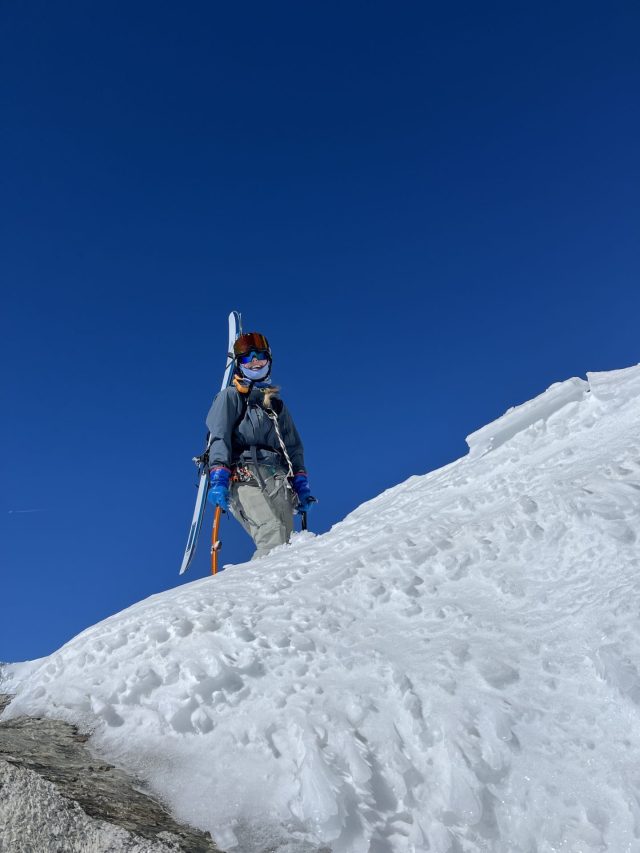 Hugin stands atop the Dent du Geant South Face in Italy, accessible from the Monte Bianco Skyway in Courmayeur. | Photo: Jesper Gustafsson
The driving thesis of the couple’s film will be to dismantle those entrenched prejudices not through dialogue but through unassailable performance in high-stakes terrain. By centering the project on Hugin’s fluid, technical execution down some of the most intimidating faces in the Alps, Hugin and Gustafsson aim to offer young women a blueprint for what is possible at the outer limits of mountain travel. At its core, the project asserts that steep snow and gravity recognize only technique and edge control, completely indifferent to who is wearing the skis. “[Skiing] really is truly gender-neutral,” Gustafsson says. “I believe there’s nothing in this world that a man can ski that a woman cannot, and I hope we get to show that.” Hugin concurs, saying that her role as a rising girl in a male-dominated sport is a big source of meaning in her life. “It feels really good. I love the sport, and I would love to maybe inspire other people to work more, and also younger people, and especially girls.”
Pierre Hourticq & Jérémie Heitz’s 2020 steep ski film Félicité was a major inspiration for the duo’s project. Instead of including standard talking-head interviews, Hugin and Gustafsson plan to center the narrative on continuous skiing. Just like in the minimalist French ski film, they want their riding to speak for itself. “[Félicité] is 12 minutes almost entirely on skiing and mountains,” Gustafsson noted. “Half of it isn’t just people talking to the camera. You actually get a ski movie with ‘ski’ as the main word. They’re doing steep and exposed stuff, but they’re still skiing it — not just jump-turn, jump-turn. They’re taking proper turns with proper speed.”
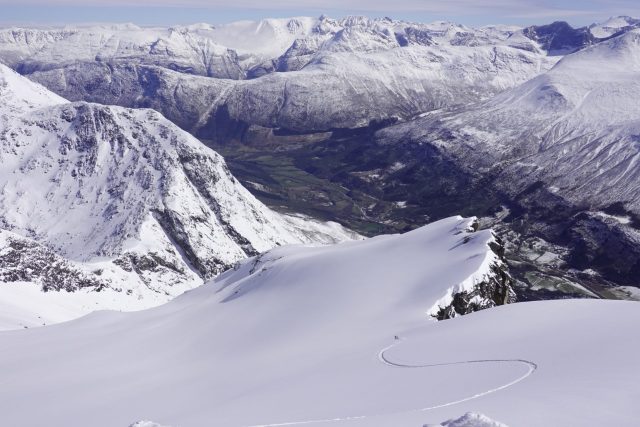 Hugin descends Storgladnebba in Øksendalen, on the west coast of Norway. | Photo: Jesper Gustafsson
For this film the couple will need to deliberately leave room for the unpredictability of high-altitude skiing. While the 800-meter West Couloir of the Matterhorn stands as their primary objective, both Hugin and Gustafsson recognize that becoming single-mindedly fixated on a single line in the Alps can quickly become deadly. For them, safety and storytelling have to go hand-in-hand.
There’s a common trap in the world of mountaineering when athletes get too fixed on a single objective; they then tend to push into hazardous conditions to satisfy a production schedule. This can prove fatal when rushing to complete an objective leads to attempting it when the mountain is in a dangerous state, like during periods of elevated avalanche danger or when the snow is icy. A willingness to adapt to whatever conditions the mountains offer is required to ensure success. As is the patience to wait for the correct window to open while always being ready to walk away from a line at a moment’s notice when the time isn’t right. “Being flexible on where and what you want to ski is the best thing you can be as a steep skier,” Gustafsson reflected. “If you choose to tackle just one objective, you will be more likely to ski it when it’s bad over a safer alternative. The human factor is the most dangerous factor when it comes to skiing overall.”
 Gustafsson makes steep turns in the Col Des Cristaux on Chamonix’s Argentiere Glacier. | Photo: Dom Daher
Their tactical flexibility is made much easier by living on wheels in a region with virtually limitless ski opportunities. Traveling and living in a van gives them the ultimate freedom to chase storms across the range, packing up at the drop of a hat whenever a target line isn’t in condition. Where fixed accommodations lock skiers into a single valley regardless of weather, van life allows Hugin and Gustafsson to follow good snow across entire mountain passes and international borders. “That’s the best thing about the Alps,” Gustafsson explained. “No matter how bad of a season in terms of snow, you can still find slush on steep lines.” That mobile lifestyle plays directly into their risk management: rather than forcing a dangerous descent on an icy, wind-scoured face simply because they booked a hotel nearby for X amount of days, the van lets them pack up and drive toward safer, better-suited terrain.
When assessing risk on steep faces, Gustafsson maintains a pragmatic view. “It’s very rare, at least for me, to feel as if I’m in danger,” he said. “As long as the snow is good enough, most people can ski most things as long as you do it in a calm, collected manner. It’s very condition-dependent. Everyone can be a hero in powder.” Hugin, on the other hand, focuses intently on the next turn ahead of her and only that turn, all while making sure she’s having a good time while doing it. “I don’t know. It’s probably just trying to be focused,” she says as she continues to ponder the question. “I think that’s the thing that I try to keep my head at, and not focus so much on the feelings around it. And also I think it’s really fun. I’m not usually that scared because I really think it’s so fun.” That passion makes the willingness to adapt their plans to the conditions at hand simple: if the line feels scary to them, then it’s dangerous, and it won’t be fun. So they travel elsewhere where it will be.
 Hugin drops the Åbittinden Face on the West Coast of Norway. | Photo: Jesper Gustafsson
Hugin and Gustafsson’s film isn’t backed by deep corporate pockets. At 23 years old, pulling off an ambitious independent production in the Alps like this one requires an all-consuming hustle. To fund the upcoming winter season, the couple spent the summer working night shifts, packing boxes together at a book distribution warehouse in Oslo. At the same time, both remain full-time university students in Trondheim; Hugin studies economics while Gustafsson is pursuing a dual degree in computer science engineering and economics. They are tact, having effectively turned Scandinavian higher education into a suave ski-bum hack. “Uni in Scandinavia is actually perfect for being a ski bum because you never have to be at school,” Gustafsson explained. “They just post everything online. The only time we have to be here is for the exam dates at the end of May.”
 Hugin and Gustafsson bootpack up the Sofia Couloir in Norway’s Lyngen Alps. | Photo: Jesper Gustafsson
The couple’s dedication to their craft has been forged through months of navigating the raw realities of mountain life, side-by-side. Before new municipal laws in Chamonix banned van camping in public lots — prompting them to search for an apartment this winter — the pair spent previous seasons almost entirely living out of their cramped van. The harsh reality of that life hit immediately on their way to France from Norway last year. “Our first day of the trip, our clutch broke in Denmark for $3,500,” Gustafsson recalled. “Waking up with no shower, no toilet, frozen water. But every morning we were cold, we just had to think about the next day we were going to ski, and it made it all worth it.” Rather than straining their relationship, the hardship only deepened their bond. “If Mia was making dinner, well, maybe then I had to clean. If Mia woke up early, well, then she was the one who got the heating going, who fixed all the water,” he said. “It’s a lot about teamwork. But skiing is the recipe.” Hugin agreed, adding, “I think a lot of people said to us, ‘If you two can manage that season in the van, you can do anything.’” Watching them finish each other’s sentences with quick, affectionate giggles, it becomes clear that their partnership isn’t just surviving the pressure — it’s actively fueled by it.
Their bond is their greatest asset when it comes to risk management in terrain where there is no margin for error. Steep skiing at this level requires exceptional technical skill, but to be successful it also demands humility. Staring down an 800-meter wall like the West Couloir, ego is by far the deadliest hazard on the mountain. For Hugin and Gustafsson, managing risk means stripping away bravado and acknowledging that the mountains remain entirely indifferent to film schedules or their own personal ambitions. Where others might let the presence of a camera push them past safe boundaries, the couple relies on an honest, open dialogue on the slope, constantly checking in with each other. Whether they ultimately stand atop the Matterhorn’s elusive West Couloir this spring or find themselves back at the drawing board, looking on where to drive their van next, their film will fundamentally be a story about connection: to the terrain, to the sport, to established stereotypes, and to themselves. Hand-in-hand, two young star-crossed Norwegians are carving out their own path through the Alps and changing the mental image people have about who steep skiers are. Watching their story unfold allows us to see the true soul of skiing a steep line, which is something that is not built on conquest or domination; rather, it’s a force that’s birthed out of passion, partnership, and mutual respect for not only the mountains but for one another — for love.
 Norwegian steep skiers Jesper Gustafsson and Mia Hugin at Courmayeur, Italy. | Photo: Jesper Gustafsson