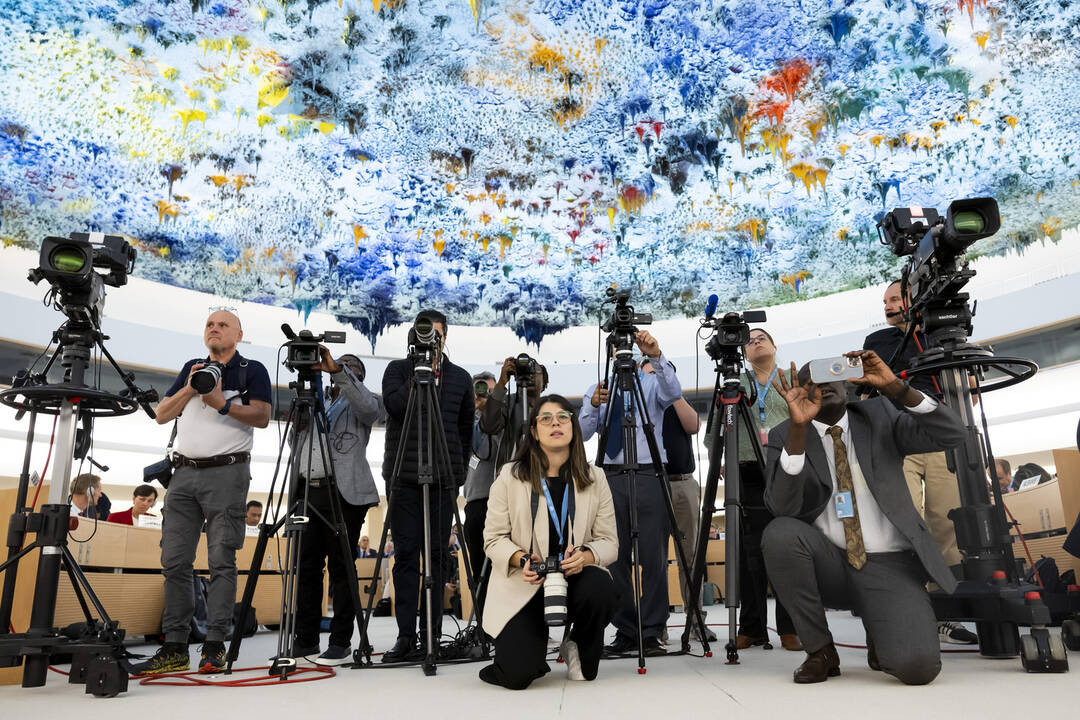
Squeezed financially and politically, the Geneva rights body opens this week with another ambitious and wide-ranging agenda. Here’s a breakdown of some of the issues on the table.
The 63rd session of the United Nations’ Human Rights Council officially got underway in Geneva today, with no less than 35 resolutions being negotiated over a tight four-and-a-half week schedule, even as it creaks under the weight of its financial pains and political strains.
Money, honey
Since last year, the UN’s human rights branch, like the rest of the cash-strapped organisation, has been in survival mode – its activities, such as country visits and investigations, drastically scaled back as money from its already reduced budget has slowly trickled in.
At the council’s organisational meeting on 24 August 2026, the UN’s deputy high commissioner for human rights, Awa Dabo, said it had so far received around 80 per cent of its 2026 $221m budget – an improvement on June, but still far from the full amount and $25m less than its 2025 budget.
“The timing of the release, in tranches, of what remains a partial allotment, limits the office’s ability to effectively manage its operations,” she told the council’s 47 members in Geneva.
To save cash, the UN body has been following strict orders to reduce its meetings by 10 per cent on 2024 levels – shaving minutes off general debates and interactive dialogues to shorten its sessions. Meanwhile several mandated reports have been delayed and had still not been published as the council kicked off on Monday. But despite the liquidity crunch, the Human Rights Council’s agenda remains packed as states continue to bring new resolutions to the table.
“Staying the course will require realism, discipline, and cooperation of all stakeholders,” Indonesian ambassador and council president, Sidharto Reza Suryodipuro, told reporters in Geneva last week.
Sudan, and other conflicts
First up on Monday after the opening speeches, states will hear from members of a UN-backed investigation into rights abuses in Sudan, after their report released last week exposed how foreign recruitment and external support networks are fuelling the violent war, which is now in its fourth year. The council will vote to renew the mandate, with observers expecting it to pass, despite efforts by Sudan to seek support among members to quash it.
After an urgent debate at the last council session in June on the escalating crisis in El Obeid, rights chief Volker Türk will also issue an update on the situation in the North Kordofan capital, one of the hotspots of the conflicts where drone attacks by the Rapid Support Forces intensified in recent months.
During its month-long session, the council will also turn its attention to the rights situation in other conflict-hit countries, with Myanmar on Monday and Iran on 21 September. Gaza and the Occupied Palestinian Territory will also be in the spotlight at the end of the month, when Türk’s office is due to present an update to its database of businesses involved in certain activities in illegal Israeli settlements, and also hold a general debate.
United front
For the first time, the European Union is taking the lead on a resolution on Russia’s human rights situation, which includes renewing the mandate of the special rapporteur, held since 2023 by Bulgarian journalist and rights expert Mariana Katzarova.
Though in practice only a technical rollover of a resolution previously led by the Benelux countries, Deike Potzel, the EU’s ambassador to the UN in Geneva, said the decision to collectively pen the text was significant, and the mandate a top priority. It notably received support from Hungary, which ousted its long-time leader and Vladimir Putin ally, Victor Orbán, in elections in April.
“The human rights situation in Russia is continuously deteriorating, and we need to ensure that the special rapporteur can continue her important work,” she told Geneva Solutions. “Her reports are an essential source of independent and verified information on the human rights situation in Russia and give a voice to victims and to civil society.”
Katzarova has repeatedly denounced the Kremlin’s systemic crackdown on journalists, rights defenders and anti-war activists – her last report in September 2025 highlighting the increased use of national security laws and other measures to punish critics. Russia has never recognised her mandate and has called her work illegitimate.
She’ll present her latest report to the council on 21 September.
Several countries take on AI
One issue generating plenty of buzz at this year’s autumn session is artificial intelligence. Two new resolutions are being brought to the council – one led by Bangladesh, Egypt, and Nepal on the implications of AI on human rights, and the other by Armenia on women and girls in the context of digital technologies.
But they are by no means the first.
Issues arising from AI are steadily creeping up the agenda at the Human Rights Council and have been tackled through various resolutions and thematic reports – including one being presented at this session by a group of experts on AI and its impact on people’s cultural rights.
But the council is yet to deliver a single, consolidated framework for how AI should be developed in line with human rights. Since 2019, South Korea has stepped in and tried to take the lead with its resolution on new and emerging digital technologies.
With other countries now entering the fray, however, it risks duplicating efforts and further “muddying the water”, says Marc Limon, executive director of Universal Rights Group. The think tank, which has been advising South Korea on its initiative, has been advocating for a special procedures mandate – without which Limon says states will never agree to guidelines on regulating AI in line with human rights.
But while many states support the idea – in 2024 The Gambia and Luxemburg led consultations with Korea – others see it as another attempt to slow innovation in AI. Limon says it’s “now or never” to unite countries behind such a mechanism, or else the topic of AI within the council will become a free-for-all.
“The ultimate goal is to have one set of accessible, unified universal guidance for states on how to regulate AI in a human rights way, and for digital technology companies on how to develop AI that complies with human rights,” he told Geneva Solutions.