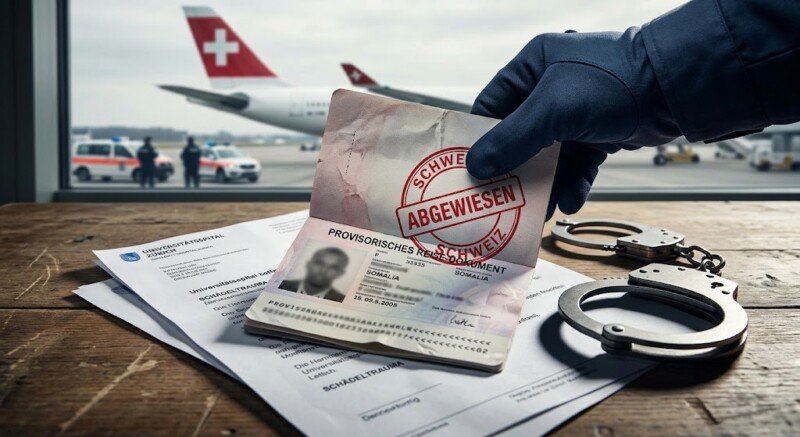
ZURICH — The Swiss human rights organization Augenauf has condemned Switzerland’s plan to forcibly deport a seriously injured Somali citizen, describing the case as part of a broader pattern of human rights violations during forced deportations.
The man, a father of three children living in Europe who has been in Switzerland for 11 years, is scheduled to be deported to Mogadishu via Istanbul on Thursday, September 10. According to Augenauf, two weeks ago he was seriously injured by two violent flatmates in the underground asylum accommodation assigned by authorities. He suffered multiple skull fractures, a traumatic brain injury, and injuries to his eyes. He underwent surgery at the University Hospital of Zurich, but two further operations scheduled for the week of September 7 were reportedly prevented by Swiss authorities.
Augenauf said the Somali Immigration and Citizenship Agency issued the man a provisional travel document without considering his medical condition, and that the person pictured on the document does not resemble the individual concerned. The man’s lawyer has demanded that the deportation be suspended.
Pattern of Violence and Violations
Switzerland has previously faced scrutiny over secret deportation plans targeting Somali nationals, with human rights organizations raising alarms about forced returns conducted without formal approval from Somalia’s government. In those cases, Swiss officials reportedly sought to negotiate clearance directly with Somali border authorities at Mogadishu airport, issuing temporary laissez-passer travel documents without Somalia’s consent. Deportees were reportedly detained for months, sometimes over a year, before being escorted under heavy police guard, restrained, and kept in isolation before flights.
According to Augenauf, Swiss police authorities use an enormous amount of violence during forced deportations, committing massive violations of Swiss and international law. In at least two cases, authorities have put the lives of those affected at serious risk. Two Somali nationals who were mistreated during their deportation have filed criminal complaints in Switzerland against their tormentors.
Augenauf has informed the relevant authorities, including the commander of the Zurich cantonal police and the National Commission for the Prevention of Torture, about the cases.
Switzerland’s ‘Carrot and Stick’ Strategy
Augenauf described Switzerland’s approach to Somalia as a “carrot and stick” strategy. The Somali Immigration and Citizenship Agency receives massive financial support and travel privileges from Switzerland, including equipment and training. However, following the EU’s lead, Switzerland tightened its visa regulations regarding Somalia and Guinea in August as a means of exerting pressure, justifying this by stating it was to “further optimise cooperation on the readmission of citizens required to leave the country.”
This approach aligns with broader European migration policy trends. The European Union has been considering stricter visa measures against Somali citizens due to what it describes as inadequate cooperation from Mogadishu on readmission procedures. Irregular arrivals from Somalia to the EU more than doubled between 2024 and 2025, prompting EU interior and justice ministers to approve new restrictive visa measures during a meeting of the Justice and Home Affairs Council in Luxembourg. EU ministers have argued that effective return mechanisms are necessary to maintain the credibility of asylum and immigration systems across the bloc.
Analysts have noted that the proposed visa restrictions are unlikely to serve as an effective “stick” to force Mogadishu to change its approach on readmission, as the number of Somalis with the resources to travel to Europe through regular channels is negligible. Nonetheless, the EU measures reflect the growing pressure on European governments to address irregular migration.
Switzerland has been strengthening its security and counterterrorism partnership with Somalia, with officials holding talks on enhancing counterterrorism efforts, intelligence sharing, and the fortification of Somalia’s security institutions. Minister of Internal Security Abdullahi Sheikh Ismail (Fartaag) expressed gratitude to Switzerland for its sustained assistance, highlighting that the partnership is instrumental in fostering peace and stability.
Switzerland has also strengthened its partnership on federalism and state-building, with high-level talks focusing on federalism, stabilization, national reconciliation, and local governance. The discussions emphasized strategies to improve public service delivery at the local level, reinforcing the partnership between the two nations.
Somalia has been modernizing its immigration and visa systems, launching a new Electronic Travel Authorization System (eTAS) to streamline visa services and strengthen digital border management. The eTAS system allows travelers to apply, pay, and receive authorization entirely online, reflecting the government’s broader digital transformation agenda.
In a landmark move, Somalia also launched its first-ever electronic visa (E-VISA) platform in August 2025, enabling travelers to apply for visas online without visiting Somali embassies or consulates. The system is designed to simplify travel procedures, enhance transparency, and strengthen border management.
The Somali Immigration and Citizenship Agency has been working to streamline passport and immigration services, introducing new Standard Operating Procedures that have reduced passport processing times to seven days for new applications and four days for renewals. The agency is also working with attachés stationed in Somali embassies worldwide to enhance services for citizens abroad.
The European Union has been engaging with Somalia on various fronts. The EU and Somalia held their first Partnership Dialogue in May 2026, addressing security, governance, migration, and economic development. The EU has also been supporting Somalia’s constitutional reforms and transition toward direct elections, with the bloc remaining one of Somalia’s largest development partners.
The European Union has also committed to enhancing security cooperation with Somalia, including increased training initiatives and logistical support to build an independent national defense force. The EU approved a €75 million contribution to AUSSOM under the European Peace Facility, making the bloc the mission’s largest financial donor.
Somalia has also been working to address the broader refugee and asylum context in the region. The country approved the Refugees and Asylum Seekers Bill, which establishes a legal framework for the rights and obligations of displaced people and provides a legal framework for handling foreigners who seek asylum in Somalia.
Somalia also launched a Refugee & Asylum Seeker ID Issuance Program aimed at providing identification documents to over 38,000 refugees and asylum seekers residing in the country, the majority from Ethiopia and Yemen.
Critical Note
This case highlights the tension between European migration policies and the human rights of individuals facing deportation. The planned deportation of a man with serious untreated injuries raises fundamental questions about Switzerland’s commitment to international human rights standards.
Switzerland’s dual approach of providing development assistance to Somali institutions while tightening visa regulations and proceeding with deportations of vulnerable individuals reflects a broader pattern in European migration policy. The Somali authorities’ willingness to issue travel documents without adequate consideration of the individual’s medical condition is also concerning.
International human rights mechanisms, including the UN Committee Against Torture, have repeatedly emphasized the principle of non-refoulement, which prohibits the return of individuals to places where they face a real risk of torture or inhuman treatment. The Swiss authorities’ actions, as documented by Augenauf, appear to conflict with this principle.
The Somali government, which has been actively seeking to improve its international standing, should ensure that its cooperation with European countries on migration matters does not come at the cost of its citizens’ human rights. This case underscores the need for greater accountability and oversight in deportation procedures, both in Switzerland and in other European countries implementing similar policies.
Recommended Reading On ftlsomalia.com